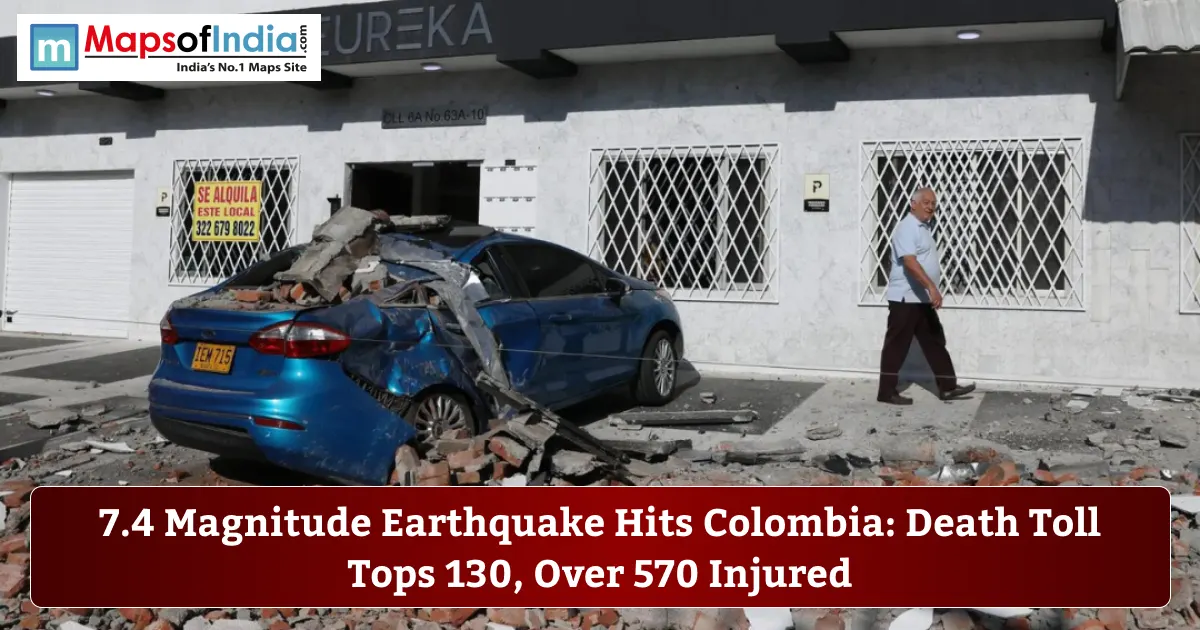
A powerful magnitude 7.4 earthquake struck western Colombia on August 10, 2026, leaving a trail of destruction across several parts of the country. The tremor destroyed buildings, damaged homes and public facilities, knocked out transportation and trapped people under debris.
The latest reports, based on Colombian authorities, have said the death toll has climbed to 132 people, with over 570 injured. As emergency personnel arrived at heavily damaged areas and conducted searches for survivors in damaged buildings, the casualty figures kept changing. The death toll had been earlier reported to be 111 and later to be more than 130, reflecting the fast pace of the disaster.
The tremor is said to be one of the most potent and destructive quakes to hit Colombia in decades and the biggest on record this century.
7.4 Magnitude Earthquake Strikes Western Colombia
The epicentre was near San José del Palmar in Colombia's Chocó Department, and the earthquake hit Monday morning. The USGS located the epicentre approximately five kilometres east of San José del Palmar, while reports indicated the epicentre was located approximately 400 kilometres west of Bogotá.
Shaking was felt in a large region, including large cities like Cali, Pereira, Manizales, Armenia and Quibdó. Tremors were also recorded outside Colombia, such as in neighbouring Ecuador and Venezuela.
The earthquake was felt in populated regions from the structural damage it caused, and though it was deep, it was of a magnitude that caused severe shaking.
Death Toll Rises as Rescue Operations Continue
The immediate reports after the earthquake suggested a much lower number of deaths. However, the death toll climbed quickly as emergency personnel went into affected areas.
Later reports quoting Colombian authorities reported 132 deaths and over 570 injuries. As the news continued to come out, other major newspapers reported lower figures, as it had been difficult to get a full picture of casualties, whilst the rescue efforts continued.
Authorities cautioned the toll may still be subject to future changes, as certain locations such as remote communities were inaccessible. Strategies also had to be hampered by communication difficulties and infrastructure destruction in trying to assess the overall disaster damage.
Buildings Collapse Across Affected Areas
The earthquake resulted in major structural damage. Over 1,600 buildings were reported damaged, and dozens of buildings were completely destroyed or collapsed.
The most severe impacts were seen in western and central Colombia. Several cities, such as Pereira, Cali, Manizales and others, were impacted by buildings.
Damage to buildings and debris strewn along the streets, and people gathering outside buildings, were seen in images and videos from the affected regions after the intense shaking. Hospitals and other public facilities were also impacted, adding to the many casualties facing emergency personnel.
Assessments of the damage were ongoing, with authorities trying to find buildings that were safe to enter.
Pereira, Cali and Other Cities Among Worst Hit
A substantial number of deaths and injuries were reported in Pereira, which turned out to be one of the worst hit cities. The quake wrought major destruction in Cali, the third largest city in Colombia.
Other cities and areas that reported strong shaking and structural damage include Manizales, Armenia and Quibdó.
Wherever there were communities that were located in inaccessible areas, surrounded by difficult terrain, this assessment was a particular challenge in parts of Chocó. Rescue and assessment teams were able to reach isolated areas, and the full extent of damage was expected to gradually become known.
Airports and Transport Services Disrupted
The tremors also caused disruptions in transportation in the western part of Colombia.
Multiple airports were shut down for inspection of runways, terminals and other structures for damage. The lockdowns brought extra difficulties for emergencies and travel.
Road infrastructure also was impacted in some areas and impeded the ability of rescue and supplies to reach communities in need.
Reopening of transport links that can be operated safely to move emergency personnel, medical supplies and other resources was prioritized.
Rescue Teams Search for Survivors
Immediately following the earthquake, the government felt that search-and-rescue was the top priority.
Fire, police, military and emergency workers and volunteers were sent into areas of damage. The teams searched for survivors in collapsed buildings by using heavy machinery and also by hand.
The risk of aftershocks persisted for rescue workers also. An aftershock of approximately 5.0 was reported, as well as at least 21 others, following the main earthquake. Aftershocks can be especially fatal since structures damaged by the main earthquake can fail when they are shaken by an aftershock.
Colombia Declares Emergency
The Colombian government, led by President Abelardo de la Espriella, declared an emergency after the earthquake and urged the authorities to focus on rescue and relief efforts.
Rescue and removal of the people who were trapped under the rubble was the immediate priority, the government said. Emergency measures were also to ensure that aid and resources could be deployed more quickly to communities impacted.
In some areas, security forces were deployed, and local authorities took other measures to ensure public order and to safeguard the damaged neighbourhoods.
The disaster came at a significant moment; the country's new government came into office just days ahead of the earthquake.
International Assistance Offered
The level of the disaster led to international assistance.
The United States committed to providing Colombia with $15.5 million in aid, while other nations such as Mexico, Chile and El Salvador provided assistance or expressed solidarity with Colombia.
Emergency relief, medical aid, shelter and recovery will be backed by international aid as Colombia analyses the longer-term effects of the quake.
Tremors Felt in Ecuador and Venezuela
The epicentre of the earthquake was not the only area that was affected by the impact of the event. There were reports of strong tremors in neighbouring countries, such as Ecuador and Venezuela.
The seismic activity is attributed to the fact that Colombia is a country situated in one of the areas with the highest seismic activity in the world. The northern Andes region has many earthquakes due to the complicated plate tectonic situation.
No reports of damage in Ecuador like in Colombia, but some residents in parts of the country said they felt the tremor.
Why Was the Earthquake So Destructive?
The magnitude of the earthquake was a major factor behind the destruction. The 7.4-magnitude quake has a tremendous amount of energy in it and can cause significant damage to buildings in a large area.
Other factors affecting impact include distance from the epicentre, depth, local geology, building quality and population density.
In Colombia, the quake struck various populated areas and extended to remote communities in which access for emergency teams was limited. Some buildings that were not strong enough to withstand the strong shaking were especially vulnerable.
What Happens Next?
Rescue and recovery work is expected to continue as officials look for buildings that have been damaged, treat injuries and offer shelter to residents whose houses are unsafe.
There will also be thousands of damaged buildings that need to be evaluated, and transportation and communication systems will need to be restored, as well as an evaluation of economic damages.
As emergency responders arrive at other sites, the number of casualties and injured may evolve. Therefore, casualty figures in the early reports must be treated as provisional.
The August 10th Colombia earthquake has already proven to be one of the most major seismic events in recent history in the country, with over 130 fatalities, hundreds of injuries, and significant structural damage reported. The next few days will be dedicated to locating survivors, helping those who lost their homes and starting the nation's long road to recovery from the catastrophe.
FAQs
1. How many people died in the Colombia earthquake?
At least 132 people have died in the magnitude 7.4 earthquake that struck western Colombia on August 10, 2026.
2. How many people were injured in the Colombia earthquake?
More than 570 people were injured after the powerful earthquake struck western Colombia.
3. What was the magnitude of the Colombia earthquake?
The earthquake that hit Colombia on August 10, 2026, measured 7.4 in magnitude, making it a major seismic event.
4. Where did the Colombia earthquake occur?
The earthquake's epicentre was near San José del Palmar in Chocó Department, western Colombia, around 400 km west of Bogotá.
5. Which cities were affected by the Colombia earthquake?
Pereira, Cali, Manizales, Armenia and Quibdó were among the areas affected by the earthquake, with widespread building and infrastructure damage reported.
6. Was the Colombia earthquake felt in Ecuador?
Yes. Tremors from the Colombia earthquake were felt in neighbouring Ecuador and other parts of the region.
7. Are there aftershocks following the Colombia earthquake?
Yes. Multiple aftershocks have been recorded following the magnitude 7.4 earthquake, and authorities continue to monitor the situation for further seismic activity.