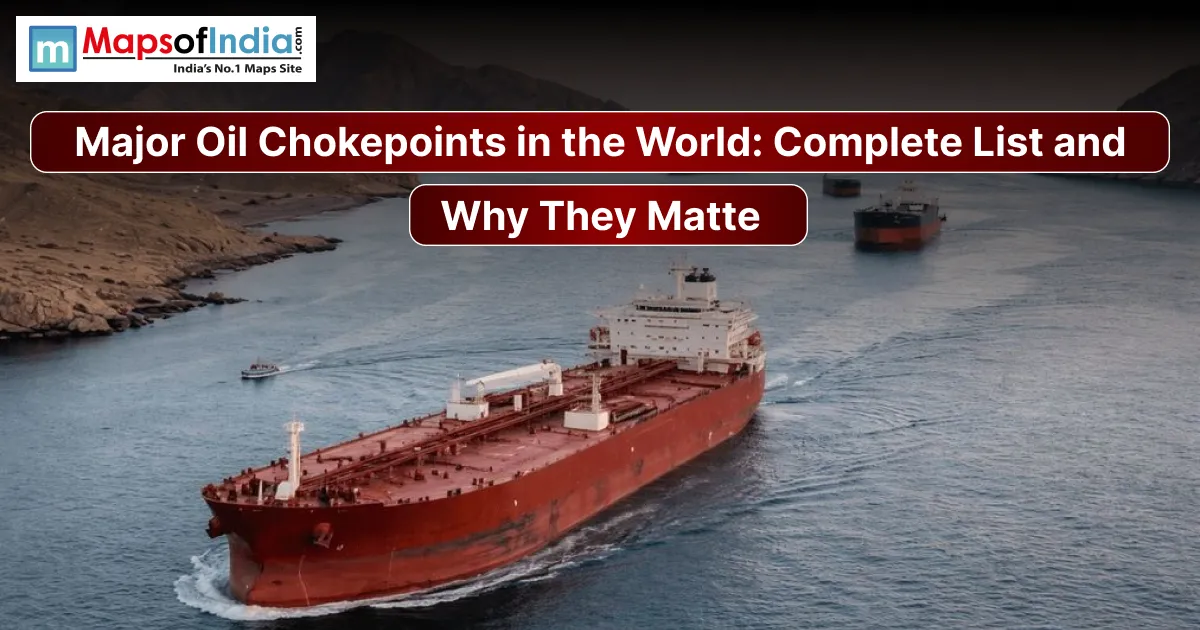
Oil chokepoints are narrow or constrained maritime passages through which large volumes of petroleum move between producing and consuming regions. A disruption can force ships onto routes, delay supplies and increase transport costs. In 2024, global maritime oil trade averaged about 79.7 million barrels per day (b/d); the Strait of Hormuz alone carried 20.7 million b/d, 26% of that total.
This world's oil chokepoints list covers the routes monitored by the U.S. Energy Information Administration (EIA), including Hormuz, Malacca, Suez, Bab el-Mandeb, the Danish and Turkish Straits, the Panama Canal and the Cape of Good Hope alternative route.
What Is an Oil Chokepoint?
An oil chokepoint is a strategically constrained passage on a major maritime route where large volumes of oil are transported. A route qualifies as important when traffic is concentrated through it, alternative routes are limited or significantly more expensive, and disruption could delay supplies or increase energy and shipping costs.
World's Major Oil Chokepoints
| Chokepoint | Location | Recent Daily Oil Flow | Key Countries/Region Served |
| Strait of Hormuz | Iran–Oman | 4.9m b/d | Gulf exporters, Asian markets |
| Strait of Malacca | Southeast Asia | 16.6m b/d | China, Japan, South Korea, Southeast Asia |
| Suez Canal | Egypt | 5.8m b/d | Europe, Mediterranean |
| Bab el-Mandeb | Red Sea/Gulf of Aden | 8.1m b/d | Europe, Middle East, Asia |
| Danish Straits | Denmark | 4.7m b/d | Baltic and European markets |
| Turkish Straits | Türkiye | 4.1m b/d | Black Sea exporters, Europe |
| Panama Canal | Panama | 3.2m b/d | Americas and Asia |
| Cape of Good Hope | South Africa | 9.4m b/d | Alternative Asia–Europe route |
1. Strait of Hormuz
Location and Geography
The Strait of Hormuz lies between Iran and Oman, connecting the Persian Gulf with the Gulf of Oman and the Arabian Sea.
Volume of Oil Passing Through
It carried 4.9 million b/d in 2Q26, down from 21.6 million b/d in 4Q25 amid major regional disruption.
Countries That Depend on It
It is crucial for oil exports from Persian Gulf producers. Supplies major Asian consuming markets.
Historical Disruptions or Risks
Geopolitical conflict can severely affect flows; EIA reported disruption and higher, more volatile crude prices during 2Q26.
2. Strait of Malacca
Location and Geography
The Strait of Malacca connects the Indian Ocean with the Pacific Ocean. It is the shortest sea route between Middle Eastern suppliers and East Asian markets.
Volume of Oil Passing Through
Oil flows averaged 16.6 million b/d in 2Q26.
Countries That Depend on It
China, Japan, South Korea and East and Southeast Asian economies rely heavily on this route.
Historical Disruptions or Risks
Piracy and attempted attacks remain risks for tanker traffic; alternative Indonesian routes include the Sunda and Lombok Straits.
3. Suez Canal
Location and Geography
The Suez Canal crosses Egypt. Connects the Red Sea with the Mediterranean, providing a direct maritime link between Asia and Europe.
Volume of Oil Passing Through
The Suez Canal and SUMED pipeline carried 5.8 million b/d in 2Q26.
Countries That Depend on It
It is particularly important for Persian Gulf energy shipments heading toward Mediterranean markets.
Historical Disruptions or Risks
The 2021 Ever Given blockage demonstrated how a temporary canal closure can disrupt global shipping, while Red Sea security problems have recently reduced traffic.
4. Bab el-Mandeb
Location and Geography
Bab el-Mandeb lies between the Horn of Africa and the Arabian Peninsula, connecting the Red Sea with the Gulf of Aden.
Volume of Oil Passing Through
Oil flows averaged 8.1 million b/d in 2Q26.
Countries That Depend on It
It is a route for energy moving between the Persian Gulf, Europe and wider international markets.
Historical Disruptions or Risks
Attacks on shipping since late 2023 have caused vessels to avoid the Red Sea and take longer routes around Africa.
5. Danish Straits
Location and Geography
The Danish Straits connect the Baltic Sea with the North Sea through waterways around Denmark.
Volume of Oil Passing Through
The route carried 4.7 million b/d in 2Q26.
Countries That Depend on It
It serves trade and European markets, with changing flows following shifts in Russian oil trade.
Historical Disruptions or Risks
Geopolitical changes and sanctions have altered trade patterns; the Kiel Canal offers an alternative for smaller tankers.
6. Turkish Straits
Geography
The Turkish Straits comprise the Bosporus and Dardanelles, linking the Black Sea with the Mediterranean through the Sea of Marmara.
Volume of Oil Passing Through
Turkish Straits flows averaged 4.1 million b/d in 2Q26.
Countries That Depend on It
They are important for oil exports from Black Sea and producers including Russia, Azerbaijan and Kazakhstan.
Historical Disruptions or Risks
Their narrow, winding waterways create navigation and accident risks, while geopolitical conditions can affect Black Sea shipping.
7. Panama Canal
Location and Geography
The Panama Canal connects the Atlantic and Pacific Oceans across Panama, shortening routes between the Americas and Asia.
Volume of Oil Passing Through
Oil flows averaged 3.2 million b/d in 2Q26.
Countries That Depend on It
The route is particularly useful for energy trade involving the United States, East Asia and the western coast of South America.
Historical Disruptions or Risks
Drought and low water levels restricted canal traffic in 2023–24, forcing some vessels onto routes and increasing shipping costs.
8. Cape of Good Hope Route
Location and Geography
The Cape of Good Hope route runs around South Africa. Connects the Atlantic and Indian Ocean shipping networks.
Volume of Oil Passing Through
9.4 million b/d travelled around the Cape in 2Q26.
Countries That Depend on It
It serves vessels travelling between Asia, Europe, Africa and the Atlantic when alternative routes are preferred.
Historical Disruptions or Risks
Unlike the other entries, the Cape is a route rather than a chokepoint. Red Sea disruptions have pushed tankers around Africa, increasing voyage distance and costs.
Why Oil Chokepoints Matter for Global Energy Security
Oil chokepoints concentrate volumes of international trade into relatively narrow routes. A disruption can reduce supply in some markets, increase tanker demand and raise transportation and insurance costs. The effect can ultimately feed into petroleum-product prices.
Their strategic significance also comes from alternatives. Pipelines can bypass some sections while other routes require ships to travel farther. For example, rerouting from the Suez route around the Cape of Good Hope adds distance and transit time.
What Happens When a Chokepoint Is Blocked or Disrupted?
A blockage can force ships onto routes, increasing fuel use, voyage times, insurance costs and vessel requirements. The 2021 Suez Canal blockage demonstrated the consequences of an obstruction, while Red Sea attacks since 2023 have caused many vessels to avoid Bab el-Mandeb and Suez altogether.
For oil markets, the effect depends on how much supply's disrupted and whether producers, inventories, pipelines or alternative shipping routes can compensate.
Conclusion
The world's oil chokepoints connect some of the biggest producing and consuming regions. The Strait of Hormuz, Strait of Malacca, Suez Canal, Bab el-Mandeb, Danish Straits, Turkish Straits and Panama Canal are maritime routes, while the Cape of Good Hope provides an important alternative when other routes become difficult to use. Their importance comes from the volume of oil they carry and the time, cost and capacity constraints of routes.
FAQs
1. Which is the most important oil chokepoint in the world?
The Strait of Hormuz is widely identified by the EIA as one of the world's strategically important oil chokepoints because of the exceptionally large volumes historically transported through it. The Strait of Malacca is also critical. Carried 16.6 million b/d in 2Q26.
2. What percentage of oil trade passes through chokepoints?
There is no percentage because individual oil chokepoint flows can overlap when the same shipment passes through multiple routes. For context, the Strait of Hormuz carried 20.9 million b/d in 1H25, equivalent to roughly one-quarter of global maritime oil trade.
3. What would happen if the Strait of Hormuz were closed?
A closure would restrict a route for Persian Gulf oil exports. Producers could use some pipeline alternatives. Available bypass capacity would not replace all normal maritime flows, potentially increasing shipping distances, supply pressures and oil-market volatility.
4. Are there routes to these chokepoints?
Yes,. Their usefulness varies. Pipelines can bypass some chokepoints while ships can use routes such as the Cape of Good Hope. These alternatives may have capacity or require substantially more time and fuel.