India's sangams in India include the Triveni Sangam at Prayagraj and the five sacred Panch Prayag of Uttarakhand along with notable river confluences across the Himalayas and peninsular India. A sangam is a meeting point of two or more rivers. In Indian tradition, many such places are regarded as sacred. This guide covers river confluences in India, the rivers that meet, their locations, cultural significance, and practical travel considerations, organised by region.
What Is a Sangam?
A sangam is a place where two or more rivers meet, and their waters flow together as a river system. The word comes from Sanskrit saṃgama, meaning coming together, meeting, or union, and the term is especially associated with river confluences in the Indian cultural context.
River confluences have both cultural importance. Geographically, they mark points where tributaries join drainage systems. Culturally, particular sangams have developed into pilgrimage centres because rivers are traditionally associated with sacredness, purification, and religious practice.
Why Are River Confluences Considered Sacred?
River confluences are considered sacred in Indian traditions because rivers have long held religious, cultural, and ecological importance. Particular sangams became pilgrimage sites where people perform prayers, ritual bathing, and other religious observances. Prayagraj and the Panch Prayag of Uttarakhand are examples.
The significance varies from one location to another. Religious traditions, local legends, temples, and historical associations all contribute to the importance of confluences, so not every sangam has the same ritual status.
Sangam vs Prayag: Is There a Difference?
Sangam is the term for a confluence or meeting of rivers, while Prayag is traditionally used for particular sacred confluences, especially in the Himalayan and North Indian pilgrimage tradition. Uttarakhand's Panch Prayag, for example, refers specifically to five revered confluences associated with the Alaknanda.
Quick List of Famous Sangams in India
- Triveni Sangam, Prayagraj, Uttar Pradesh. Ganga, Yamuna and the recognised Saraswati.
- Devprayag, Uttarakhand. Alaknanda and Bhagirathi; the combined river is called Ganga.
- Rudraprayag, Uttarakhand. Alaknanda and Mandakini.
- Karnaprayag, Uttarakhand. Alaknanda and Pindar.
- Nandprayag, Uttarakhand. Alaknanda and Nandakini.
- Vishnuprayag, Uttarakhand. Alaknanda and Dhauliganga.
- Teesta–Rangeet Confluence, Sikkim/West region. Teesta and Rangeet.
- Kudalasangama, Karnataka. Krishna and Malaprabha.
- Bhagamandala, Karnataka. Cauvery, Kannike and the recognised subterranean Sujyoti.
- Indus–Zanskar Confluence, Ladakh. Indus and Zanskar.
Triveni Sangam, Prayagraj (Uttar Pradesh)
Which Rivers Meet Here?
The Triveni Sangam at Prayagraj is traditionally regarded as the meeting point of the Ganga, Yamuna, and Saraswati. The Ganga and Yamuna are rivers at the confluence, while Saraswati is traditionally believed to meet them invisibly. The Prayagraj district administration describes the meeting point as Triveni.
Why It Is the Most Famous Sangam in India
Prayagraj's Sangam is among India's known sacred river confluences because of its long association with Hindu pilgrimage and the Kumbh tradition. The site is also known as Prayag or Tirtharaj in tradition, and the confluence attracts pilgrims and visitors throughout the year.
Its importance is not based on the physical meeting of rivers. Religious traditions, historic pilgrimage practices, and large-scale festivals have made the Sangam a major cultural landmark.
Kumbh Mela and Other Festivals at the Sangam
The Sangam is the site for major religious gatherings in Prayagraj, including the Kumbh Mela and the annual Magh Mela. The recent Maha Kumbh Mela at Prayagraj took place from 13 January to 26 February 2025.
The annual Magh Mela also takes place at the Sangam. For 2027, the Government of India's Incredible India portal lists the Magh Mela from 15 January to 6 March 2027.
How to Visit?
Prayagraj is connected by air, rail, and road. The district administration lists Prayagraj Airport and several railway stations, including Prayagraj Junction and Prayagraj Sangam. Boats are also used to reach the Sangam area from ghats.
For a sightseeing experience, visitors can consider periods outside major festival crowds. During melas, expect substantially heavier crowds and follow official arrangements and local instructions.
The Panch Prayag of Uttarakhand
The Panch Prayag are five confluences in Uttarakhand associated with the Alaknanda river system: Vishnuprayag, Nandprayag, Karnaprayag, Rudraprayag and Devprayag. Together they form a pilgrimage circuit in the Garhwal Himalayas.
Devprayag: Where the Alaknanda and Bhagirathi Form the Ganga
Devprayag is where the Alaknanda and Bhagirathi meet. After this confluence, the combined river takes the name Ganga. It is the final and most downstream of the five Panch Prayag.
Devprayag is also a pilgrimage destination with temples, traditional religious associations, and a distinctive Himalayan landscape. Uttarakhand Tourism identifies it as one of the Panch Prayag. Note its location on the Char Dham route.
Rudraprayag: Alaknanda and Mandakini
Rudraprayag is the confluence of the Alaknanda and Mandakini rivers. It is the fourth Panch Prayag when following the Alaknanda downstream. The town is also a route junction for travel towards Kedarnath and Badrinath.
Karnaprayag: Alaknanda and Pindar
Karnaprayag is where the Pindar River joins the Alaknanda. It forms the major confluence in the traditional sequence of the Panch Prayag. The town lies along the route through the Garhwal Himalayas towards the pilgrimage destinations.
Nandprayag: Alaknanda and Nandakini
Nandprayag is the confluence of the Nandakini and Alaknanda rivers. It is the Panch Prayag in the downstream sequence and forms part of the traditional pilgrimage route through the Alaknanda valley.
Vishnuprayag: Alaknanda and Dhauliganga
Vishnuprayag is where the Dhauliganga meets the Alaknanda. Uttarakhand Tourism places it at the beginning of the downstream sequence of the Panch Prayag and associates the site with Vishnu Kund and an ancient temple.
Sonprayag and Other Notable Himalayan Confluences
Sonprayag is a confluence and pilgrimage-area landmark in Uttarakhand, but it is not one of the five Panch Prayag. The Panch Prayag are Vishnuprayag, Nandprayag, Karnaprayag, Rudraprayag, and Devprayag.
This distinction matters because the term "Panch Prayag" refers to a traditional group rather than every important river meeting point in Uttarakhand.
Sangams in Eastern and Northeastern India
Teesta and Rangeet Confluence
The Teesta–Rangeet confluence, commonly called Triveni, is a known meeting point of the Teesta and Rangeet rivers in the Sikkim–West Bengal region. The Rangeet is a tributary of the Teesta, and their meeting creates a prominent Himalayan river landscape.
Sikkim Tourism highlights both rivers for their importance in the state's river and adventure-tourism landscape, including rafting and riverside activities.
Brahmaputra Confluences in Assam and Arunachal
The Brahmaputra system has important confluences across Assam and Arunachal Pradesh because the river receives water from a large network of Himalayan and regional tributaries.
Then, treating every tributary junction as a major pilgrimage sangam, notable examples should be selected according to the purpose of the article. Confluences involving rivers such as the Subansiri, Dibang and Lohit are important parts of the Brahmaputra drainage system, while Assam's wider river landscape also has strong cultural and ecological significance.
Sangams in South India
Kudalasangama (Karnataka): Krishna and Malaprabha
Kudalasangama is a confluence in North Karnataka where the Krishna and Malaprabha rivers meet. The site is especially important in the history of the Lingayat tradition because of its association with the 12th-century social reformer and philosopher Basavanna.
The Sangameshwara Temple, Basavanna's samadhi, and the surrounding cultural heritage make Kudalasangama both a river confluence and a significant pilgrimage destination.
Cauvery Confluences in Karnataka and Tamil Nadu
The Cauvery basin contains notable confluences. At Bhagamandala in Karnataka, the Cauvery meets the Kannike and the recognised subterranean Sujyoti, forming a Triveni Sangam. Karnataka Tourism identifies Bhagamandala as a confluence near Talacauvery.
Another important Cauvery confluence is Tirumakudalu Narasipura (T. Narasipura) in Karnataka, where the Cauvery meets the Kabini and another stream traditionally identified with the Spatika or Sphatika river. It is a religious centre in the Cauvery basin.
Sangams in North and Western India
Indus and Zanskar Confluence Ladakh
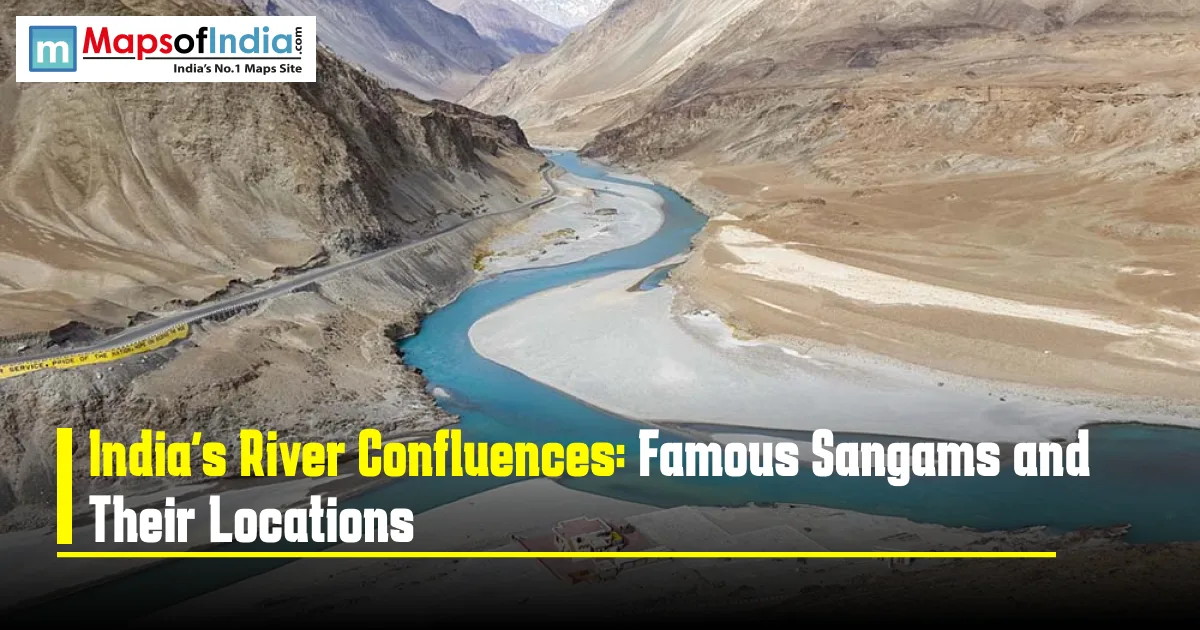
The Indus-Zanskar Confluence near Nimmu in Ladakh is one of India's visually unique river confluences. Here the Zanskar joins the Indus, and the two rivers can look very different in colour depending on the time of year and water levels.
The confluence is 35 km from Leh and is a popular place to stop along the Leh-Srinagar route. Ladakh's tourism authorities promote the area because of its beauty, its culture, and its adventure opportunities.
Other Important Confluences
India has other important river confluences that are important for geography, culture, or history. Examples include where the Ganga and Ramganga meet within the Ganga basin, where the Narmada and Tawa meet in Madhya Pradesh, and many smaller river junctions across the Godavari, Krishna, Mahanadi, and Brahmaputra basins.
Not every river junction is called a sangam. The word is used often when the place has a special cultural, religious, or local importance.
Sangams and Pilgrimage: Rituals, Festivals and Rules
At sangams, people may take part in activities like bathing, praying, giving offerings, and visiting temples. The exact things people do can be very different depending on where the local traditions are. Visitors should follow the ways that are used nearby, rather than thinking that everything is the same everywhere.
At places where people go on pilgrimage, like Prayagraj and the Panch Prayag, there can be very large groups of people during festivals. Visitors should use the designated places to bathe and the right steps to get into the water. They should follow the safety instructions that are given, respect the events, and not go into areas that are not safe or that are closed.
It is also important to look after the environment. Do not throw away trash; put waste in the designated places, and do not leave plastic or other things in the river or near it.
Tips for Visiting River Confluences
Best Time to Go
The time to visit depends on where the confluence is. For places in the Himalayas, spring, summer, and after the monsoon can offer better conditions for travel, but the weather changes a lot with the height of the place.
For Prayagraj, the winter months are usually more comfortable for seeing the area. Big religious events can bring a very large number of people. In Ladakh, the time when it is possible to travel is much shorter. The Ladakh tourism site says that April to October is the time for the Indus-Zanskar Confluence.
Staying Safe Near Rivers and Steps
Rivers can change quickly during the rainy season or after big rains. Use the places to go into the water, listen to local warnings and stay away from places where the banks are not safe or the water is moving fast.
In places in the Himalayas, the height, weather and the roads are also important to think about. At places where people go on pilgrimage follow what the local people say and avoid places that're too crowded or not allowed.
Combining Confluences in a Trip
A trip in the Himalayas can include Rishikesh, Devprayag, and other Panch Prayag places, depending on how much time and road conditions allow. Uttarakhand Tourism says that the Panch Prayag places are connected by road to Rishikesh and other main places in the area.
For a trip, people can go to Leh and visit the Indus-Zanskar Confluence in Ladakh or go to the Bhagamandala-Talacauvery area in Karnataka. The best route depends on the time of year, how easy the roads are, and what the trip is for.
Quick Facts
- A sangam is a place where two or more rivers meet and flow together.
- The Triveni Sangam at Prayagraj is connected with the Ganga, Yamuna, and Saraswati.
- The Panch Prayag are Vishnuprayag, Nandprayag, Karnaprayag, Rudraprayag and Devprayag.
- At Devprayag, the Alaknanda and Bhagirathi meet, and the river that comes from that is called the Ganga.
- Kudalasangama is where the Krishna and Malaprabha rivers meet in Karnataka.
- Bhagamandala is a Triveni Sangam where the Cauvery, Kannike and Sujyoti rivers meet.
- The Indus-Zanskar Confluence is near Nimmu in Ladakh, 35 km from Leh.
Conclusion
India's river confluences range from the Triveni Sangam of Prayagraj and the five Panch Prayag of Uttarakhand to special places in Ladakh, Karnataka and the Northeast. For someone who is visiting for the first time, Prayagraj is the best choice for its cultural and religious importance. The Panch Prayag offers a way to see more of the Himalayas. Visiting these places helps people learn about how the rivers in India're shaped and the traditions that have grown around them.
FAQs
What is a sangam in geography?
A sangam is a place where two or more rivers meet and flow together. The word means coming or union and is often used in India for places where rivers meet that have a special meaning for geography, culture, or religion. Known examples are the Triveni Sangam at Prayagraj and the Panch Prayag of Uttarakhand.
Which is the famous sangam in India?
The Triveni Sangam at Prayagraj is considered the most famous river confluence in India. It is connected with the Ganga, Yamuna, and Saraswati. It is an important place for pilgrims. Its connection with the Kumbh and Magh Melas has made Prayagraj one of the places for religious visits in India.
Where is the Triveni Sangam located?
The Triveni Sangam is in Prayagraj in Uttar Pradesh. It is where the Ganga and Yamuna meet, and the Saraswati is believed to join them in a way. The Sangam area is kilometres from the main part of Prayagraj and can be reached by road and boat from certain places.
What is the Panch Prayag? Where are they?
The Panch Prayag are five special river confluences in Uttarakhand: Vishnuprayag, Nandprayag, Karnaprayag, Rudraprayag and Devprayag. They are along the Alaknanda River system. At Devprayag, the Alaknanda joins the Bhagirathi, and the river that comes from that is called the Ganga.
Which two rivers form the Ganga at Devprayag?
The Alaknanda and Bhagirathi form the Ganga at Devprayag. Their meeting is the one in the traditional Panch Prayag. After the two rivers meet, the river is known as the Ganga as it goes on to the plains. Devprayag is therefore very important for the Ganga system in terms of geography and religious traditions.
Why is the Saraswati called invisible at Prayagraj?
The Saraswati is called invisible at Prayagraj because it is not a river that flows there now. It is part of religious beliefs, and it is believed that it joins the Ganga and Yamuna in a hidden or unseen way. The rivers that people can see are the Ganga and Yamuna.
What is the best time to visit the Prayagraj Sangam?
The best time for seeing the area at Prayagraj is usually when it is cooler, especially when there are not many people. However, those who want to see a big religious event might choose to go during a festival. The Magh Mela is held at the Sangam, and the Kumbh events can bring a large number of people.