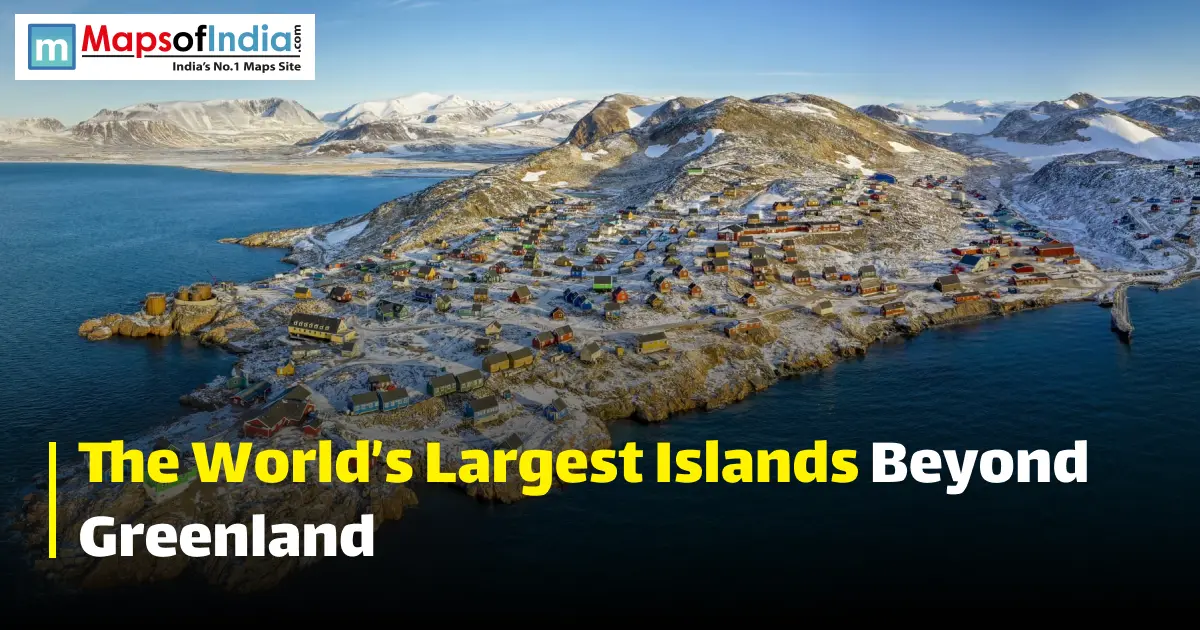
Beyond Greenland, the world’s largest islands include New Guinea, Borneo, Madagascar, Baffin Island, and Sumatra.
Greenland spans 2.13 million km². New Guinea, the second-largest island, covers about 786,000 km². This guide lists the world’s 10 islands and shows their areas, locations, countries, and key geographical facts.
What Are the Largest Islands in the World After Greenland?
New Guinea is the world’s second-largest island after Greenland, followed by Borneo, Madagascar, Baffin Island, Sumatra, Honshu, Victoria Island, Great Britain, and Ellesmere Island. Area figures vary slightly between sources, so the values below are approximate.
Largest Islands in the World
Rank | Island | Area (km²) | Area (sq mi) | Location/Ocean | Country/Countries |
| 1 | Greenland | ~2,130,800 | ~822,700 | North Atlantic & Arctic Oceans | Kingdom of Denmark |
| 2 | New Guinea | ~785,753 | ~303,381 | Southwest Pacific | Indonesia, Papua New Guinea |
| 3 | Borneo | ~748,168 | ~288,869 | Southeast Asia | Indonesia, Malaysia, Brunei |
| 4 | Madagascar | ~587,041 | ~226,658 | Indian Ocean | Madagascar |
| 5 | Baffin Island | ~507,451 | ~195,928 | Arctic Ocean | Canada |
| 6 | Sumatra | ~443,065 | ~171,068 | Indian Ocean | Indonesia |
| 7 | Honshu | ~227,938 | ~88,007 | Northwest Pacific | Japan |
| 8 | Victoria Island | ~217,291 | ~83,897 | Arctic Ocean | Canada |
| 9 | Great Britain | ~209,331 | ~80,823 | North Atlantic | United Kingdom |
| 10 | Ellesmere Island | ~196,236 | ~75,767 | Arctic Ocean | Canada |
Note: Area figures are approximate because different geographic sources use slightly different measurement methods.
Why Is Greenland Counted as the Largest Island (and Not Australia)?
Greenland is considered the world’s largest island because Australia is classified as a continent rather than an island. The distinction is based on classification, not simply land area.
Australia is much larger than Greenland. It is usually treated as a continental landmass. Greenland, even though it is huge, is classified as an island because it is surrounded by ocean and is not considered a continent. This convention places Greenland at the top of lists of the world’s islands.
The Top 10 Islands Beyond Greenland
New Guinea
Ranked second, New Guinea covers approximately 785,753 km² (303,381 sq mi), making it the largest island in Oceania and the second‑largest island on Earth. New Guinea lies in the Pacific Ocean and is divided politically between Indonesia and Papua New Guinea.
New Guinea has a diverse landscape with high mountain ranges, tropical forests, wetlands and wide lowlands. The highest point, Puncak Jaya, rises to more than 4,800 metres. New Guinea is also known for its biodiversity, with many species that live nowhere else. The large area and rugged interior help keep ecosystems and cultures alive.
Borneo
Ranked third, Borneo covers approximately 748,168 km² (288,869 sq mi). Borneo is located in Southeast Asia. It is politically divided among Indonesia, Malaysia, and Brunei.
Borneo is famous for its rainforests and exceptional biodiversity. Borneo contains Mount Kinabalu, the mountain in Malaysia, as well as long river systems and lowland forests. Orangutans, proboscis monkeys, and many other species live in its ecosystems.
Madagascar
Madagascar ranks fourth with an area of 587,041 km² (226,658 sq mi). Madagascar lies in the Indian Ocean off the southeastern coast of Africa. Madagascar is the world’s island country.
Madagascar has been isolated from mainland Africa for a long time. This isolation created species that exist only on Madagascar. Lemurs are the famous animals on Madagascar. Madagascar is also known for baobab trees and for landscapes that range from rainforests to forests and highlands. Madagascar’s location and varied terrain have created distinct ecological regions across the island.
Baffin Island
Baffin Island ranks fifth, covering 507,451 km² (195,928 sq mi). Baffin Island is Canada’s largest island and forms part of the Canadian Arctic Archipelago. Baffin Island belongs to the territory of Nunavut.
The landscape of Baffin Island is dominated by Arctic mountains, glaciers, fjords, and tundra. Much of Baffin Island has a polar climate with long winters and a relatively short summer. Baffin Island is also home to Arctic wildlife that has adapted to these conditions. Polar bears, Arctic foxes, seals, and caribou can be found on Baffin Island.
Sumatra
Sumatra is the largest island in the world with an area of approximately 443,065 km² (171,068 sq mi). Sumatra is part of Indonesia. It lies in the western portion of the Indonesian archipelago.
Sumatra stretches along the side of the Malay Archipelago and contains the Barisan Mountains, which run along much of its length. Sumatra’s tropical forests support species such as Sumatran orangutans, tigers, elephants and rhinoceroses. Sumatra is also an agricultural region. Coffee, palm oil and rubber are produced on Sumatra.
Honshu
Honshu ranks seventh, covering 227,938 km² (88,007 sq mi). Honshu is Japan’s largest island and contains many of the country’s major cities, including Tokyo, Osaka, Kyoto and Hiroshima.
Honshu has a landscape of mountains, plains, forests and volcanic terrain. Mount Fuji, Japan’s highest mountain, is located on Honshu. Honshu also contains industrial, cultural and historical centres. Honshu is one of the most densely populated large islands in the world.
Victoria Island
Victoria Island ranks eighth with an area of 217,291 km² (83,897 sq mi). Victoria Island is located in Canada’s Arctic Archipelago. It is divided between Nunavut and the Northwest Territories.
Victoria Island’s landscape consists largely of Arctic tundra, hills, and numerous lakes. Victoria Island experiences a climate with long cold winters and short summers. Victoria Island’s sparse population and remote location make it one of the least densely inhabited islands among the world’s largest islands.
Great Britain
Great Britain ranks ninth, covering 209,331 km² (80,823 sq mi). Great Britain is the island in the British Isles and comprises England, Scotland and Wales.
Great Britain has a variety of landscapes from the mountainous Scottish Highlands and Welsh uplands to the lowlands of England. Great Britain also contains cities such as London, Birmingham, Manchester, Glasgow and Edinburgh. Great Britain’s long history has left a collection of cultural, architectural and archaeological heritage.
Ellesmere Island
Ellesmere Island ranks tenth, covering 196,236 km² (75,767 sq mi). Ellesmere Island is part of Canada’s Nunavut territory. It lies within the Canadian Arctic Archipelago.
Ellesmere Island has an Arctic landscape featuring mountains, glaciers, ice fields and tundra. Its northern position makes it one of the most remote major islands on Earth. Despite the environment, wildlife such as Arctic hares, muskoxen, polar bears and Arctic foxes can be found on Ellesmere Island.
Largest Islands by Region
Asia
Borneo is an island in Asia with an area of approximately 748,168 km². Borneo is shared by Indonesia, Malaysia, and Brunei.
Africa
Madagascar is Africa’s island covering about 587,041 km². Madagascar is also the world’s island country.
North America
Baffin Island is the island in North America and the largest island in Canada’s Arctic Archipelago. Baffin Island covers 507,451 km².
Europe
Great Britain is usually called Europe’s biggest island. It covers about 209,331 km². Great Britain holds England, Scotland and Wales.
Largest Islands Owned by a Single Country
Many of the world’s islands belong to more than one country. New Guinea is shared by Indonesia and Papua New Guinea. Borneo is split among Indonesia, Malaysia and Brunei.
Among the ten, Madagascar is the biggest island that belongs to just one country. Madagascar, the country, takes up the island and a handful of small surrounding islands.
Other large islands that belong to one country are Baffin Island in Canada, Sumatra in Indonesia, and Honshu in Japan.
Fascinating Facts About the World’s Biggest Islands
- Greenland is the world’s island if Australia is called a continent instead of an island.
- New Guinea is the island and is split between Indonesia and Papua New Guinea.
- Borneo is the island in the top three that is shared by three countries: Indonesia, Malaysia and Brunei.
- Madagascar is the largest island country in the world and is famous for its very high level of endemic biodiversity.
- Baffin Island is Canada’s largest island and one of the major islands in the Arctic Archipelago.
- Honshu is Japan’s largest island and holds Tokyo, the country’s capital and biggest metropolitan area.
- The top ten biggest islands cover the Arctic, Atlantic, Pacific and Indian Ocean regions, showing how large islands are spread over the planet.
Conclusion
The world’s biggest islands stretch from the Arctic lands of Greenland, Baffin Island and Ellesmere Island to the forests of New Guinea, Borneo and Sumatra. Their huge differences in climate, geography, wildlife and human settlement prove that island size alone does not decide an island’s character. Together these ten islands create a snapshot of the world’s physical and cultural geography.
FAQs
1. What is the second‑largest island in the world?
New Guinea is the second-largest island in the world after Greenland. It covers about 785,753 km². New Guinea is split between Indonesia and Papua New Guinea. It lies in the southwestern Pacific Ocean. Its mountains, tropical forests, and exceptional biodiversity make it one of the world’s geographically diverse islands.
2. What are the 10 largest islands in the world?
The ten biggest islands are Greenland, New Guinea, Borneo, Madagascar, Baffin Island, Sumatra, Honshu, Victoria Island, Great Britain and Ellesmere Island. Their sizes range from about 2.13 million km² for Greenland to about 196,236 km² for Ellesmere Island.
3. Is Australia an island?
Australia is surrounded by water. It is normally called a continent instead of an island. This classification is why Greenland is considered the world’s largest island even though Australia is much larger in area.
4. What is the largest island in Asia?
Borneo is the largest island in Asia. It covers about 748,168 km². Borneo is shared by Indonesia, Malaysia, and Brunei. It is famous for its tropical rainforests and high biodiversity.
5. Which large island is home to a country?
Madagascar is the biggest of the ten islands that belong to just one country. Unlike New Guinea and Borneo, which are split between countries, Madagascar is the main landmass of the country named Madagascar.
6. How is an island different from a continent?
An island is a landmass surrounded by water. It is usually smaller than a continent. Continents are landmasses that are major divisions of Earth’s land. Australia is treated as a continent while Greenland is classified as an island.
7. What is the largest island in the world that people can visit easily?
People often think there is a list that says which island is the easiest to visit. Great Britain is one of the world’s islands. Great Britain has roads, trains, buses, and big airports that bring many people from all around the world. Because of these connections, Great Britain is very easy to reach when compared to the far‑away Arctic islands that rank among the top ten hardest places to travel to. Great Britain’s ease of travel is a fact for wanderers, but it is not an official geographic label.