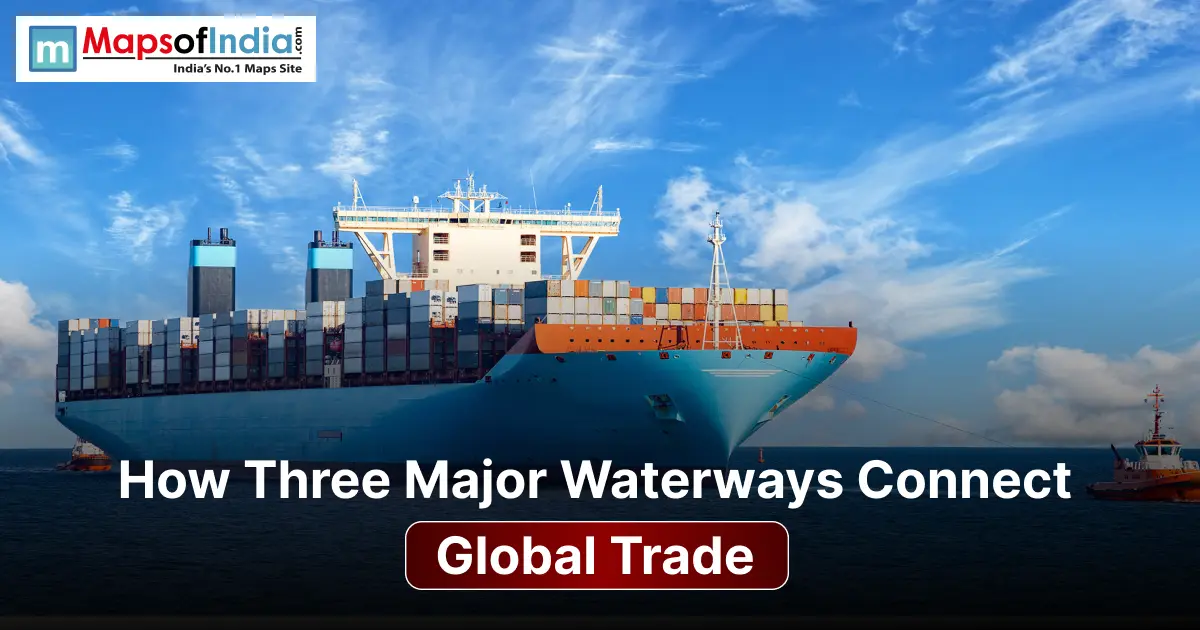
80% of world trade by volume moves by sea, which makes a few maritime routes very important for the global economy. I notice that the Suez Canal, the Panama Canal and the Strait of Malacca are three of the vital waterways that link continents, industries and supply chains. These routes cut shipping times, transport costs and keep goods flowing between Asia, Europe, Africa and the Americas.
Maritime transport remains the backbone of commerce because ships can move enormous quantities of cargo more efficiently than most other transport methods. From oil and natural gas to electronics, automobiles, and food products, countless goods rely on major shipping routes. Among the world's key maritime chokepoints, the Suez Canal, Panama Canal, and Strait of Malacca play important roles in connecting global markets.
1. The Suez Canal — Linking Europe, Asia and Africa
Location and History
The Suez Canal stretches across Egypt, connecting the Mediterranean Sea with the Red Sea. Opened in 1869, the canal eliminated the need for ships to sail around Africa's Cape of Good Hope, dramatically shortening voyages between Europe and Asia. Today it remains one of the world's most valuable artificial waterways.
Trade Volume Key Cargo Type
12% of global trade passes through the Suez Canal each year. It carries a range of cargo including:
- Crude oil and petroleum products
- Liquefied natural gas (LNG)
- Consumer electronics
- Containers filled with manufactured goods
- Agricultural commodities
The canal serves as a critical route for trade between Europe, the Middle East, and Asia.
Impact of Disruptions
The Given container ship blockage in 2021 demonstrated how vulnerable global trade can become when the canal is interrupted. The six-day closure delayed hundreds of vessels. Disrupted supply chains worldwide. Recently, security concerns in the Red Sea have prompted some shipping companies to reroute vessels around southern Africa, increasing travel time and transportation costs.
2. The Panama Canal — Connecting the Atlantic and Pacific
Strategic Role for the Americas
The Panama Canal crosses the Isthmus of Panama, linking the Atlantic Ocean and the Pacific Ocean. Completed in 1914, it transformed shipping by eliminating the need to navigate around South America's Cape Horn. The canal plays an important role in trade involving:
- The United States
- Latin America
- East Asia
- Europe
Recent Drought and Capacity Challenges
Unlike the Suez Canal, Panama depends heavily on freshwater reservoirs to operate its lock system. Severe drought conditions in recent years reduced water levels, forcing authorities to limit daily ship transits. These restrictions created congestion and delayed cargo movement across trade routes.
Effect on U.S. And Asian Shipping Costs
When fewer ships can pass through the canal, shipping companies often choose alternative routes. Those diversions increase fuel consumption, extend delivery times, and raise transportation costs for goods moving between Asia and North America.
3. The Strait of Malacca — Asia's Trade Lifeline
Why It Is the World's Busiest Strait
The Strait of Malacca, located between Malaysia, Indonesia, and Singapore, is widely regarded as one of the busiest shipping lanes on Earth. It serves as the maritime connection between the Indian Ocean and the Pacific Ocean, making it indispensable for trade between Asia, Europe, and the Middle East.
Oil and Energy Shipments
The strait is especially important for energy markets. Large volumes of:
- Crude oil
- Refined petroleum
- Liquefied natural gas
travel through this narrow passage every day, supplying major economies such as China, Japan, and South Korea.
Piracy, Congestion and Geopolitical Risk
Its geography creates several challenges. Heavy vessel traffic increases congestion. Piracy has historically threatened shipping, although regional cooperation has reduced attacks. Geopolitical tensions can affect one of the world's important maritime chokepoints.
Quick Comparison of the Three Waterways
| Waterway | Connects | Main Importance | Major challenge |
| Suez Canal | Mediterranean Sea ↔ Red Sea (Europe–Asia) | Container trade, crude oil, and LNG shipments | Red Sea security disruptions and shipping delays |
| Panama Canal | Atlantic Ocean ↔ Pacific Ocean | Trade between North America, Latin America, and Asia | Drought-related water shortages reducing ship capacity |
| Strait of Malacca | Indian Ocean ↔ Pacific Ocean | Asia's busiest shipping route for oil, LNG, and container trade | Congestion, piracy risks, and geopolitical tensions |
How These Waterways Are Interconnected
Although each waterway serves a different region, they form part of the same global shipping network. Many container vessels travel through chokepoints during a single journey. For example, cargo leaving East Asia may pass through the Strait of Malacca, continue across the Indian Ocean, enter the Suez Canal, and finally reach ports. Large shipping alliances coordinate these routes to maximize efficiency and reduce operating costs.
What Happens When a Waterway Is Disrupted?
A disruption at one waterway rarely remains a local problem. Instead, delays ripple across supply chains. Common consequences include:
- Longer shipping routes
- Fuel costs
- Increased freight rates
- Delivery delays
- Higher prices for imported goods
The Ever Given incident and Panama Canal drought restrictions showed how quickly localized disruptions can affect businesses and consumers worldwide.
The Future of Global Trade Waterways
Climate change and evolving trade patterns are reshaping transport. Several developments are attracting attention:
- Arctic shipping routes become more accessible during certain seasons.
- Continued discussion of canal projects, including proposals involving Nicaragua.
- Major investments to modernize existing canals and ports.
- Digital technologies improving vessel traffic management and logistics.
Despite these changes, the Suez Canal, Panama Canal and Strait of Malacca are expected to remain central to commerce for years to come.
Conclusion
The Suez Canal, Panama Canal and Strait of Malacca form three of the world's important maritime gateways. Together they shorten journeys, reduce transportation costs and connect economies across continents. As global trade continues to expand, protecting these waterways will remain essential for maintaining stable supply chains and supporting international commerce.
FAQs
1. Why are the Suez Canal, Panama Canal and Strait of Malacca so important?
They connect oceans and continents while significantly reducing shipping distance, travel time, and transportation costs for international trade.
2. Which waterway carries global trade?
The Strait of Malacca is considered a shipping strait, while the Suez Canal carries roughly 12% of global trade annually.
3. Why is the Panama Canal affected by drought?
Its lock system relies on freshwater reservoirs; lower water levels can reduce the number of ships allowed to transit each day.
4. What happened during the Ever Given incident?
In 2021, the Ever Given container ship blocked the Suez Canal for six days, delaying hundreds of vessels and disrupting global supply chains.
5. Why is the Strait of Malacca considered a chokepoint?
Its narrow geography concentrates heavy vessel traffic, creating risks from congestion, security concerns, and potential disruptions.
6. Can ships avoid these waterways?
Yes, but alternative routes are usually much longer, consume fuel, increase shipping costs, and extend delivery times.
7. How do these waterways affect consumers?
Disruptions can increase freight costs, which may contribute to prices for imported goods ranging from electronics to household products.