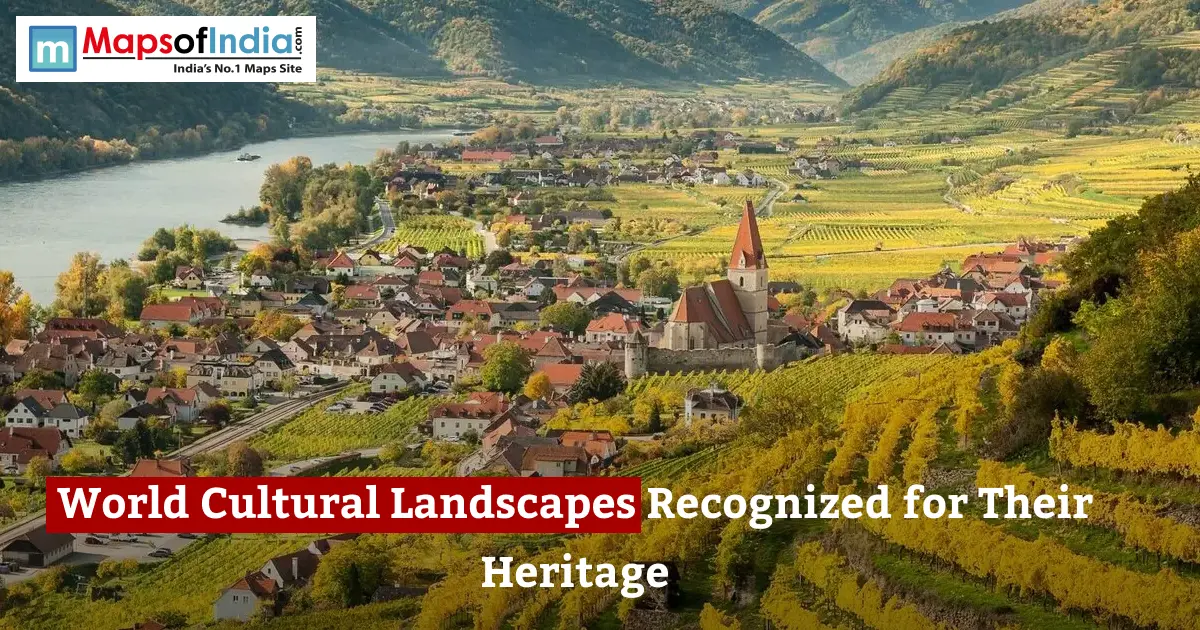
From terraced rice fields and vineyard valleys to mountains, gardens and traditional settlements, cultural landscapes show how people have shaped and lived within their natural surroundings over many years.
UNESCO recognises these places as World Heritage because their value comes from the relationship between human communities, culture and the environment. Today UNESCO’s World Heritage List includes 121 properties designated as landscapes, including six transboundary properties; one of the 121 has since been delisted.
What Is a UNESCO Cultural Landscape?
A UNESCO cultural landscape is a heritage place that represents the combined works of nature and humankind. It shows how societies have interacted with their environment through farming, settlement, traditions, architecture, land management, or other cultural practices. UNESCO formally incorporated landscapes into the World Heritage framework in 1992.
Unlike a cultural World Heritage Site, which may focus primarily on buildings, monuments or archaeological remains, a UNESCO cultural landscape emphasises the relationship between people and their surroundings. A UNESCO cultural landscape can also differ from a World Heritage Site, where the primary value lies in natural features and ecological processes.
A UNESCO cultural landscape can therefore contain both cultural features and natural elements, with the landscape itself telling the story of long‑term human interaction with nature.
The Three Categories of Cultural Landscapes
UNESCO divides landscapes into three main categories:
Clearly Defined or Designed Landscapes
These are intentionally planned and created by people, often for aesthetic, religious, or recreational purposes. Historic gardens, parks, and landscapes surrounding buildings are common examples.
Organically Evolved Landscapes
These developed gradually through economic, administrative or religious activities and their interaction with the natural environment. UNESCO further divides them into:
- Relict or fossil landscapes: landscapes where the evolutionary process has ended but important physical features remain.
- Continuing landscapes: landscapes that still have a role in contemporary society and continue to evolve while retaining traditional characteristics.
Associative Cultural Landscapes
These are valued because of their strong religious, artistic, cultural or spiritual associations with nature. Physical evidence of activity may be limited or even absent.
How Many Cultural Landscapes Are Recognised Today?
UNESCO currently states that 121 properties have been included as landscapes on the World Heritage List, including six transboundary properties. One property has subsequently been delisted.
The wider World Heritage List has also continued to expand. At its session in Busan in July 2026, the World Heritage Committee added 25 new properties, including 19 cultural, five natural and one mixed property.
Using UNESCO’s total of 1 273 World Heritage properties after the 2026 addition, the 121‑property cultural‑landscape figure represents roughly 9.5 % of the List. This percentage is a comparison because UNESCO’s cultural‑landscape page notes that one of the 121 properties has been delisted.
New inscriptions are considered during the World Heritage Committee's session. Countries submit nominations, which are evaluated before the Committee makes decisions on inscription.
Notable Examples Around the World
Cultural landscapes appear in forms across continents, reflecting local environments and traditions.
Europe
Europe contains vineyard, agricultural, garden, and historic settlement landscapes. Examples include:
- Alto Douro Wine Region, Portugal. A wine‑growing landscape shaped by centuries of viticulture.
- Lavaux, Vineyard Terraces, Switzerland. Terraced vineyards overlooking Lake Geneva.
- Tokaj Wine Region Historic Cultural Landscape, Hungary. A landscape associated with a long‑established wine tradition.
- Cultural Landscape of the Serra de Tramuntana, Spain. A Mediterranean mountain landscape shaped by agriculture and water‑management systems.
Asia
Asian cultural landscapes include terraces, sacred areas, and landscapes shaped by religious traditions.
- Cultural Landscape of Bali Province, Indonesia. Associated with the Subak irrigation system and the philosophy of Tri Hita Karana.
- Honghe Hani Rice Terraces, China. Mountain terraces reflecting generations of agricultural knowledge.
- Iwami Ginzan Silver Mine and its Cultural Landscape, Japan. Combining mining remains with the surrounding landscape.
- Al‑Ahsa Oasis, Saudi Arabia. An evolving oasis landscape shaped by agriculture, water resources, and settlement.
Africa
African examples demonstrate the relationship between communities, agriculture, sacred traditions, and natural environments.
- Konso Cultural Landscape, Ethiopia. Known for its agricultural terraces and traditional settlement patterns.
- Bassari Country, Senegal. It reflects the cultural traditions and landscapes of Bassari, Fula and Bedik communities.
- Sukur Cultural Landscape, Nigeria. Combines terraced farming, settlements, sacred features and iron‑working traditions.
The Americas
The Americas also contain landscapes where farming, settlement and cultural traditions have shaped the environment.
- Coffee Cultural Landscape of Colombia. Shows a long‑established tradition of growing coffee.
- Landscape of Grand Pré, Canada. Reflects centuries of adaptation to a tidal environment.
- Viñales Valley, Cuba. Combines agricultural practices with the valley’s natural setting.
How a Site Becomes a Recognised Cultural Landscape
A Cultural Landscape follows the World Heritage nomination process. A country first identifies a property. Usually, it places it on its Tentative List before preparing a nomination for consideration.
The nomination dossier explains the property’s boundaries, history, cultural and natural attributes, protection arrangements, management system and Outstanding Universal Value. Advisory bodies evaluate the nomination, after which the World Heritage Committee considers the case during its session.
Inscription is based on the World Heritage Convention’s requirements, including Universal Value and the relevant selection criteria as well as appropriate protection and management arrangements. Cultural Landscape does not have a separate World Heritage criterion; different cultural criteria can be used depending on the property's values.
Why These Landscapes Matter
Cultural Landscape preserves evidence of how communities have adapted to their surroundings. Terraced farming can demonstrate water and soil‑management techniques, while sacred Cultural Landscape can preserve longstanding spiritual relationships with nature.
Cultural Landscape conservation can therefore support:
- identity by protecting traditions and historic Cultural Landscape.
- Traditional knowledge by maintaining long‑established practices.
- Biodiversity where traditional forms of land management help sustain Landscapes
- Sustainable land use by preserving techniques adapted to environmental conditions.
- Community continuity by protecting places that remain part of people’s lives.
At the same time, Cultural Landscapes can face pressure from changing landscape patterns,s population shifts, development, natural hazards, and climate change. UNESCO notes that increasing disaster risks and climate change can create conservation challenges for Cultural Landscapes.
Cultural Landscapes on the World Heritage in Danger List
The World Heritage in Danger List identifies properties facing threats to the characteristics for which they were recognised. UNESCO identifies conflict, environmental pressures, natural disasters, uncontrolled development and climate‑related factors among the possible threats.
One clear example is the Cultural Landscape and Archaeological Remains of the Bam Valley in Afghanistan, which remains on the World Heritage in Danger List.UNESCO's 2026 decision retained it along with properties facing serious conservation challenges.
Other cultural landscapes can face threats without necessarily being placed on the Danger List. For example, UNESCO's monitoring of Nigeria’s Sukur Cultural Landscape has documented pressures including insecurity, weather and climatic conditions, erosion, environmental degradation and damage to structures.
The Danger List is intended to draw attention to threatened properties and encourage corrective conservation measures rather than simply serve as a list of permanently lost heritage.
FAQs
1. What is a Landscape?
A Cultural Landscape is a place where the interaction between people and the natural environment has created landscapes, spiritual or land‑use values recognised as having significant heritage.
2. How many UNESCO Cultural Landscapes are there?
UNESCO currently states that 121 properties have been included as Cultural Landscapes, with six properties and one property that have been delisted.
3. When did UNESCO begin recognising Cultural Landscapes?
UNESCO formally incorporated Cultural Landscapes into the World Heritage framework in 1992, when the World Heritage Committee adopted guidelines for their inclusion.
4. What are the three types of Cultural Landscapes?
They are: Designed landscapes, organically evolved landscapes, and associative cultural landscapes. Evolved landscapes can further be classified as relict or continuing landscapes.
5. Are Cultural Landscapes natural areas?
No. Cultural Landscape specifically represents the interaction of communities and their natural surroundings. It may include areas, settlements, gardens, sacred places, vineyards, and archaeological or historic features.
6. Can a Cultural Landscape be on the World Heritage in Danger List?
Yes. Cultural Landscape can be placed on the Danger List when threats put its World Heritage values at risk. The Bamiy Valley is one example.
7. Why does UNESCO protect Cultural Landscapes?
Their protection helps conserve evidence of human‑environment relationships, traditional land‑use systems, cultural identity and, in some cases, biodiversity and sustainable practices.