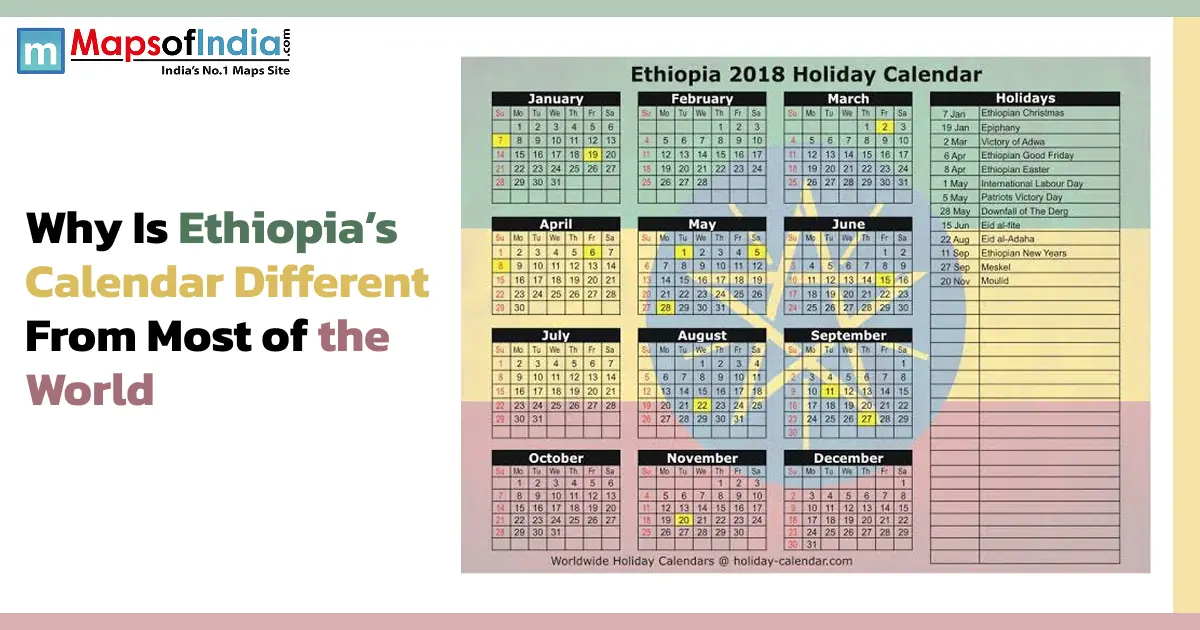
Right now, most of the world is living in 2026. Ethiopia isn't. It's 2018 there. Same planet, same day, different year entirely. That's the Ethiopian Calendar for you, and it's not a typo or a mistake. It's a genuinely different system, running quietly alongside the Gregorian one the rest of us use. Let's get into why.
What Is the Ethiopian Calendar?
The Ethiopian calendar is a solar calendar, rooted in the ancient Alexandrian, or Coptic, computus. It's the calendar Ethiopia actually runs on, day to day, alongside the Ethiopian Orthodox Tewahedo Church's own religious calendar.
Ge'ez Calendar Naming
You'll also hear it called the Ge'ez calendar. Same system, different name, tied to Ethiopia's ancient liturgical language.
Why Is Ethiopia 7 Years Behind?
Here's the real story. Back in the 4th and 5th centuries, church scholars in Alexandria and Rome sat down separately to calculate the exact date of the Annunciation, the moment Christian tradition marks as the beginning of Christ's earthly timeline. They landed on different answers. Both were working from fragmentary, incomplete historical evidence. Neither is provably "right." The Roman calculation eventually became the basis for the Gregorian calendar most of the world uses today. The Alexandrian calculation stuck in Ethiopia, and it never changed.
The Math Behind the 7–8 Year Gap
The gap isn't fixed at exactly 7 years, and that trips people up constantly. It actually shifts every September, when the Ethiopian New Year lands. From September 11 through December 31, Ethiopia sits 7 years behind. From January 1 through September 10, it's 8 years behind. Right now, for instance, it's Ethiopian year 2018.
Why Does Ethiopia Have 13 Months?
Twelve months of exactly 30 days each. Then one short, extra month called Pagume, tacked on at the very end. Pagume runs 5 days in a normal year, 6 in a leap year.
Ethiopian Months vs. Gregorian Months
Ethiopian Month | Approximate Gregorian Overlap |
| Meskerem | September–October |
| Tikimt | October–November |
| Hidar | November–December |
| Tahsas | December–January |
| Tir | January–February |
| Yekatit | February–March |
| Megabit | March–April |
| Miyazya | April–May |
| Ginbot | May–June |
| Sene | June–July |
| Hamle | July–August |
| Nehase | August–September |
| Pagume | September (short) |
Ethiopian Calendar vs. Gregorian Calendar
Feature | Ethiopian Calendar | Gregorian Calendar |
| Number of months | 13 (12 full + Pagume) | 12 |
| New Year date | September 11 (or 12) | January 1 |
| Leap year rule | Every 4 years, no exceptions | Every 4 years, with century-year exceptions |
| Current year | 2018 (until September 2026) | 2026 |
Enkutatash — Ethiopian New Year
Enkutatash falls on September 11 most years, shifting to September 12 the year before a Gregorian leap year. The name translates to "gift of jewels," tied to a legend involving the Queen of Sheba's return from visiting King Solomon, greeted with jewels on her arrival home. It also lines up with the end of Ethiopia's rainy season, so the holiday doubles as a celebration of fresh, green landscapes and new beginnings. Expect flowers, new clothes, and family gatherings across the country.
Why Didn't Ethiopia Adopt the Gregorian Calendar?
This is really the heart of the story. Ethiopia is one of the only African nations never fully colonized by a European power. It faced a brief Italian occupation from 1936 to 1941, but never the sustained colonial rule that reshaped calendars, languages, and institutions elsewhere on the continent. Without that outside pressure, there was simply no forced switch to the Gregorian system. The Ethiopian Orthodox Church also held, and still holds, deep cultural and religious authority. Keeping its own calendar wasn't an oversight. It was a genuine, deliberate act of preserving religious and national identity.
How to Convert Between Ethiopian and Gregorian Dates?
Here's a rough rule of thumb. Add 7 years and 8 months to an Ethiopian date to land on its approximate Gregorian equivalent. The exact conversion shifts a bit depending on the month, since the two calendars don't start their years on the same date. For anything precise, an online Ethiopian-Gregorian date converter handles the math instantly, and there are several free ones available.
Conclusion
Ethiopia's calendar isn't behind in any meaningful sense. It's simply different, built on a separate 1,500-year-old calculation that the country never had reason to abandon. Thirteen months, a New Year in September, and a year count that sits 7 to 8 years apart from the Gregorian world, all of it still running today, in daily use, not as some historical relic.
FAQs
Is Ethiopia really 7 years behind?
Sort of, and it depends on the time of year. The gap is 7 years from September 11 through December 31, and 8 years from January 1 through September 10, since the two calendars start their years on different dates.
What year is it in Ethiopia right now?
As of most of 2026 on the Gregorian calendar, it's Ethiopian year 2018. That shifts to 2019 once Enkutatash arrives on September 11, 2026.
Does Ethiopia use the Gregorian calendar at all?
Yes, alongside its own. International business, diplomacy, and travel documents often reference the Gregorian date too, but daily civil life, religious festivals, and national holidays all run on the Ethiopian calendar.
How many days are in Pagume?
Five days in a common year, six days in an Ethiopian leap year.
Do other countries use similar calendars?
Yes. The Coptic calendar in Egypt shares the same basic structure: 12 months of 30 days plus a short 5-or-6-day final month, since both trace back to the same ancient Alexandrian system.
Why does the Ethiopian New Year fall in September, not January?
It ties back to the ancient Alexandrian calendar's own new year point, which also happens to line up with the end of Ethiopia's rainy season, giving Enkutatash a natural, seasonal significance beyond just the calendar date itself.
Is the Ethiopian calendar lunar or solar?
Solar. It's derived from the ancient Coptic calendar, not linked to lunar cycles at all, and has no connection to the Chinese Lunar New Year or the Islamic Hijri calendar.
Why is the exact year gap not always 7 years?
Because Ethiopia's New Year falls in September, not January. For part of the Gregorian year, the two calendars are 7 years apart. For the rest, they're 8 years apart. The crossover happens each year right at Enkutatash.