Picture a country bigger than France, Spain, Germany, and Belgium combined. Now picture just 3.5 million people living in it. That's Mongolia. Mongolia's population density sits at roughly 2 people per square kilometre, the lowest of any sovereign country on Earth. So why is it this empty? Geography, climate, and a way of life built around wide open space all play their part. Let's break it down.
Why Is Mongolia So Sparsely Populated?
The numbers alone tell a striking story. Around 3.5 million people. A land area of roughly 1.56 million square kilometres. Do the math, and you land at about 2 people per square kilometre. For comparison, the global average sits closer to 60. Mongolia isn't just sparse. It's in a category almost entirely of its own.
Mongolia's Population Density vs. Other Low-Density Countries
Country | Density (people/km²) | Notes |
| Mongolia | ~2 | Lowest of any sovereign country |
| Namibia | ~3 | Desert terrain, coastal population clusters |
| Australia | ~3 | Interior largely empty, coast heavily populated |
| Western Sahara | ~2 | Disputed territory, not a fully recognized sovereign state |
| Greenland | ~0.03 | Autonomous territory, not a sovereign country |
Worth flagging here. Greenland actually beats Mongolia on raw emptiness. But Greenland isn't a sovereign nation; it's an autonomous territory of Denmark. That's exactly why Mongolia holds the title specifically among the world's fully sovereign countries.
Mongolia's Harsh Geography and Climate
The Gobi Desert stretches across Mongolia's south. Endless steppe grassland covers much of the rest. And the climate doesn't do this country any favours either. Winters plunge to brutal, bone-deep cold. Summers swing to genuinely hot. That kind of extreme continental climate, one of the harshest anywhere on the planet, makes year-round, settled life a real challenge.
Why Farming and Dense Settlement Are Difficult?
Short growing seasons and unpredictable rainfall make large-scale farming genuinely difficult across most of the country. Without farming to anchor dense, permanent settlements, the land stays exactly what it's been for centuries. Vast, open, and thinly populated.
The Role of Nomadic and Semi-Nomadic Herding
Herding livestock- sheep, goats, horses, cattle, camels- has shaped Mongolian life for generations. It's not a lifestyle that works in small spaces. Herds need room to roam and fresh grazing land, season after season.
How Herding Shapes Settlement Patterns?
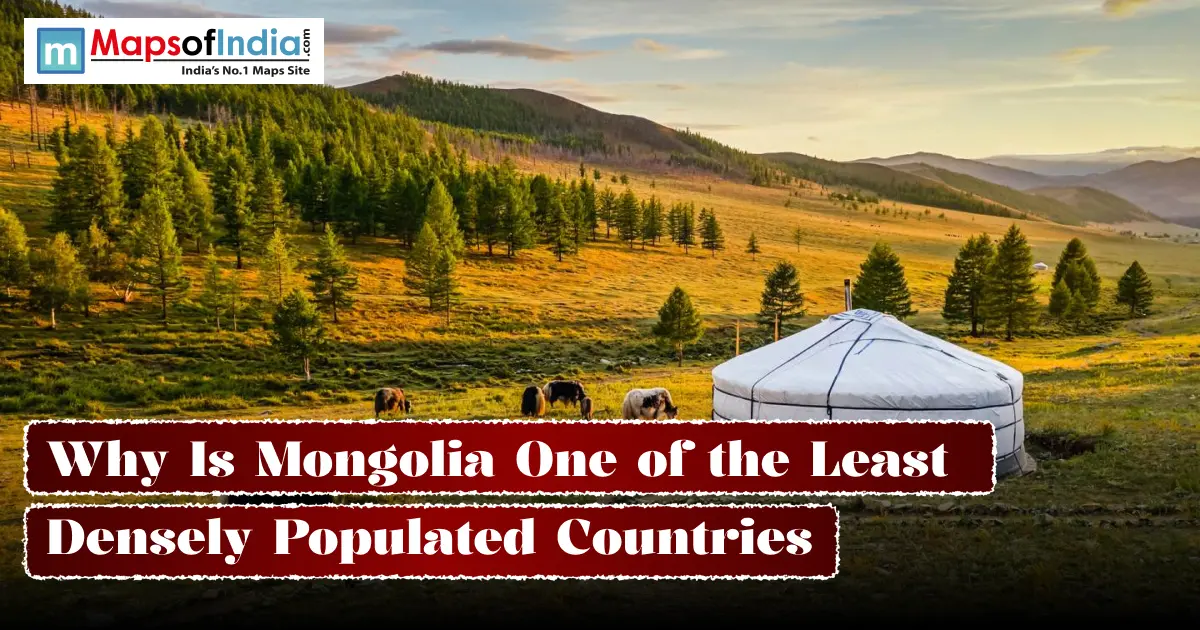
Traditional gers, the round felt tents Mongolian herders live in, get packed up and moved as the seasons change and grazing land shifts. This isn't small-scale wandering either. Families can cover real distances over a year, chasing better pasture. That constant, deliberate spreading-out is baked directly into the country's traditional way of life, and it's a huge part of why dense towns never really took hold outside a handful of urban centres.
Historical Factors Behind Low Population Growth
Mongolia's population stayed remarkably small for a remarkably long stretch of history. During centuries of Qing dynasty rule, a large share of Mongolian men entered Buddhist monastic life, which suppressed birth rates significantly over generations. Disease and periodic conflict took their own toll too. The result was a country with an enormous landmass and a genuinely tiny population base to fill it, a gap that persists in the numbers even today.
The Ulaanbaatar Paradox — Urban Crowding vs. Rural Emptiness
Here's the twist in the story. Roughly 45 to 47% of Mongolia's entire population lives in just one city: Ulaanbaatar. Meanwhile, close to 70% of the country lives in urban areas overall, a genuinely high figure for a nation famous for its emptiness.
Why the Countryside Stays Empty While the Capital Grows?
Jobs, schools, and healthcare all cluster in Ulaanbaatar, pulling people in from the countryside generation after generation. Meanwhile, the vast rural interior stays home mainly to herding families and small, scattered settlements. The result is a genuinely strange split. A capital city packed with people, sitting inside a country that's otherwise almost entirely empty.
Mongolia vs. the World's Other Least Densely Populated Countries
Mongolia, Namibia, and Australia all share a common thread. Big territory, difficult terrain, and populations squeezed into small, livable pockets. Namibia's Namib and Kalahari deserts push most residents toward its wetter north and its capital, Windhoek. Australia's story is different but oddly similar. Around 85% of Australians live within 50 kilometres of the coast, leaving its vast interior nearly as empty as Mongolia's steppe. Different climates, different histories, same basic outcome: hard land pushes people toward the easiest corners to live in.
Conclusion
Mongolia's emptiness isn't random. It's the direct result of a punishing climate, land that resists dense farming, and a herding culture built around constant movement, not permanent settlement. Layer centuries of historically slow population growth on top, and you get a country where 3.5 million people are spread across a landmass bigger than Western Europe, with nearly half of them packed into one single city. It's a genuinely unique way for a country to exist, and honestly, that's exactly why it's worth understanding.
FAQs
Is Mongolia the least densely populated country in the world?
Among fully sovereign countries, yes. Greenland has an even lower density, but it's an autonomous territory of Denmark, not a sovereign nation in its own right.
What is the population density of Mongolia, in terms of people per square km?
About 3.5 million people in 1.56 million km2 (an average of 2 per km2) in 2026.
What is the reason for the large proportion of Mongolians living in Ulaanbaatar?
The capital city is the epicentre of employment, education and health care, which pulls people out of the country. Today, almost half of the country's population resides there.
Is Mongolia's population growing or shrinking?
Growing, though gradually. Mongolia's population has increased steadily in recent decades, even as its overall density remains the lowest of any sovereign country.
What is the most densely populated country, by contrast?
Monaco holds that title among widely recognised sovereign states, packing tens of thousands of people into just about 2 square kilometres, an almost complete opposite of Mongolia's situation.
Why isn't Mongolia's low density mainly about war or disaster?
It's mostly geography and lifestyle, not conflict. Extreme climate, difficult farming conditions, and a traditional herding culture built around wide, open grazing land all play a far bigger role than any single historical event.
Do all of Mongolia's people live a nomadic lifestyle?
No, not anymore. While herding remains culturally significant and a real livelihood for many rural families, roughly 70% of Mongolia's population now lives in urban areas, mostly concentrated in Ulaanbaatar.
How does Mongolia's density compare to its neighbours, Russia and China?
Both neighbours are far more densely populated overall, though Russia's own Siberian regions share a similarly sparse, harsh-climate pattern. China's density sits dramatically higher, driven by its much larger population concentrated in a comparable-sized landmass.