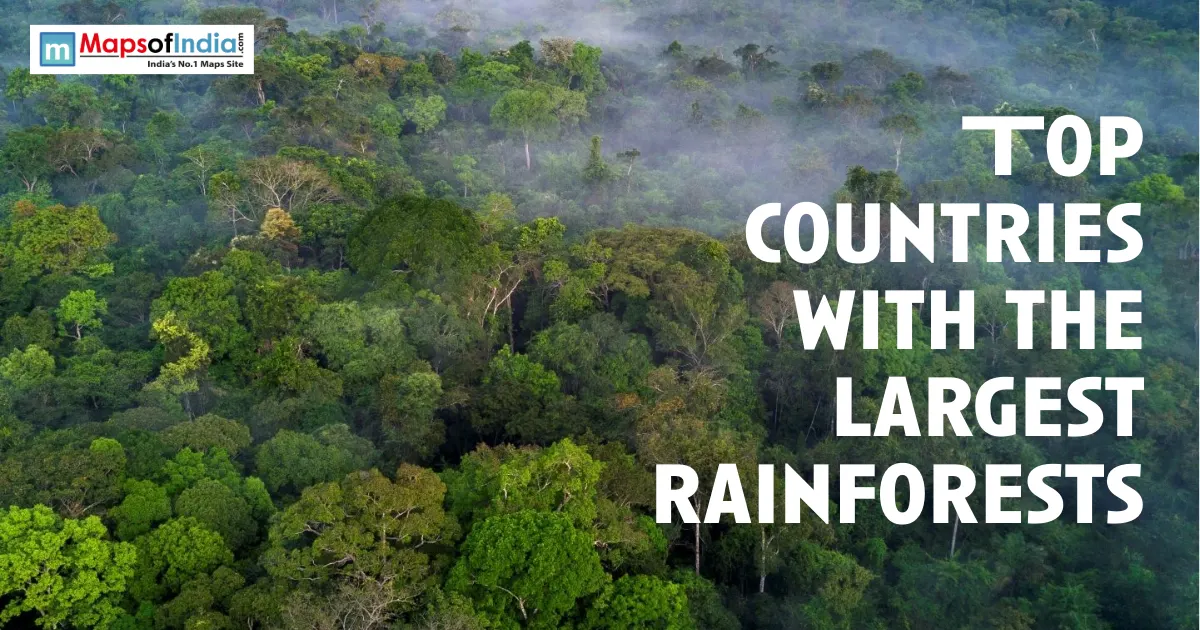
Brazil holds more rainforest than any other country on Earth, home to roughly 60% of the entire Amazon. This guide ranks the countries with the largest rainforests, using verified figures rather than the outdated "tropical forest" data that still circulates online and quietly counts dry woodland alongside true rainforest. Let's get into the real numbers.
What Counts as a Rainforest?
A rainforest is a dense forest that receives heavy, consistent rainfall year-round, typically over 2,000mm annually, supporting an unusually thick, layered canopy and extraordinary biodiversity. That's a narrower category than "tropical forest" in general, which can include much drier woodland too. A lot of older rankings blur that line, which is exactly why some lists put Australia or Sudan near the top. This one doesn't.
Top 10 Countries with the Largest Rainforests
1. Brazil
Brazil holds roughly 60% of the Amazon rainforest within its borders, close to 3.3 million square kilometres. The Amazon here alone hosts over 40,000 plant species and more than 850,000 Indigenous people across hundreds of tribes. Brazil also unfortunately leads the world in primary rainforest loss, responsible for more than a quarter of all global tropical forest loss between 2015 and 2024.
2. Democratic Republic of the Congo
The Democratic Republic of Congo holds around 992,000 square kilometres of primary rainforest, more than any country except Brazil, based on Global Forest Watch data. It anchors the Congo Basin, the world's second-largest contiguous rainforest, home to gorillas, okapi, and forest elephants found almost nowhere else.
3. Peru
Peru holds about 13% of the Amazon, roughly 750,000 square kilometres. Its rainforest is exceptionally biodiverse, home to an estimated 3,000 amphibian, bird, mammal, and reptile species combined, with around 16% found nowhere else on Earth.
4. Indonesia
Indonesia's rainforest spans two very different regions: the western half of New Guinea and huge stretches of Sumatra and Borneo. Together, these forests hold some of the highest concentrations of palm species anywhere on the planet, though Indonesia also ranks second globally for total deforestation between 2015 and 2024, having lost around 10 million hectares in that period.
5. Colombia
Colombia holds close to 8% of the Amazon, around 440,000 square kilometres, plus a share of the Chocó rainforest along its Pacific coast, one of the wettest and most biodiverse regions on Earth.
6. Bolivia
Bolivia holds roughly 6% of the Amazon, around 330,000 square kilometres. It has also become one of the fastest-deforesting countries recently, ranking second globally for primary forest loss in 2024 alone.
7. Venezuela
Venezuela holds another 6% share of the Amazon, close to 330,000 square kilometres, alongside significant protected land elsewhere in the country, including Canaima National Park.
8. India
India's rainforest is far smaller in scale than the Amazon or Congo, concentrated mainly in the Western Ghats and parts of the country's northeast. What it lacks in size, it makes up for in endemism, with the Western Ghats ranking among the world's recognized biodiversity hotspots.
9. Papua New Guinea
Papua New Guinea holds the eastern half of the New Guinea rainforest, roughly half of its 786,000 square kilometre total. This is the third-largest contiguous rainforest block on Earth, home to tree kangaroos, crowned pigeons, and species found on no other landmass.
10. Malaysia
Malaysia's rainforest sits mainly across Borneo and the Malay Peninsula, historically home to some of the world's oldest rainforest ecosystems, though heavy logging and palm oil expansion have shrunk its coverage substantially over recent decades.
Rainforest Coverage by Country
Country | Rainforest Area (approx.) | Share of Major Rainforest | Major Rainforest |
| Brazil | ~3,300,000 km² | ~60% of Amazon | Amazon |
| DR Congo | ~992,000 km² | ~60% of Congo Basin | Congo Basin |
| Peru | ~750,000 km² | ~13% of Amazon | Amazon |
| Indonesia | Spans multiple regions | Western New Guinea + Sumatra/Borneo | Australasian + Sundaland |
| Colombia | ~440,000 km² | ~8% of Amazon | Amazon |
| Bolivia | ~330,000 km² | ~6% of Amazon | Amazon |
| Venezuela | ~330,000 km² | ~6% of Amazon | Amazon |
| India | Smaller, concentrated | N/A | Western Ghats, Northeast India |
| Papua New Guinea | ~393,000 km² | ~50% of New Guinea rainforest | Australasian |
| Malaysia | Borneo + Peninsula | N/A | Sundaland |
A quick honest note: exact square kilometre figures vary depending on the source and year, especially since deforestation keeps shrinking these numbers in real time. Treat these as solid working estimates, not fixed totals.
Why These Rainforests Matter?
Rainforests contain a disproportionately large amount of biodiversity for the amount of land that they occupy. Estimated to have 2.5 million insect species, 40,000 plant species and 3,000 fish species, the Amazon is home to many more. They also have a huge impact on global rainfall and carbon storage, and are far more than a wildlife issue; they are a crucial part of the fight against climate change.
Threats to the World's Largest Rainforests
Deforestation
Brazil lost more primary rainforest than any other country in 2024, over 2.8 million hectares, more than 40% of the global total that year. Indonesia and Bolivia both rank among the next worst offenders.
Climate Change
Rising temperatures and shifting rainfall patterns are already stressing rainforest ecosystems directly. Research shows tropical forests actually stop absorbing carbon dioxide effectively during El Niño events, undercutting one of their most important climate functions exactly when it's needed most.
Illegal Logging & Mining
Unregulated logging and mining operations continue driving forest loss across the Amazon, Congo Basin, and Southeast Asian rainforests alike, often pushing deep into areas nominally protected on paper.
Rainforest Conservation Efforts by Country
Brazil, Peru, and Colombia have all expanded protected Amazon territory in recent years, though enforcement remains inconsistent in remote regions. The DRC has worked with international partners on Congo Basin conservation funding, given how central the region is to global carbon storage. Indonesia has introduced palm oil moratoriums aimed at slowing deforestation, with mixed results so far.
Conclusion
Brazil leads by a wide margin, but the real rainforest story spans a dozen countries across three continents: the Amazon nations, the Congo Basin countries, and the Southeast Asian and Australasian forests of Indonesia, Papua New Guinea, and Malaysia. All of them face the same core threat: shrinking forest cover, even as the world depends on these exact ecosystems more than ever.
FAQs
Which country has the largest rainforest in the world?
Brazil, home to roughly 60% of the Amazon rainforest, around 3.3 million square kilometres within its own borders.
What per cent of the Amazon does Brazil have?
About 60%. The remainder is distributed in Peru, Colombia, Venezuela, Bolivia, Guyana, Ecuador, Suriname and French Guiana.
What are the countries that have the Amazon Rainforest?
Nine countries in total: Brazil, Peru, Colombia, Venezuela, Bolivia, Guyana, Ecuador, Suriname and French Guiana, which is a French overseas department.
Which is the second biggest rainforest in the world?
The rainforest of the Congo Basin, which extends over six nations in Central Africa, most of which have the Democratic Republic of the Congo as their largest slice.
What % of oxygen do rainforests produce in the world?
The rainforests, and especially the Amazon, are said to produce a significant amount of oxygen for the world, but this is not as straightforward as it sounds: In spite of producing oxygen, mature forests absorb oxygen in the process of decomposition, balancing out a lot of what they produce.
Is India a big rainforest country?
Not as vast as Brazil or the Congo Basin nations, but India does possess truly important rainforests in the Western Ghats and in the north-east, the latter of which is recognised as being a globally important biodiversity hotspot.
What causes these area figures for rainforests to differ amongst sources?
The figures are only continuing to fall, as deforestation continues, and the older figures sometimes include drier tropical forests as well as true rainforest, making them artificially high for countries such as Australia, which is not primarily a rainforest country.
What's the country that is losing rainforest the fastest?
Brazil lost more than 2.8 million hectares in total in 2024, while Bolivia and Indonesia have been among the top 10 fastest rates of deforestation in the past few years.