

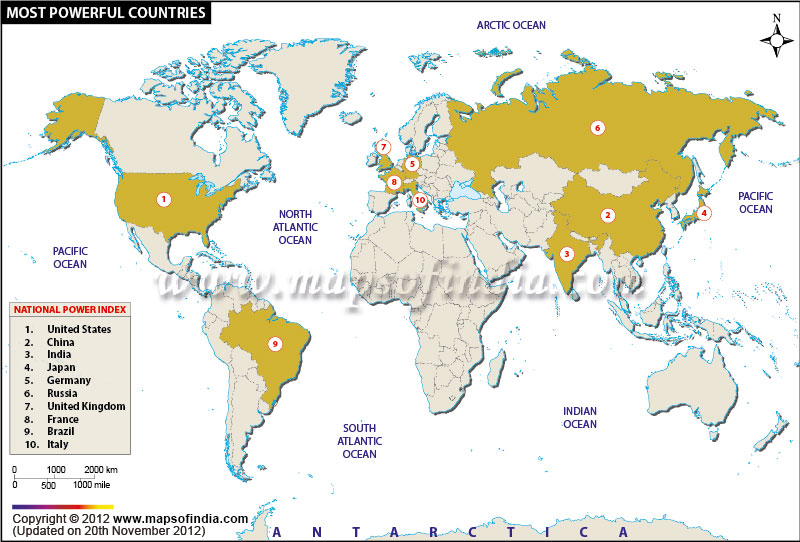





According to this ranking, the top ten countries in the power rankings are the United States, China, India, Japan, Germany, Russia, United Kingdom, France, Brazil and Italy. The former superpower Russia, the largest country in the world, remains a major military and geopolitical power, although its position varies depending on the ranking methodology. Countries from Asia such as China and India have joined Japan in the list. The sole country from South America is Brazil.
The global power ranking of a country is calculated on the basis of factors such as Gross Domestic Product of a country, its defense spending, its infrastructure & technology, and its population. The National Power Index score of a country is derived from the product of these weighted factors. These scores are computer calculated and expressed as a country's share of global power. The values can be forecasted for any country.
United States
Based on the GDP and its defense spending, the US is the most powerful country. It is also the third largest by area and population. All these are factors are taken into account while calculating the power ranking of a country, and so the United State is still the dominant power in the world.
Europe
In the last century European countries such as Germany, United Kingdom, France and Italy have been the most powerful countries in the world. They are still in the list of the most powerful countries but at slightly lower rankings. According to this ranking, Germany now is the most powerful country in Europe because of its strong economy ahead of United Kingdom (historically, a leading country) and France. Europe remains a global leader in several fields of technology, innovation, and research, although leadership varies across different sectors.
FAQs
Q1: What are world power rankings?
World power rankings compare countries based on factors such as economic strength, military capability, technological advancement, infrastructure, population, and global influence.
Q2: Which factors determine a country's global power?
A country's global power is commonly assessed using indicators such as Gross Domestic Product (GDP), defense spending, technological capabilities, infrastructure, population, diplomatic influence, and overall economic performance. The exact methodology varies by ranking organization.
Q3: Which countries are considered the world's most powerful?
The list of the world's most powerful countries varies depending on the ranking methodology and the year of publication. Economic, military, political, and technological factors all influence the rankings.
Q4: How can a world map help in understanding global power rankings?
A world map helps visualize the geographical location of powerful countries, their regional influence, neighboring nations, and strategic positions across different continents.
Q5: Why do global power rankings change over time?
Global power rankings change due to shifts in economic growth, military strength, technological innovation, geopolitical developments, demographic changes, and international relations.
Q6: Is military strength the only factor in determining a country's power?
No. While military capability is important, modern power rankings also consider economic performance, innovation, diplomacy, infrastructure, natural resources, population, and global influence.
Q7: Why is a world map useful for studying international relations?
A world map provides geographical context for understanding international relations, trade routes, strategic locations, regional alliances, and the distribution of global powers, making complex geopolitical concepts easier to understand.
Last Updated on : July 06, 2026


