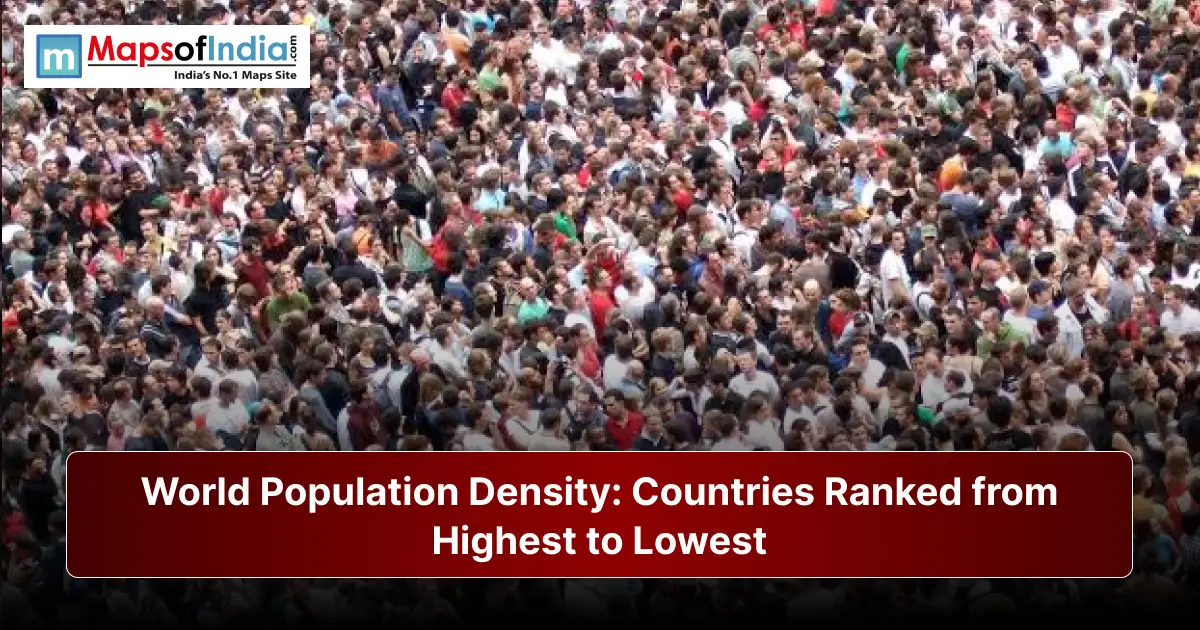
Population density is the number of people in a particular area of land, typically people per square kilometre, and is a measure of how densely populated an area is. The number of people that live in each country of the world can vary widely, from a few square kilometres per ten thousand people in the most densely populated city-states, to several square kilometres per person in the largest nations. All figures cited in this piece are based on UN World Population Prospects data and land areas from the CIA World Factbook (as of 2026). The list below is of the most populated corners to the least populated.
How Population Density Is Calculated?
The formula is simple. The total population per total land area, not total area, is used, and that is the critical distinction. Land area excludes lakes, rivers, and other water bodies because they would otherwise reduce density, but they are included with the total area, so only that figure should be used for density measurements. Despite all this, national averages can be misleading. If the cities in the country are really crowded, then the uninhabitable desert, mountain, etc., lowers the average density. Egypt is as obvious an example; its national average density is not that high, but almost the entire population is cramped into the narrow belt of the Nile River.
World Population Density Map
The choropleth map style is used in a map of world population density by country, with light and dark shading indicating the relative density of the country. Some city-states, such as Monaco and Singapore, are represented by small, dark, almost black spots, and others, such as Mongolia, Canada and Australia, are vast pale areas. Coastal and river areas tend to be brighter than more arid interior deserts and arctic regions because people have always tended to settle around water and farmland.
Top Densely Populated Countries in the World
Rank | Country | Density (people/km²) |
| 1 | Monaco | 26,150 |
| 2 | Macau (China) | 22,563 |
| 3 | Singapore | 8,590 |
| 4 | Hong Kong (China) | 7,140 |
| 5 | Gibraltar (UK) | 5,000 |
| 6 | Bahrain | 2,239 |
| 7 | Maldives | 1,802 |
| 8 | Malta | 1,649 |
| 9 | Bangladesh | 1,350 |
| 10 | Palestine | 880 |
| 11 | Taiwan | 653 |
| 12 | Rwanda | 602 |
| 13 | South Korea | 527 |
| 14 | Netherlands | 523 |
| 15 | India | 484 |
The very top of this population density table is taken up by the city-states, because they have few, if any, areas with much population density beyond their one main urban area. The population density is very different for Bangladesh, which is the most crowded, with more than ten million residents per square km.
Least Densely Populated Countries in the World
Rank | Country | Density (people/km²) |
| 1 | Mongolia | 2.1 |
| 2 | Western Sahara | 2.5 |
| 3 | Namibia | 3.1 |
| 4 | Australia | 3.5 |
| 5 | Iceland | 3.5 |
| 6 | Suriname | 3.7 |
| 7 | Guyana | 4.0 |
| 8 | Libya | 4.1 |
| 9 | Botswana | 4.2 |
| 10 | Canada | 4.3 |
| 11 | Mauritania | 4.6 |
| 12 | Kazakhstan | 7.7 |
| 13 | Central African Republic | 8.0 |
| 14 | Russia | 8.8 |
| 15 | Bolivia | 11.6 |
Most of this list can be attributed to the harsher terrain. Large areas of land are virtually uninhabitable in Mongolia's grasslands, Australia's interior desert, and Canada's arctic north, dragging the national average density down even though some of these cities are still a bustling hub of activity.
Region-Wise Population Density Breakdown
Many of the countries in Asia have fertile river valleys and coastal plains, which account for their high average density, such as Bangladesh, India and Japan.
Europe's average is moderate, concentrating in densely populated areas like the Netherlands and Malta and diffusing in sparsely populated Nordic countries.
Africa is second overall, due to its high population growth rates, and not to its high densities; Rwanda is the most densely populated country.
The only exception is North America, where the vast (and largely unpopulated) northern regions of Canada pull the regional average well down, compared with what the USA or Mexico themselves would indicate.
But South America is still made up of large low-density land masses, and the Amazon interior continues to keep the countries of Suriname and Guyana among the least populated places on earth.
Australia's desert interior absorbs the bulk of the continent, and Oceania has the lowest regional average of any other region.
Population Density vs. Population Size - Key Differences
Although they measure completely different things, these two numbers are often confused. Population size is the actual number of people populating a country. Land area is also a factor, which is why China and India, despite being the largest populations on Earth, aren't in the top spots on the list of population density. In Monaco, it's a completely different story. With a small land area, the population density is the highest in the world.
Factors That Influence a Country's Population Density
- Climate attracts people to temperate climate zones, and repels them from extreme climate zones.
- Deserts, mountains, and dense forests do not permit settlement.
- Urbanization brings about a high concentration of people in urban areas, with rural areas being comparatively empty.
- Economic opportunity is a force that drives people to areas of opportunity for jobs and away from areas that offer few jobs.
- Cities tend to settle in the same areas, and people have concentrated in those areas since then.
- Population redistributions can be hastened or slowed by government policies, such as land-use policies and migration controls.
Conclusion
Overall, the ranking by population density reveals that more raw population size does not necessarily imply that an area is more densely populated. The level of intimacy of a nation's people is determined by the land, climate and history of a country. The numbers represent projections for 2026, and the ranking may change when new census and UN data are published, so do not consider this ranking as a permanent and definitive list.
FAQs
1. What is meant by population density, and how is it determined?
Population density is the amount of population in a particular portion of land, for example, people per km2. This is achieved by dividing the number of people in a country by the land area (excluding the land that is part of inland water bodies like rivers, lakes, etc.).
2. Which country, in 2026, has the densest population?
Monaco has the highest population density in the world at 26,150 people per sq km.
3. What countries in the world have the lowest population density (fewest people per square kilometre)?
Western Sahara, Namibia, Australia, Iceland, Suriname, Guyana, Libya, Botswana and Canada are the second least-populated countries in the world.
4. Which is the reason that Monaco and Singapore are so densely populated?
Small size and high population density in the highly urbanised areas of small countries such as Monaco or Singapore are responsible for this. This results in a high population density in a smaller area.
5. How is the size of the population different from the population density?
Population size is the number of people in the country, and population density is their distribution in the landmass of the country. Country having a large population but less population density will have a large area of land.
6. Why is the density of population in India higher compared to countries like Canada & Australia?
India is highly populated as the country has a large population base and is comparatively a small landmass. In contrast, though, Canada and Australia have a large land mass and low numbers of people, and consequently low population densities.
7. What are some of the factors that determine a country's population density?
Climate, land forms, urbanisation, economic opportunities, historical settlements and government policies of land use and migration are all factors which impact a country's population density. The areas of fertile land, abundant water resources and good economic conditions have more people living in them.
8. How is it that the average population density of a country can be misleading?
The average density of a country is not necessarily a good measure of the distribution of the population over a country's area. High population density in urban areas can be accompanied by low density in other places, like deserts, mountains, forests or Arctic regions that decrease the national average.