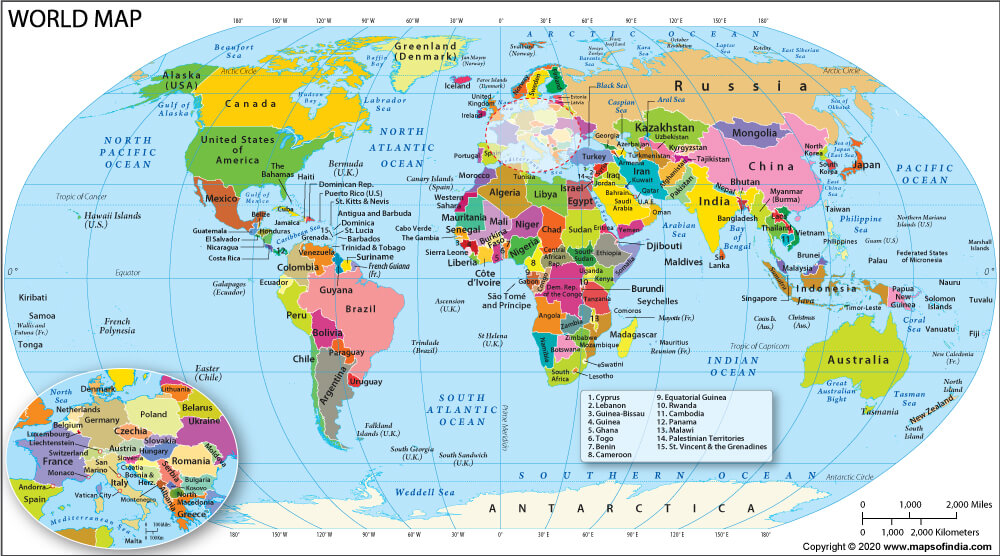
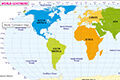
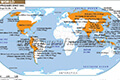
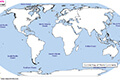
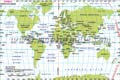
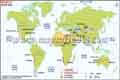
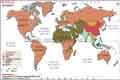
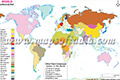
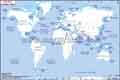
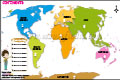
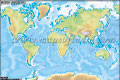
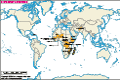
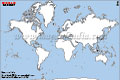
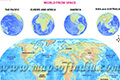
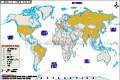
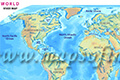
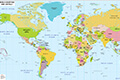
A world map is a two-dimensional representation of the Earth that shows its continents, countries, oceans, seas, and major geographical features. A world map with countries helps identify national boundaries and the relative location of countries across continents. It provides a global view of the planet and helps users understand the location and relative position of different countries, regions, landforms, and water bodies. A world map with countries shows national boundaries and countries, while a world map with continents highlights the major landmasses and their geographical relationships.
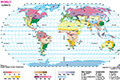
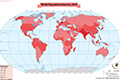
Modern world maps may also show capital cities, major cities, islands, mountain ranges, rivers, deserts, lakes, and other important geographical features. The information displayed depends on the purpose of the map. Political world maps focus on countries and boundaries, whereas physical world maps emphasize natural features and landforms. Other maps can represent specific global patterns such as climate, population, languages, elevation, or time zones.
Because the Earth is spherical, its surface must be represented on a flat map using a map projection. Different projections can affect how the size, shape, distance, or direction of geographical features appear. Understanding this is important when comparing countries and continents on a world map.
Today, digital world maps make it easier to explore countries and regions, locate geographical features, and understand the global distribution of land and water. Whether used for education, research, travel, or general reference, a world map provides an essential overview of the Earth's geography. Explore the world map to locate countries, continents, oceans, capitals, major geographical features, and their relative positions across the globe.
World Map at a Glance
| Feature | Information |
|---|
| Continents | 7 |
| Oceans | 5 |
| Largest continent | Asia |
| Largest ocean | Pacific Ocean |
| Equator | 0° latitude |
| Prime Meridian | 0° longitude |
Interactive World Map
The Interactive World Map offers an easy way to explore countries, continents, oceans, and geographical regions around the world. Unlike a static map, it allows users to interact with different parts of the map and quickly identify the location of individual countries and their surrounding regions.
Users can click on a country to explore its location and access a more detailed country map. This makes it easier to move from a global view to country-level information and understand the geographical relationship between neighbouring countries, continents, and major water bodies.
The interactive world map is useful for students, teachers, travellers, researchers, and geography enthusiasts who want to explore global geography visually. It provides a convenient way to locate countries, compare their positions, and navigate to detailed maps while gaining a better understanding of the geographic organization of the world. The interactive world map also provides a convenient starting point for exploring detailed maps of individual countries and regions.
Seven Continents of the World
A world map with continents provides a quick overview of these seven major landmasses and their relative positions. There are 7 important continents, which are listed below (Ordered from largest in size to smallest)
- Asia - Asia is the largest and most populous continent, covering about 30% of the Earth’s land area. It is home to diverse cultures, economies, and landscapes—from the Himalayas to vast deserts. Countries like India and China make it a global centre for population and economic growth.
- Africa - Africa is the second-largest continent and is known for its rich natural resources and biodiversity. It features iconic landscapes such as the Sahara Desert and the Nile River. The continent has a rapidly growing population and a deep cultural heritage.
- North America - North America includes countries like the United States, Canada, and Mexico. It is known for its advanced economies, technological development, and diverse climates ranging from Arctic cold to tropical warmth.
- South America - South America is famous for the Amazon Rainforest, the largest rainforest in the world. It also features the Andes Mountains, the longest mountain range globally. The continent is rich in biodiversity and cultural traditions.
- Antarctica - Antarctica is the coldest and least populated continent, covered almost entirely by ice. It has no permanent residents but hosts scientific research stations. It plays a crucial role in regulating Earth’s climate and sea levels.
- Europe - Europe is known for its historical significance, cultural diversity, and economic influence. It includes many developed nations such as Germany and France. The continent has played a major role in shaping global history, politics, and art.
- Oceania (Australia) - Oceania includes Australia, New Zealand, and many Pacific islands. Australia is the largest country in this region. It is known for its unique wildlife, island geography, and marine ecosystems. Oceania is a broader geographic region that includes Australia, New Zealand, and numerous Pacific islands.
Five Oceans of the World
It also portrays the important oceanic divisions on Earth, which include:
- Arctic Ocean - The Arctic Ocean is the smallest and shallowest of all oceans, located around the North Pole. It is covered with sea ice for most of the year and plays a key role in regulating Earth’s temperature. Despite its harsh conditions, it supports unique wildlife like polar bears and seals.
- Atlantic Ocean - The Atlantic Ocean is the second-largest ocean and separates the Americas from Europe and Africa. It is one of the busiest oceans for trade and transportation, with major shipping routes connecting continents. It also influences weather patterns, including hurricanes.
- Indian Ocean - The Indian Ocean is the third-largest ocean and is bordered by Asia, Africa, and Australia. It is known for its warm waters and monsoon weather systems, which significantly affect countries like India. It is also an important route for international trade.
- Pacific Ocean - The Pacific Ocean is the largest and deepest ocean on Earth, covering more than one-third of the planet’s surface. It contains thousands of islands and is home to the Mariana Trench, the deepest point on Earth. The Pacific plays a major role in global climate and marine biodiversity.
- Southern Ocean (Great Southern Ocean/Antarctic Ocean) - The Southern Ocean surrounds Antarctica and is known for its strong currents, including the Antarctic Circumpolar Current. It helps regulate global ocean circulation and climate. The region is rich in marine life such as whales, penguins, and krill.
How to Read a World Map?
Learning how to read a world map makes it easier to identify countries, continents, oceans, coordinates, distances, and geographical features. Reading a world map becomes easier when you understand its basic geographical elements and how information is represented. A world map helps you identify continents and oceans, locate places using coordinates, estimate distances, and understand how the Earth's curved surface is displayed on a flat map.
Identify Continents and Oceans
Start by locating the seven continents—Asia, Africa, Europe, North America, South America, Australia, and Antarctica—and the five oceans: Pacific, Atlantic, Indian, Southern, and Arctic. Identifying these major landmasses and water bodies provides a basic framework for understanding the location of countries and geographical regions.
Use Latitude and Longitude
Latitude and longitude form a global coordinate system used to locate places accurately on Earth. Latitude lines run east to west and measure distance north or south of the Equator, while longitude lines run from pole to pole and measure distance east or west of the Prime Meridian. Together, they help pinpoint the location of countries, cities, and other places. On a world map, latitude and longitude help users determine the precise geographic position of countries, cities, landmarks, and other locations.
Understand Scale
Map scale shows the relationship between distance on the map and the corresponding distance on the Earth's surface. A world map covers a very large area, so its scale is generally smaller than that of a city or regional map. Scale helps users estimate the distance between countries, cities, and other locations, although the accuracy of distance measurements can vary depending on the map projection.
Understand Map Projection
Since the Earth is approximately spherical while a world map is flat, map projections are used to represent the Earth's surface on a two-dimensional map. Different projections can distort the size, shape, distance, or direction of geographical features. For example, some projections make areas near the poles appear much larger than they actually are. Understanding the projection helps users interpret the appearance and relative size of countries and continents more accurately.
World Map Projections
A
world map projection is a method of representing the Earth's curved, three-dimensional surface on a flat map. Because the Earth is approximately spherical while maps are generally flat, every projection introduces some degree of distortion. No single projection can preserve area, shape, distance, and direction perfectly at the same time.
The main types of world map projections include cylindrical, conic, and azimuthal projections, along with specialized projections designed to preserve particular geographic properties. Some projections prioritize accurate area, while others are designed to preserve shape, direction, distance, or suitability for navigation. Commonly known world map projections include the Mercator, Robinson, Winkel Tripel, Mollweide, and Equal Earth projections. Learn more about the different types of world map projections and how they affect the representation of countries and continents.
Why the World Looks Different on Maps
The Earth is approximately spherical, but a map is usually displayed on a flat surface. Converting the globe into a flat map inevitably creates distortion. Depending on the projection used, countries and continents may appear different in size, shape, distance, or position. This is why the same geographical features can look noticeably different on different world maps.
For example, a projection that preserves the shape of countries may distort their area, while an equal-area projection represents the relative size of landmasses more accurately but may alter their shapes. The choice of projection therefore depends on how the map is intended to be used.
Major Types of World Map Projections
- Cylindrical Projections: The Earth's surface is projected onto a cylinder. The Mercator projection is one of the best-known examples and has historically been widely used for navigation.
- Conic Projections: The globe is projected onto a cone and is particularly useful for mapping regions at mid-latitudes.
- Azimuthal Projections: The Earth's surface is projected onto a flat plane and is commonly used for polar and hemisphere maps.
- Equal-Area Projections: These aim to preserve the relative area of countries and continents. The Equal Earth and Mollweide projections are examples.
- Compromise Projections: These attempt to provide a balanced representation by reducing overall distortion rather than perfectly preserving one geographic property. The Robinson and Winkel Tripel projections are examples.
Mercator vs Equal Earth
The Mercator projection is widely known for preserving local angles and was developed primarily for navigation. However, it significantly enlarges areas toward the poles. As a result, places such as Greenland can appear much larger relative to equatorial regions than their actual area.
The Equal Earth projection, introduced in 2018, is an equal-area projection that represents the relative size of landmasses more accurately. It preserves area but allows some distortion in shape and does not preserve every geographic property.
What Changed in 2026?
In September 2026, the United Nations General Assembly adopted a resolution titled "Correct the Map: Rebalancing Global Cartographic Representation and Promoting Equitable Representation of the World's Regions, Particularly Africa." The resolution renewed attention to how different map projections represent the relative size of countries and continents.
The resolution does not make Mercator obsolete or require it to be replaced. Mercator remains useful for specific applications, particularly navigation. Instead, the 2026 development highlights the importance of choosing a map projection according to its purpose and encourages greater awareness of how different projections represent the world. The resolution does not designate Equal Earth as a mandatory replacement for Mercator; different projections remain appropriate for different mapping purposes.
Types of World Maps
- Physical World Map
A physical world map focuses on the natural features of the Earth. They highlight landforms like mountains, plains, and plateaus, as well as bodies of water such as rivers and lakes. It often uses colours and shading to indicate elevation and terrain types, helping users understand the Earth's surface. A physical world map is particularly useful for studying mountains, rivers, deserts, and other natural formations. They are widely used in geography education, environmental studies, and outdoor planning. A physical world map helps users visualize the Earth's natural landscape without political boundaries.
- Political World Map
A world political map shows borders as well as political entities like states, cities, and nations. They frequently feature capital cities and significant urban centres and highlight the division of regions. These are frequently used for general reference and in instructional contexts. A political world map is useful for understanding international boundaries, sovereign nations, and administrative divisions and is commonly used in schools, offices, and reference publications.
- World Longitudes and Latitudes Map
It uses a coordinate system based on latitude and longitude to specify locations. This grid divides the Earth into a series of coordinates that can be used to pinpoint any place on the planet. Latitude and longitude maps are essential for navigation, aviation, maritime travel, and GPS-based location services. They also help students understand Earth's coordinate system and global positioning.
- World River Map
A world river map visually represents the major rivers and their tributaries across the globe. Rivers are crucial features on any geographic map, influencing landscapes, ecosystems, and human activities. It is essential in order to understand the global distribution of rivers and their significance. These maps also highlight important river basins that support agriculture, transportation, and freshwater resources. They are valuable for environmental studies and water resource management.
- World Weather Map
Meteorological data, such as temperature, precipitation, and atmospheric pressure, are displayed on weather maps. These are essential for understanding climate patterns and making weather forecasts. Modern weather maps also display information such as wind direction, storm systems, humidity, and cyclone movements. They are widely used by meteorologists, travellers, farmers, and disaster management agencies.
- World Historical Map
Historical maps portray geographical areas as they were at various points in history. These are valuable for understanding historical changes in borders, land use, and urban development. Researchers, historians, and educators use them to study and visualize past landscapes and political boundaries. They provide valuable insights into the evolution of civilizations, trade routes, and historical events. Comparing historical maps with modern maps helps illustrate geographical and political transformations over time.
- Blank World Map
A blank world map displays the outlines of continents and countries without labels, making it an excellent learning resource for students and educators. It is widely used for classroom activities, geography quizzes, map-labelling exercises, and competitive exam preparation. Blank world maps also help improve spatial awareness and geographical knowledge.
- Printable World Map
A printable world map is designed for easy downloading and printing in various formats and sizes. It is useful for classrooms, offices, travel planning, presentations, and educational projects. Printable maps allow users to mark routes, highlight countries, and customize maps according to their specific needs.
- World Time Zone Map
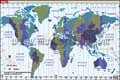
A world time zone map shows the Earth's 24 standard time zones and illustrates the time differences between different regions. It helps travellers, businesses, and international organizations coordinate activities across countries and continents. The map also highlights the International Date Line, which plays a key role in determining changes in calendar dates across the globe.
Latitude and Longitude on the World Map
The lines of latitude are parallel to one another and run horizontally across the Earth from east to west, but measure distances north or south from the Equator (0°) to the poles at 90°. Longitude lines are drawn up and down and measure distance east and west of the Prime Meridian (0°) to 180°. A coordinate pair is used to locate a specific point on Earth.
For instance, New Delhi is located at Latitude 28.6° N and Longitude 77.2° E, which is just north of the equator and well east of the Prime Meridian. At approximately 40.7° N, 74.0° W, New York City is to the north of the Equator but to the west of the Prime Meridian. These coordinates can be used to compare the relative geographic positions of places on a world map.
Explore the dedicated
Latitude and Longitude Map to access the complete interactive grid.
FAQs
Q1: Why does Greenland look so large on some world maps?
Greenland looks much larger than its actual size mainly because of the Mercator projection. This projection increasingly enlarges areas toward the North and South Poles. In reality, Greenland is much smaller than Africa.
Q2: What is the Mercator projection?
The Mercator projection is a cylindrical map projection developed by Gerardus Mercator in 1569. It preserves local angles and directions, making it particularly useful for navigation, but it significantly distorts the size of areas near the poles.
Q3: What is the Equal Earth projection?
The Equal Earth projection is an equal-area world map projection introduced in 2018. It represents countries and continents according to their relative area more accurately than projections such as Mercator, although their shapes may be somewhat distorted.
Q4: Why do world maps distort the Earth's size?
World maps distort the Earth's size because the Earth is curved while a world map is flat. Flattening the globe onto a plane inevitably causes distortions in area, shape, distance, or direction. Different projections minimize different types of distortion.
Q5: What are the seven continents?
The seven continents are Asia, Africa, North America, South America, Antarctica, Europe, and Australia. Together, they make up the world's major continental landmasses.
Q6: What are the five oceans?
The five oceans are the Pacific Ocean, Atlantic Ocean, Indian Ocean, Southern Ocean, and Arctic Ocean. The Pacific is the largest and deepest of the world's five oceans.
Q7: What is the difference between latitude and longitude?
Latitude measures how far a location is north or south of the Equator, while longitude measures how far it is east or west of the Prime Meridian. Latitude lines run east-west, while longitude lines run north-south.
Q8: Where is the Equator?
The Equator is an imaginary line at 0° latitude that circles the Earth and divides it into the Northern Hemisphere and Southern Hemisphere. It passes through parts of South America, Africa, and Southeast Asia.
Q9: Where is the Prime Meridian?
The Prime Meridian is the imaginary line at 0° longitude that divides the Earth into the Eastern Hemisphere and Western Hemisphere. It passes through Greenwich, London, and is used as the reference point for measuring longitude.
Last Updated on: September 24, 2026