

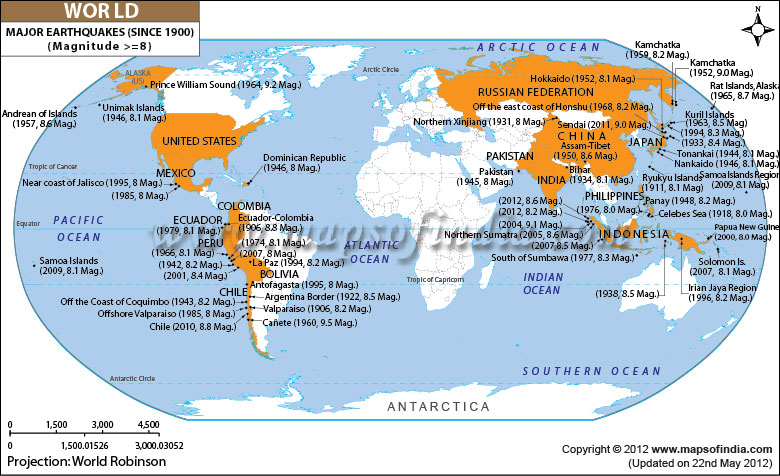





An earthquake results from a sudden release of energy that creates seismic waves, causing the ground to shake, even violently in some cases, and can potentially lead to damage to structures, landscapes, as well as human settlements. There are typically four major types involved, which include tectonic, volcanic, collapse, and human-induced earthquakes. Human-induced earthquakes can be generally caused by activities such as mining, reservoir impoundment (large dams), geothermal energy projects, wastewater injection, and oil and gas extraction. These are often characterized by the effects inflicted by them, which consist of ground shaking and tremors; structural damages; landslides, rockfalls, and soil liquefaction; tsunamis; fire outbreaks; and gas leaks.
These events can have long lasting socioeconomic impacts on any region. A large number of people are often displaced from their homes and are forced to migrate away from their native places in search of shelter. Accompanied with this are the feelings of stress as well as psychological trauma in the face of the loss of loved ones. Thus, earthquakes and shifting of tectonic plates can be connected to the formation of new landforms; similarly, they can also be linked to large destructive activities. Hence, there is a need to take in both aspects to develop an understanding of the nature of the concerned phenomenon.
Geological Understanding
Earth’s crust is divided into moving plates called tectonic plates. Faults are fractures in the Earth's crust along which rocks move, and most earthquakes occur when movement takes place along these faults. Earth’s mantle is the layer beneath the crust, driving plate movement. Seismic waves are vibrations that travel through the Earth's interior and along its surface, generated by the sudden release of energy during an earthquake.
In the construction of geological concepts, three key theories have been explored by geologists. These include the elastic rebound theory (introduced by Harry Fielding Reid), the plate boundary theory, and the stress accumulation theory. According to the first theory, Earth’s crust stores energy, which is released, causing the subsequent vibrations. On the other hand, the Plate Boundary Theory says most earthquakes occur at plate boundaries, although some also occur within tectonic plates (intraplate earthquakes). In slight contrast, the Stress Accumulation Theory advocates that the built up stress is released during earthquakes.
Major Earthquakes of the World
The Great Chilean Earthquake (May 22, 1960) is known to be the largest recorded earthquake in history. The magnitude was calculated to reach an alarming value of 9.5 on the Richter Scale. The shockwaves triggered a tsunami that traveled across the Pacific Ocean, thereby impacting many countries that fell in its course.
Another deadly occurrence was recorded off the coast of Sumatra on 26 December 2004. The magnitude was recorded to reach a value of 9.1–9.3 on the Moment Magnitude Scale (Mw). The tsunami that followed caused large-scale destruction of property and loss of life in Thailand, Sri Lanka, India, and other countries located in close proximity to the Indian Ocean.
The San Francisco earthquake that was triggered in 1906, culminated in the burning of almost 80% of the city, which left thousands of people homeless. This acted as a wake call for the authorities, as post-the event, following subsequent fires, there were significant changes in building codes and emergency preparedness.
The Shaanxi Province was no differently affected as the sudden destruction, landslides, and flooding set in. Named the North China Earthquake, which set in on January 23, 1556, it triggered a chain of events that eventually led to the death of approximately 830,000 people. Its exact magnitude remains unknown because the earthquake occurred before modern seismic instruments existed.
Japan, or “the land of rising sun,” also experienced the phenomenon on the 11th of March, 2011. The intensity on the Moment Magnitude Scale (Mw) was estimated to be 9.1, and its epicenter was concentrated off the coast of Tohoku, Japan. The earthquake as well as the tsunami that ensued led to a nuclear meltdown at Fukushima Daiichi. The earthquake and tsunami led to nearly 19,700 deaths and missing persons.
These are some of the major earthquakes with a recorded magnitude near 9.0 or 8.0 on the Richter scale, many of which can be located on a world map to understand their global distribution and tectonic settings. Yet these are not the only ones to have affected human life or the natural resources. Instead, there are several other earthquakes, such as the Mexico City earthquake, the Great Kanto earthquake, and the Haiti earthquake, which are attributed to be the deadliest earthquakes of all time.
Seismographs and accelerometers stood as the primary resources for the detection of the vigorous shaking of the ground. These were used in the early times, but the advancement of technology has revolutionized the detection of natural disasters, which might not aid in their prevention, but it can definitely aid in the minimization of risks.
Seismic monitoring networks have been brought to use, detect earthquakes immediately after they begin and can provide early warnings that give people seconds to tens of seconds of notice before strong shaking reaches them, depending on their distance from the epicenter. These are often integrated together with early warning systems that can signal people living close to the epicenter. In addition to this, the advent of smartphones has also made it easier to convey or broadcast emergency information. In the digitalized era, ground motion sensors have also come into existence, which can prove to be handy in detecting seismic activities.
Yet following the detection, people need to be wary of their surroundings in order to ensure safety. During an earthquake, people should "Drop, Cover, and Hold On" instead of immediately evacuating a building. Once the shaking stops, they should move to an open area if the building is unsafe. Essential phone numbers and a medical kit must be kept in handy in case of emergencies. One must remain calm and should follow the instructions provided by the authorities.
- The Earth’s crust is composed of 7 major and numerous minor tectonic places, upon which the landmasses as well as the ocean beds float. It is due to the collision and irregular movement of these plates which led to earthquakes.
- Japan experiences more than 1,500 felt earthquakes every year.
- The location of the Philippines in the Pacific Ring of Fire makes it vulnerable to occurrences of earthquakes.
- The deadliest recorded earthquake in history occurred in China in the year 1556. This led to the deaths of approximately 830,000 people.
- Earthquakes are also known to be the chief causes behind the occurrence of volcanic eruptions. Earthquakes do not generally cause volcanic eruptions; instead, both earthquakes and volcanic eruptions are often driven by the movement of tectonic plates and magma beneath the Earth's surface.
- The action of these phenomena can lead to the formation of new landforms, such as mountains.
- The deepest earthquake ever recorded occurred at a depth of nearly 700 km.
- An estimate by scientists and researchers worldwide reveals that a total of 50-100 earthquakes take place every day.
- Methane and other gases are released in response to the vigorous movements of the tectonic plates. Small amounts of gases such as methane may occasionally be released through faults after some earthquakes, but this is not a universal characteristic of all earthquakes.
- The Moment Magnitude Scale (Mw) is now the standard scale used to measure the magnitude of earthquakes. Although the Richter Scale is still widely used informally, it does not have a fixed range from 1 to 10.
FAQs
Q1: What causes earthquakes?
Earthquakes are primarily caused by the sudden movement of tectonic plates along faults in the Earth's crust. This movement releases energy in the form of seismic waves, which causes the ground to shake.
Q2: Which was the strongest earthquake ever recorded?
The Great Chilean Earthquake of 22 May 1960 is the strongest earthquake ever recorded. It measured 9.5 on the Moment Magnitude Scale (Mw).
Q3: What is the difference between the Richter Scale and the Moment Magnitude Scale (Mw)?
The Richter Scale was developed to measure smaller earthquakes and is now used mainly for historical reference. Today, scientists primarily use the Moment Magnitude Scale (Mw) because it provides more accurate measurements for earthquakes of all sizes.
Q4: What should you do during an earthquake?
If you are indoors, follow the "Drop, Cover, and Hold On" method. Stay away from windows and heavy objects, and move to an open area only after the shaking has stopped if the building is unsafe.
Q5: Which countries are most prone to earthquakes?
Countries such as Japan, Indonesia, the Philippines, Chile, Mexico, New Zealand, Turkey, Nepal, and parts of the United States are among the most earthquake-prone due to their location near tectonic plate boundaries.
Q6: How can a world map of major earthquakes help?
A world map of major earthquakes helps users identify earthquake-prone regions, understand the distribution of significant earthquakes, and observe their relationship with tectonic plate boundaries around the world.
Q7: What is the epicenter of an earthquake?
The epicenter of an earthquake is the point on the Earth’s surface that lies directly above the point where the quake originated.
Last Updated on : July 03, 2026


