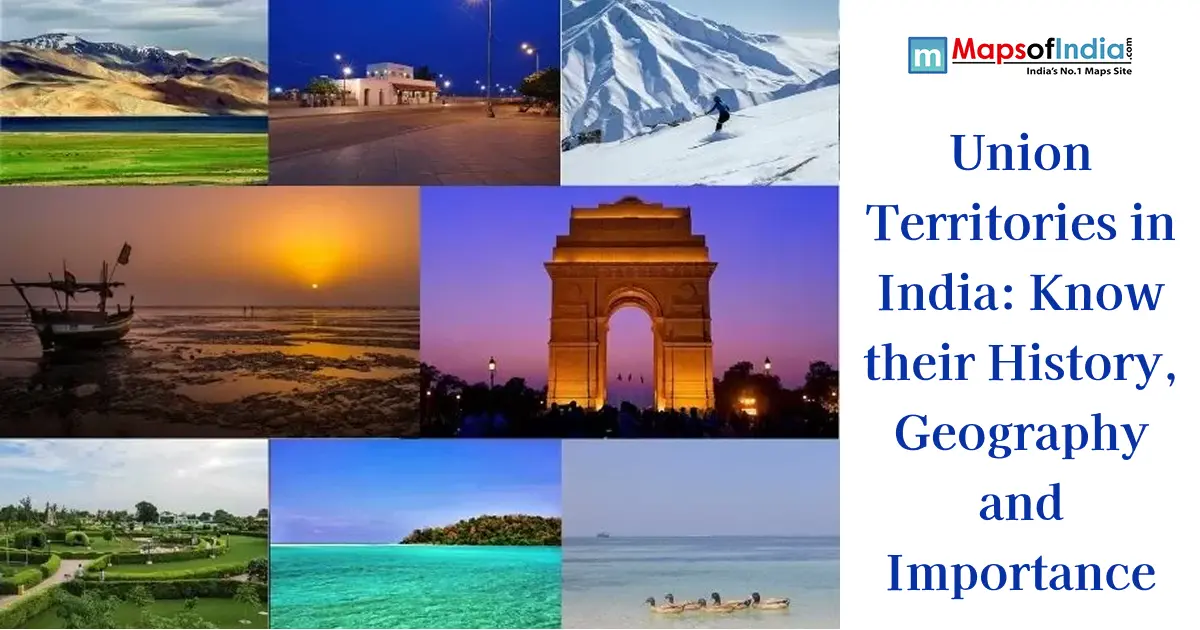
India is divided into 28 states and 8 Union Territories, each with its own unique identity and administrative structure. Unlike states, Union Territories are governed directly by the Central Government, although some have elected legislatures with limited powers. Spread across the mainland and islands, these territories are known for their strategic importance, rich cultural heritage, natural beauty, and economic significance. From the national capital of Delhi to the tropical islands of Lakshadweep and the Andaman and Nicobar Islands, each Union Territory plays a vital role in India's governance, tourism, and development.
Andaman & Nicobar Islands
Far out in the Bay of Bengal lies a cluster of islands, separate from India's mainland, which make up the Andaman and Nicobar group. Made up of 572 individual landmasses, just 38 host human settlements. The administrative centre is Port Blair. Facing the shoreline, untouched coastlines extend out; below the surface, coral reefs flourish with a diversity of life. These islands were once under British rule and had a prison of the dreaded Cellular Jail. Behind strong walls, a home to the rebellious. Unique tribesman that have inhabited the area long before maps were drawn. The language is heard in sheltered forests; it is not heard anywhere else. Standing still on the important sea routes, her eyes were carefully scrutinised by the military. Not only palm trees and waves, but a silent sentinel at India's far end.
Chandigarh
Having neither state nor another, Chandigarh is a city all its own. Constructed in the 1950s under the direction of Le Corbusier, its buildings are clean, its streets are wide, and nature is in open spaces. Sectors partition the land into sections which contain parks, water bodies, attractions like the Rock Garden, Sukhna Lake, etc. Life is good, schools are good, hospitals are good. This place embodies this postIndependence dream in a tangible manner, subtly strong.
Dadra and Nagar Haveli and Daman and Diu
Earlier, Dadra and Nagar Haveli and Daman and Diu were two separate Union Territories. Today, they have been merged into one Union Territory. Maharashtra lies close by, and the western coasts rub shoulders with Gujarat. Colonial influences can still be heard, which have been left by centuries of rule from Lisbon. The beaches lie peacefully in Daman and Diu, flanked by a stone-built church from an earlier age. Dadar and Nagar Haveli have dense tree cover with green vegetation underneath, inhabited by forest-rooted communities. The movement accelerates here, and small factories are built up alongside an increase in travellers' interest. A haven where the muffled cousin of Goa resides, pieced together from memory, soil, and sea.
Delhi - National Capital Territory
Delhi, also called the National Capital Territory of India, is located on the border of the northern part of the country, where power and history converge. Once, rulers used to hold court here, first the Mughals, and later colonial rulers. Some of the lanes are old giants who watch the Red Fort silently; Qutub Minar stands high, and Humayun's Tomb is underneath green shade. Currently, the roads are wide, with vehicles cruising through the city, and the nearby streets are narrow, with rickshaws gliding down them. Older lives in the modern rush. Every morning, decisions cascade from here all around the country. Old stories and choices intertwine here.
Jammu and Kashmir
North of India, Jammu and Kashmir turned into a Union Territory when Article 370 was removed in 2019. It links two countries, Pakistan and China and is located at the border of the two countries. The mountains are steep, and there are numerous lakes, gardens and floating houses in the valleys here. In the south, instead of snowy peaks, beautiful ancient temples are attracting tourists all year round. This is a land that is on our doorstep and has a powerful influence well beyond the region. Not only beauty in all the valleys, but also the power that is humming under old traditions.
Ladakh
Ladakh is a Union Territory, situated at a high elevation in the Northern part of the Himalayas. The peaceful area is dotted with old stone-built monasteries that monks walk through on rocky cliff sides. It is bordered by China on the east, and contains two main hubs, Leh on the east and Kargil on the west. Long trails suitable for hiking trips that meander over rough terrain attract adventure travellers. Photographers come to the site to capture the still moments because light hits the sharp ridges just at dawn or dusk. Cyclists ride on narrow passes well out of the way of other roads. Its unique feature is the untouched nature of its landscape, combined with its Buddhist traditions.
Lakshadweep
Lakshadweep is the smallest Union Territory of India, located in the Arabian Sea off the coast of Kerala. The group consists of 36 coral islands, but only 11 are inhabited. Much of what you see here is white sands and clear waters. Under the water, coral structures grow, and abundant marine life flourishes. The environment is sensitive, and access to visitors is regulated. The majority live there and practice Islam, creating a culture of their own. Few are aware of it, a little island no one visits.
Puducherry
Pondicherry, as it was known before its name was changed after Independence, is located on its southeast coastline. Despite its small size, it is divided into four separate units: Puducherry, Karaikal, Mahe and Yanam, all of which are enclosed within different states. Old French heritage permeates throughout, recognised in architecture, cuisine, and long streets with trees. Auroville is quietly emerging from the background, where they are striving to build it for those who seek inner discovery. Picture a land where the temple sounds mingle with the shutout windows of cafés.
Importance of Union Territories
Despite being a small number, India's Union Territories have a lot of value in terms of culture, economy, defence, etc. Some defend the sea fronts, which extend deep into the sea lands formed by the tides and reefs. The country's capital is nestled among them, leading with steering laws and policies from its central position. There are high, cold deserts alongside strips of coastal land where tropical life prevails. Old towns tell tales under foreign rule, which are now incorporated into modern times. Growth flows through these lands without eroding the differences in each land. They are unique in so many ways, and they form the larger picture in subtle ways. Their presence brings dimensions not just space, but also dimensions to India.