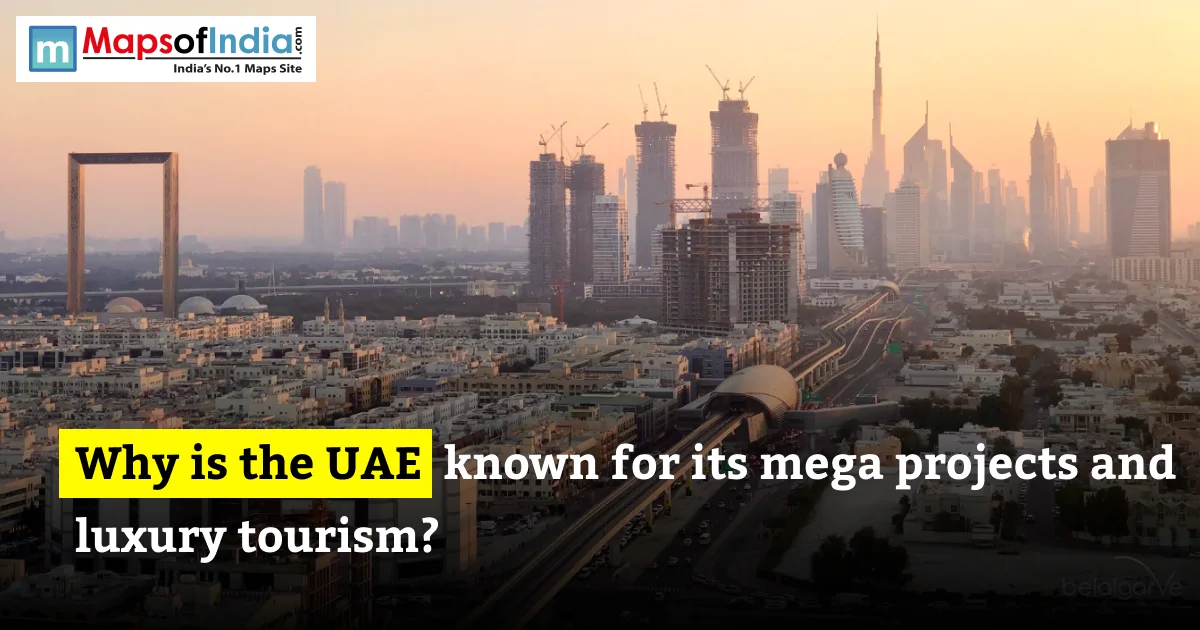
The United Arab Emirates built its reputation on three things working together: a deliberate push to diversify away from oil, decades of genuinely long-term government vision, and a location that sits perfectly between East and West. Add all three up, and you get a country that turned a handful of desert trading posts into one of the world's biggest hubs for UAE mega projects and luxury tourism in the UAE. Here's how that actually happened.
UAE's Transformation
Fifty years ago, Dubai was a modest port town built around the pearling and trading industry. Today, non-oil activities make up 79.4% of the UAE's entire GDP, as of the first quarter of 2026 alone. That's not a small shift. That's a country that rebuilt its entire economic identity from scratch, and did it on purpose.
The Economic Reasons Behind UAE's Mega Projects
Diversifying Away from Oil Dependency
Oil built the UAE. It no longer defines it. Non-oil GDP share climbed from 78.0% in 2025 to 79.4% in Q1 2026, and the country's central bank expects real GDP growth to accelerate to 5.4% in 2026. That kind of shift doesn't happen by accident. It happens because leadership decided, decades ago, that oil wouldn't last forever, and started building alternatives while the money was still flowing.
Government Vision (UAE Vision 2031, Dubai Plans)
The UAE's current roadmap, officially called "We the UAE 2031," sets genuinely ambitious targets. Double the national GDP to AED 3 trillion. Double annual tourist numbers to 40 million. Push non-oil exports toward AED 800 billion. Grow tourism's own GDP contribution to AED 450 billion. These aren't vague aspirations. They're specific, numbered targets with a clear deadline attached.
Attracting Foreign Investment & Free Zones
Free zones let foreign companies operate in the UAE with full ownership and major tax advantages, and they've become a genuine magnet for international business. That framework, paired with political stability rare in the wider region, is a huge part of why global companies keep choosing Dubai and Abu Dhabi as regional headquarters.
Strategic Geography and Global Connectivity
Location Between East and West
The UAE sits almost perfectly between Europe, Asia, and Africa, within an eight-hour flight of roughly two-thirds of the world's population. That's not a coincidence the tourism industry stumbled into. It's exactly why the country built its entire aviation and logistics strategy around being the world's stopover point.
World-Class Aviation Hubs (Dubai & Abu Dhabi Airports)
Emirates and Etihad Airways turned Dubai and Abu Dhabi into two of the busiest connecting hubs on Earth. Millions of passengers pass through these airports every year without ever leaving the terminal, and a meaningful share of those transit passengers turn into actual tourists once they see what's waiting outside.
Iconic Mega Projects That Define the UAE
Burj Khalifa — World's Tallest Building
Standing at 828 metres, the Burj Khalifa has held the title of the world's tallest building since it opened in 2010. It remains the single most recognizable symbol of the UAE's entire mega-project era.
Palm Jumeirah & The World Islands
The artificial palm-shaped island Palm Jumeirah, which was completed in the mid-2000s, set a new standard for how coasts can be developed. The idea was pushed to the extreme with the development of the World Islands, a group of man-made islands in the shape of a map of the world, some of which are still undeveloped today.
Museum of the Future
Tucked behind the Dubai Marina Water Tower, this torus-shaped building, covered in Arabic calligraphy, is one of the most photographed buildings in Dubai and was designed with the aim of showcasing emerging technology and future-oriented design.
Expo City Dubai
Built on the site of Expo 2020, this district was designed from the start to outlive the exhibition itself, transitioning into a permanent mixed-use community rather than sitting empty once the crowds left.
Upcoming Projects (Dubai Creek Tower and Beyond)
Dubai Creek Tower has had a genuinely complicated history. Originally announced to surpass the Burj Khalifa entirely, the project has been redesigned more than once, paused during the pandemic, and revived again with a new construction tender issued in early 2026. The current version is expected to stand shorter than the Burj Khalifa, deliberately moving away from the height-record narrative toward architectural experience instead. Full completion isn't expected before 2030.
UAE's Landmark Mega Projects
Project | Location | Year Completed/Planned | Significance |
| Burj Khalifa | Dubai | 2010 | World's tallest building |
| Palm Jumeirah | Dubai | Mid-2000s | Iconic artificial island |
| Museum of the Future | Dubai | 2022 | Landmark futuristic architecture |
| Expo City Dubai | Dubai | 2022 onward | Post-Expo permanent district |
| Dubai Creek Tower | Dubai | Post-2030 (est.) | Redesigned observation landmark |
Why Luxury Tourism Thrives in the UAE?
Tax-Free Shopping & Duty-Free Zones
No personal income tax and extensive duty-free shopping give the UAE a genuine edge over higher-tax destinations, particularly for high-spending international visitors.
Ultra-Luxury Hospitality (Burj Al Arab, Atlantis, Private Islands)
The Burj Al Arab, often unofficially called the world's only "seven-star" hotel, set the tone for the entire industry when it opened in 1999. Atlantis The Palm and a growing list of private-island resorts have kept pushing that same ultra-luxury standard even higher since.
Safety, Stability, and Ease of Travel
The UAE consistently ranks among the safer, more politically stable destinations in its wider region, which matters enormously for a luxury traveller deciding where to spend serious money.
World-Class Events (Expo, F1, Art Dubai, Dubai Shopping Festival)
Formula 1 races, Art Dubai, the Dubai Shopping Festival, and the legacy of Expo 2020 all give the country a packed annual events calendar, giving travellers a reason to visit beyond just the skyline.
The Role of Government Vision & Leadership
None of this happened without deliberate, long-term leadership. Sheikh Zayed bin Sultan Al Nahyan, the UAE's founding president, pushed early oil wealth into infrastructure and education rather than short-term consumption. Sheikh Mohammed bin Rashid Al Maktoum, Dubai's ruler, has continued that same long-horizon thinking, championing projects like the Burj Khalifa and Dubai's aviation strategy well before most of the world saw the payoff coming.
Criticism and Challenges
Sustainability Concerns
Mega projects built on reclaimed land and powered by heavy air conditioning use are genuinely energy and resource-intensive, and the UAE's own sustainability commitments are still working to catch up with the scale of what's already been built.
Labour Practices in Construction
International human rights organizations have repeatedly raised concerns about migrant worker conditions on UAE construction sites, including long hours and restrictive sponsorship arrangements. The UAE has introduced reforms in recent years, including wage protection systems, but labour conditions remain a genuine, ongoing point of criticism, not a fully resolved issue.
Conclusion
The UAE didn't stumble into luxury tourism or its skyline full of record-breaking towers. It built both, deliberately, as part of a decades-long strategy to survive life after oil. Vision, geography, and genuinely long-term leadership all had to line up for it to work, and by most current economic measures, it's working better than ever. Whether that growth stays sustainable, and whether labour conditions genuinely improve alongside it, remain the real open questions for the UAE's next chapter.
FAQs
Why is Dubai famous for luxury?
Dubai built its luxury reputation through tax-free shopping, ultra-high-end hotels like the Burj Al Arab, iconic architecture like the Burj Khalifa, and a deliberate government strategy to position the city as a premier global destination.
What is the UAE's most famous mega project?
The Burj Khalifa, the world's tallest building at 828 metres, remains the single most recognisable UAE mega project globally.
How did the UAE become rich beyond oil?
Through deliberate economic diversification, building free zones, aviation hubs, tourism infrastructure, and finance and logistics sectors that now account for 79.4% of the country's total GDP.
Is UAE tourism only for luxury travellers?
No. While luxury tourism defines much of the UAE's global image, the country also offers a wide range of mid-range hotels, cultural attractions, and desert experiences accessible to a much broader range of travellers.
What is the UAE's Vision 2031?
Officially called "We the UAE 2031," it's the country's national economic roadmap, targeting a doubling of GDP to AED 3 trillion, doubling annual tourists to 40 million, and growing tourism's own GDP contribution to AED 450 billion.
How many tourists visit the UAE each year?
The UAE has set a Vision 2031 target of doubling annual tourist arrivals to 40 million, building on already strong existing visitor numbers driven largely by Dubai and Abu Dhabi.
What role does Emirates Airline play in UAE tourism?
Emirates, alongside Etihad Airways, turned Dubai and Abu Dhabi into major global connecting hubs, funnelling millions of transit passengers annually, many of whom go on to become actual tourists once they experience the destination.
Is the UAE's mega-project boom sustainable long-term?
That remains genuinely debated. Economic diversification metrics look strong, but sustainability concerns around resource use and ongoing criticism of labour practices in construction suggest the growth model still has real challenges left to solve.