Several countries operate with more than one capital city. Bolivia, the Netherlands, Sri Lanka, Malaysia, and Burundi all split capital functions across two cities. South Africa goes even further, running three. This arrangement usually divides legislative, judicial, and administrative power across different places, instead of stacking it all in one. Let's look at exactly how, and why.
List of Countries With Multiple Capitals
- Bolivia → Sucre (constitutional) and La Paz (seat of government)
- Netherlands → Amsterdam (constitutional) and The Hague (government seat)
- Sri Lanka → Colombo (commercial) and Sri Jayawardenepura Kotte (administrative)
- Malaysia → Kuala Lumpur (constitutional/economic) and Putrajaya (administrative)
- South Africa → Pretoria, Cape Town, and Bloemfontein, three capitals in one country
- Burundi → Bujumbura (economic) and Gitega (political)
- Eswatini → Mbabane (administrative) and Lobamba (royal/legislative)
- Côte d'Ivoire → Abidjan (economic) and Yamoussoukro (political)
Why Do Some Countries Have More Than One Capital?
A few recurring reasons show up again and again. Political compromise, first. Splitting power across cities can ease tension between regions or ethnic groups who'd otherwise fight over which city gets the crown. Colonial history plays a role too, since some capitals were inherited from a colonial administration and never fully replaced, just supplemented. Decentralization matters as well. Spreading government functions physically apart can genuinely limit how much power concentrates in one single place. And sometimes it's just practical. A commercial hub and a government seat don't always want to be the same overcrowded city.
Countries With Two Capitals
Bolivia — Sucre (Constitutional) and La Paz (Seat of Government)
Sucre holds the official constitutional title, and it's home to Bolivia's judiciary. La Paz, the country's third-largest city, actually houses the executive and legislative branches. So even though Sucre is "the" capital on paper, La Paz runs the day-to-day government.
Netherlands — Amsterdam (Constitutional) and The Hague (Government Seat)
Amsterdam holds the constitutional title. But parliament, the Supreme Court, and the royal residence all sit in The Hague instead. Most foreign embassies are based there too, not in Amsterdam.
Sri Lanka — Colombo and Sri Jayawardenepura Kotte
Colombo is Sri Lanka's largest city and commercial engine. Sri Jayawardenepura Kotte, a suburb of Colombo, holds the official title of administrative capital and seat of government.
Malaysia — Kuala Lumpur and Putrajaya
Kuala Lumpur remains Malaysia's constitutional, economic, and ceremonial capital. Putrajaya, a purpose-built city, took over as the administrative seat of government back in the 1990s, specifically to ease congestion in KL.
Others (Burundi, Czechia's Edge Case, Côte d'Ivoire, Eswatini)
Burundi split its capital in 2019, keeping Bujumbura as the economic hub while shifting political functions to Gitega. Côte d'Ivoire follows a similar pattern: Abidjan for commerce, Yamoussoukro for politics. Eswatini splits things by role too: Mbabane handles administration, while Lobamba, the royal and legislative capital, is home to the king. Czechia is more of a borderline case. Prague remains the clear, singular capital, but Brno hosts the country's Supreme Court, a partial split that doesn't quite rise to a full dual-capital system.
Countries With Three Capitals
South Africa — Pretoria, Cape Town, Bloemfontein
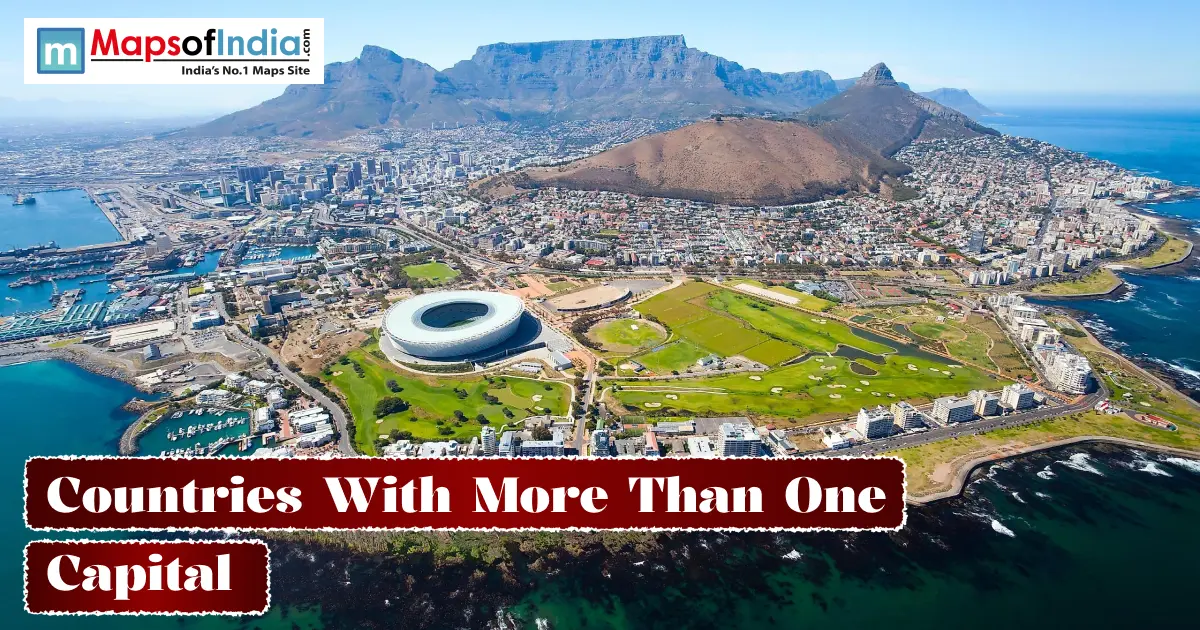
South Africa is the standout example here, splitting government three ways. Pretoria hosts the executive branch. Cape Town holds parliament, making it the legislative capital. Bloemfontein serves as the judicial capital, home to the Supreme Court of Appeal. The arrangement traces back to a political compromise struck when the country unified in 1910, balancing power between rival regions rather than picking one outright winner.
Full Comparison Table
Country | Capital(s) | Function of Each | Reason for Split |
| Bolivia | Sucre / La Paz | Constitutional & judicial / Executive & legislative | Historical compromise |
| Netherlands | Amsterdam / The Hague | Constitutional / Government seat, courts | Historical tradition |
| Sri Lanka | Colombo / Sri Jayawardenepura Kotte | Commercial / Administrative | Decongestion, planning |
| Malaysia | Kuala Lumpur / Putrajaya | Constitutional, economic / Administrative | Decongestion |
| South Africa | Pretoria / Cape Town / Bloemfontein | Executive / Legislative / Judicial | Regional political compromise |
| Burundi | Bujumbura / Gitega | Economic / Political | Decentralization |
| Eswatini | Mbabane / Lobamba | Administrative / Royal, legislative | Traditional monarchy structure |
| Côte d'Ivoire | Abidjan / Yamoussoukro | Economic / Political | Political symbolism |
Historical Examples of Countries That Once Had Multiple Capitals
Pakistan briefly ran a split arrangement before 1971, with East Pakistan and West Pakistan functioning almost as two separate political centres, before East Pakistan became independent Bangladesh. Norway shifted its government functions temporarily during the 1940 German invasion, relocating operations away from Oslo as a wartime emergency measure. These weren't permanent dual-capital systems, more like temporary or transitional splits, but they show the same underlying idea: capital status can move when circumstances demand it.
Administrative vs Legislative vs Judicial Capital
An administrative capital houses the executive branch, the president or prime minister's offices, and the day-to-day machinery of government. A legislative capital is where parliament actually sits and votes on laws. A judicial capital hosts the highest courts, like South Africa's Bloemfontein. Most countries stack all three functions in one city. The countries on this list deliberately don't.
Conclusion
Splitting a capital isn't a quirk. It's usually a deliberate answer to a real problem, regional rivalry, colonial leftovers, overcrowding, or a genuine effort to spread power around rather than concentrate it. South Africa's three-way split remains the most extreme example, but Bolivia, the Netherlands, Malaysia, and several others all show the same basic instinct at a smaller scale. One city, it turns out, doesn't always have to do all the work.
FAQs
How many countries have more than one capital?
Around eight to ten countries currently maintain a genuine multi-capital arrangement, depending on how strictly you define the split, with South Africa, Bolivia, the Netherlands, Sri Lanka, and Malaysia forming the most commonly cited core group.
Which country has three capitals?
South Africa, which has its government offices in three separate cities: Pretoria (executive), Cape Town (legislative) and Bloemfontein (judicial).
Which of the cities, Amsterdam and The Hague, is the true capital of the Netherlands?
The official constitutional title is Amsterdam. The Hague, however, is where parliament, the Supreme Court and most foreign embassies are in fact located, and so it is the real seat of government.
Why did apartheid divide South Africa's capital into three cities?
It can be traced back to a political compromise that was made at the time of the unification of the country in 1910, where they were deliberately spread out by dividing the power between competing regions instead of focusing it in one place.
Which country recently moved or added a new capital?
Equatorial Guinea officially relocated its capital from Malabo to Ciudad de la Paz on 2 January 2026. Indonesia is also mid-transition, building a new capital called Nusantara, though Jakarta legally remains the capital until a formal presidential decree completes the transfer.
Does having multiple capitals cause administrative problems?
It can. Splitting government functions across cities often means officials and diplomats travel more, and coordination between branches can get logistically messier than having everything in one place.
Is Putrajaya replacing Kuala Lumpur as Malaysia's capital?
No, not fully. Putrajaya took over as the administrative seat of government, but Kuala Lumpur remains Malaysia's official constitutional, economic, and ceremonial capital.
Are there countries where the capital city is disputed or unclear?
Yes. Jerusalem is the most politically sensitive example, claimed as the capital by both Israel and the Palestinian Authority, with sovereignty over the city remaining internationally disputed.