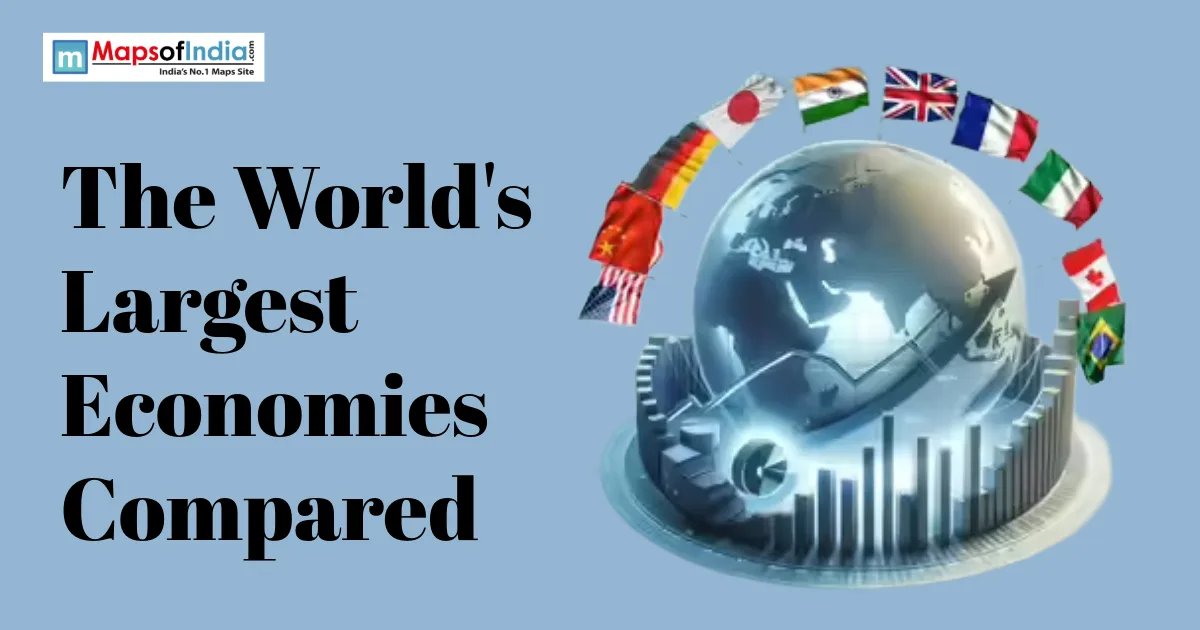
In 2026, the five largest economies by nominal GDP are the United States, China, Germany, Japan and India. The ranking reflects the great size of economic activities, trade and production between countries. Let's look in detail at these ten economies, compare them and understand that there is a difference between their nominal GDP and their GDP in purchasing power parities, see which are the fastest-growing economies, and finally see a bit why total size is not always the most telling indicator.
What are the World's Largest Economies in 2026?
The ranking is based on the latest data from the International Monetary Fund (IMF) and World Bank data for 2026.
Rank | Country | Nominal GDP (USD Trillion) | GDP per Capita (USD) | Growth Rate (%) |
| 1 | United States | 28.78 | 85,200 | 2.4 |
| 2 | China | 19.45 | 13,800 | 4.6 |
| 3 | Germany | 4.92 | 58,900 | 1.8 |
| 4 | Japan | 4.31 | 34,800 | 1.5 |
| 5 | India | 4.11 | 2,850 | 6.8 |
| 6 | United Kingdom | 3.58 | 52,300 | 1.9 |
| 7 | France | 3.25 | 49,700 | 1.7 |
| 8 | Italy | 2.28 | 38,900 | 1.2 |
| 9 | Brazil | 2.15 | 9,800 | 2.9 |
| 10 | Canada | 2.14 | 53,200 | 1.6 |
Nominal GDP vs PPP GDP - What's the Difference?
What is Nominal GDP?
Nominal GDP is calculated by the total value of goods and services produced in a country at current market prices. It is a measure in local currency and, according to the size of the economy, uses conversion rates between currencies.
What is PPP (Purchasing Power Parity)?
PPP means purchasing power parity. By taking into account the different prices in different countries, the GDP is measured.
Why the Rankings Change Depending on the Metric?
In reality, with GDP measured at PPP, it is China that is the biggest economy in the world, not the USA. The same applies in India as well; they have the highest GDP growth in PPP terms. Put another way, nominal GDP is a more accurate indicator of wealth in developed countries, and purchasing power is greater in developing countries.
Top 10 Largest Economies by Nominal GDP
1. United States
Nominal GDP: $28.78 trillion | GDP per capita: $85,200 | Growth Rate: 2.4%
The American economy is still the largest in the world because of its technological advancements, huge consumer base and financial, entertainment and innovation dominance.
2. China
Nominal GDP: $19.45 trillion | GDP per capita: $13,800 | Growth Rate: 4.6%
Even though the property sector in China has faced a number of challenges, the country's massive manufacturing output, infrastructure development and robust export economy give it the second position.
3. Germany
Nominal GDP: $4.92 trillion | GDP per capita: $58,900 | Growth Rate: 1.8%
Europe's largest economy is third in the world for engineering prowess, automotive manufacturing and exports of high-quality machinery and chemicals.
4. Japan
Nominal GDP: $4.31 trillion | GDP per capita: $34,800 | Growth Rate: 1.5%
Despite its demographic problems, Japan still holds onto its position by way of advanced technology, robotics, automobiles and high skill levels.
5. India
Nominal GDP: $4.11 trillion | GDP per capita: $2,850 | Growth Rate: 6.8%
India is now in the top five due to its solid manufacturing and services growth, digital economy development, and domestic consumption.
6. United Kingdom
Nominal GDP: $3.58 trillion | GDP per capita: $52,300 | Growth Rate: 1.9%
The UK is a financial hub of the world, with London and has a thriving creative sector.
7. France
Nominal GDP: $3.25 trillion | GDP per capita: $49,700 | Growth Rate: 1.7%
France is a leader in luxury goods, aerospace, tourism and agriculture.
8. Italy
Nominal GDP: $2.28 trillion | GDP per capita: $38,900 | Growth Rate: 1.2%
Italy is high ranking because of its manufacturing, fashion and tourism industries.
9. Brazil
Nominal GDP: $2.15 trillion | GDP per capita: $9,800 | Growth Rate: 2.9%
Brazil is the largest agricultural country and also the richest in natural resources in South America.
10. Canada
Nominal GDP: $2.14 trillion | GDP per capita: $53,200 | Growth Rate: 1.6%
Canada is blessed with abundant natural resources, energy exports and a stable economy.
Top 10 Largest Economies by PPP (Purchasing Power Parity)
Rank | Country | PPP GDP (USD Trillion) | Key Reason for Ranking |
| 1 | China | 35.2 | Massive domestic market and lower costs |
| 2 | United States | 28.78 | High productivity and strong currency |
| 3 | India | 14.8 | Large population and growing consumption |
| 4 | Japan | 6.1 | An advanced economy with high efficiency |
| 5 | Germany | 5.9 | Strong industrial base |
| 6 | Russia | 5.1 | Energy and resource wealth |
| 7 | Indonesia | 4.9 | Rapidly growing emerging market |
| 8 | Brazil | 4.3 | Natural resources and agriculture |
| 9 | France | 4.1 | A diverse and developed economy |
| 10 | United Kingdom | 3.9 | Services and finance hub |
Fastest-Growing Major Economies in 2026
As stated above, the overall economy of China is the largest. However, when it comes to economic growth, China only takes second place after India. According to the forecast, India's GDP will grow by 6.8% in 2026. This is because of a high percentage of domestic consumption and an increase in the population. The other developing countries like Indonesia, Turkey and Vietnam also have the growth rate exceeding 5% GDP.
In turn, the developed world (except the UK) is growing more slowly in its own economies. The economy of the United States, for example, is expected to grow by only 2.4% in 2026. Germany is also projected to expand by just 1.8%, as will France.
Which Continent Has the Strongest Economies?
Asia's Economic Powerhouses
The region of the world has the largest share of the world's economies. They are mostly from developing countries (with the exception of Japan and South Korea).
Europe's Largest Economies
There are fewer countries in Europe than in Asia with large economies, and they all have one thing in common - luxury goods.
The Americas
The economies of the countries in this region differ significantly, from the most developed, the United States, to developing countries such as Mexico and Brazil.
Africa's Emerging Economies
This is the area where the largest number of developing economies are found. There are also nations that have developed ones such as Nigeria, Egypt and South Africa.
GDP Per Capita vs Total GDP - Why Size Isn't Everything
GDP per capita is an indicator of the extent of economic development of a country. Thus, a country with a large overall GDP but a small number of inhabitants will have a much higher GDP per capita. That is to say, a country can have a low GDP per capita, even have a high GDP.
For instance, the Indian economy is the fifth largest in the world, but the average GDP per capita of the Indian people is at an average level. Luxembourg, a small nation, in turn, has one of the highest GDPs per capita in the world.
How Are These Rankings Calculated? (Methodology & Sources)
This article is based on the most up-to-date statistics provided by the International Monetary Fund, the World Bank and the governments of various nations. GDP in nominal terms is calculated by using an exchange rate for the local currency and USD, and GDP per capita is calculated by using the number of inhabitants of a particular country.