Ever attempted to name all 7 continents in one shot? Most people will freeze after #4. So let's put that right now. You'll find the complete list, important details, and even controversies among geographers.
The 7 Continents of the World
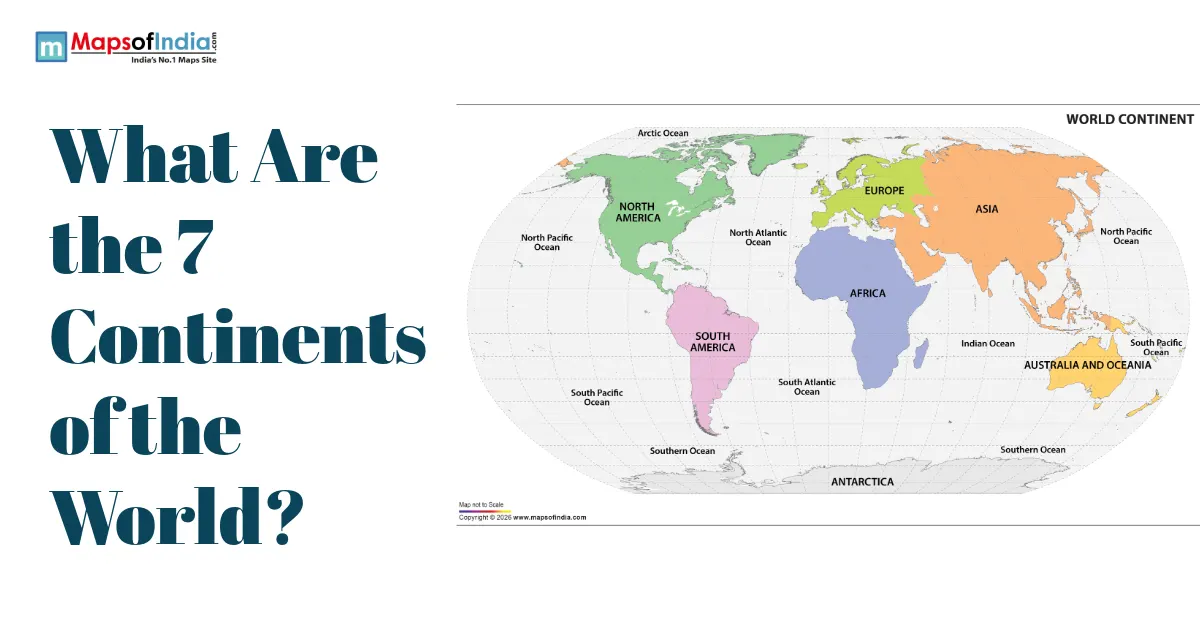
List of seven continents:
- Asia
- Africa
- North America
- South America
- Antarctica
- Europe
- Australia/Oceania
Here is the conventional seven-continent description. This is the one that's taught in most schools around the world. However, there's one catch. Some countries have five continents of education. Others teach six. It depends on whether you either merge Europe and Asia into "Eurasia" or combine North and South America into "The Americas". We'll expand on that in a bit.
Continents Ranked by Size and Population
Continent | Area (sq km) | Population (2026 est.) | Number of Countries |
| Asia | 44,579,000 | 4.8 billion | 48 |
| Africa | 30,065,000 | 1.5 billion | 54 |
| North America | 24,709,000 | 600 million | 23 |
| South America | 17,840,000 | 435 million | 12 |
| Antarctica | 14,200,000 | No permanent population | 0 |
| Europe | 10,180,000 | 745 million | 44 |
| Australia/Oceania | 8,600,000 | 46 million | 14
|
Continent-by-Continent Overview
Asia
Covers approximately 44.58 million sq km, has a population of around 4.8 billion people, includes 48 sovereign countries, and Russia is the largest transcontinental country, while China is the largest country located entirely in Asia.
Mount Everest is the tallest mountain in the world, located in Asia. Plus, it has two of the most populous countries in the world: China and India. Tokyo, the largest city in Asia, is its largest metro area.
Asia is bordered by Europe in the west, and it is in contact with the Pacific, Indian and Arctic Oceans.
Africa
Covers approximately 30.07 million sq km, has a population of around 1.5 billion people, includes 54 sovereign countries, and Algeria is the largest country by land area.
The Sahara is the biggest hot desert in the world, which is in Africa. It is also the only continent that is found in all four hemispheres. It is home to the largest cities in Lagos and Cairo.
Africa is flanked by the Atlantic and Indian Ocean and is also joined to Asia via the Sinai Peninsula.
North America
Covers approximately 24.71 million sq km, has a population of around 600 million, includes 23 sovereign countries, and Canada is the largest country by land area.
The largest economy in the world is in this continent, which is the United States. It also contains the world's biggest freshwater lakes, the Great Lakes. Mexico's largest city.
North America is bordered by the Atlantic, Pacific, and Arctic Oceans.
South America
Covers approximately 17.84 million sq km, has a population of around 435 million, includes 12 sovereign countries, and Brazil is the largest country on the continent by area.
The lungs of the planet are called the Amazon Rainforest and are situated in South America. It also contains the longest mountain range in the world, the Andes. Its most populous city is São Paulo.
The Pacific and Atlantic Oceans form the boundaries of South America.
Antarctica
Covers approximately 14.2 million sq km, has no permanent residents, contains no sovereign countries, and is governed under the Antarctic Treaty System, an international agreement dedicated to peaceful scientific research.
Antarctica has the coldest climate in the world. It is nearly completely covered by ice. There are also a few thousand scientists who live there during the summer and conduct research at research stations.
The Southern Ocean is encircled by Antarctica on all sides.
Europe
Europe covers 10.18 million km², has a population of around 745 million, and is home to 44 sovereign countries. Russia is Europe's largest country overall, while Ukraine is the largest country entirely within Europe.
The European Union is a powerful influence on global politics and the economy. Some of the oldest cities on record are also part of it, such as Rome and Athens. Germany has the largest population.
Asia is bordered by Europe in the east and the Atlantic and Arctic Oceans.
Australia/Oceania
8,600,000 sq. km, 46 countries; the largest country is Australia, 14 countries, 46 million people.
This is actually a continent that's comprised of one single continent and thousands of islands. Consider Fiji, Samoa and PNG. Australia's coast is dotted with the world's largest coral reef system, the Great Barrier Reef.
Australia/Oceania is the border that runs between the Pacific and the Indian Ocean.
Is It 5, 6, or 7 Continents? (Different Models Explained)
That's where things get interesting, however. Not all are in agreement with seven.
Four-continent model: Classifies the landmasses into Afro-Eurasia, the Americas, Antarctica and Australia. Mostly in the context of science and geology.
Five continents model: Usual in Olympic symbolism, and some Latin American schools. It brings Europe and Asia together as Eurasia, and North and South America together.
There are two versions of the 6-continent model. One combines Europe and Asia, while leaving the Americas intact. The other is a joining of North America and South America, with Europe and Asia separated.
Model of seven continents: The most popular model around the world, particularly in the United States, the United Kingdom, India and China. Takes each landmass as a whole package.
All of the following are correct. It's not a scientific argument; it's just a categorizing decision. Regional lines are drawn by nature, culture and tradition.
Largest and Smallest Continents
Asia is the largest continent by area and the most populous one. Australia/Oceania is the smallest in terms of land area. Antarctica is the least populated continent; it has no permanent residents
Oceania is not only the smallest continent in terms of people by continent, but it is also the smallest in terms of the number of people living there.
How Continents Are Formed?
The Earth's crust is fractured into giant plates. Under these plates is a hot, semi-fluid layer on which they float. They wander, collide and break apart over millions of years. Here's the skinny on plate tectonics.
Scientists think that all the landmasses were joined together as one massive supercontinent, Pangaea, about 200 million years ago. It eventually began to crack and rip apart. Those fragments were carried to the continents known today. But it didn't end there either. There are still plates moving today, but at a much slower pace than we can see day-to-day.
Draw a sketch of the continents, subcontinents, and regions. Draw a sketch of the continents, subcontinents and regions.
Continents vs. Subcontinents vs. Regions
One of the geographical land masses is called a continent.
A subcontinent is a large landmass that is part of a continent but could be called by its own name. India is the archetypal case. It is located in the Indian subcontinent in Asia, but is divided by the Himalayas.
A region is an area that is grouped together based on geographical, cultural, or political factors. For example, Southeast Asia is one of the regions of Asia.
Europe brings one more twist. It is not a continent in a strict sense of the word, but rather a peninsula of the bigger continent Eurasia. However, tradition and culture keep it classified alone.
Conclusion
Thus, there you are. The world has seven continents: Asia, Africa, North America, South America, Antarctica, Europe and Australia/Oceania. Asia is the largest region in terms of size and population. Oceania is the smallest of the continents. There are no people living in Antarctica.
FAQs
1. Which is the largest continent in the world?
Asia is the largest continent, covering about 30% of the Earth's land area.
2. Which continent has the most countries?
Africa has the most countries, with 54 internationally recognized sovereign nations.
3. Which continent has no permanent human population?
Antarctica has no permanent residents and is mainly inhabited by scientists and researchers at temporary research stations.
4. What is the difference between a continent and a country?
A continent is a large landmass made up of many countries, while a country is an independent political nation with defined borders.
5. Which continent is known as the "Dark Continent"?
Africa was historically referred to as the "Dark Continent," but the term is outdated and generally avoided today.
6. Which continent is called the "Land Down Under"?
Australia is commonly known as the "Land Down Under" because it lies in the Southern Hemisphere.
7. Which continents are entirely in the Northern Hemisphere?
Europe and North America are entirely in the Northern Hemisphere, while Asia lies mostly in the Northern Hemisphere.
8. Which continents are crossed by the Equator?
The Equator passes through South America, Africa, and Asia (Indonesia).