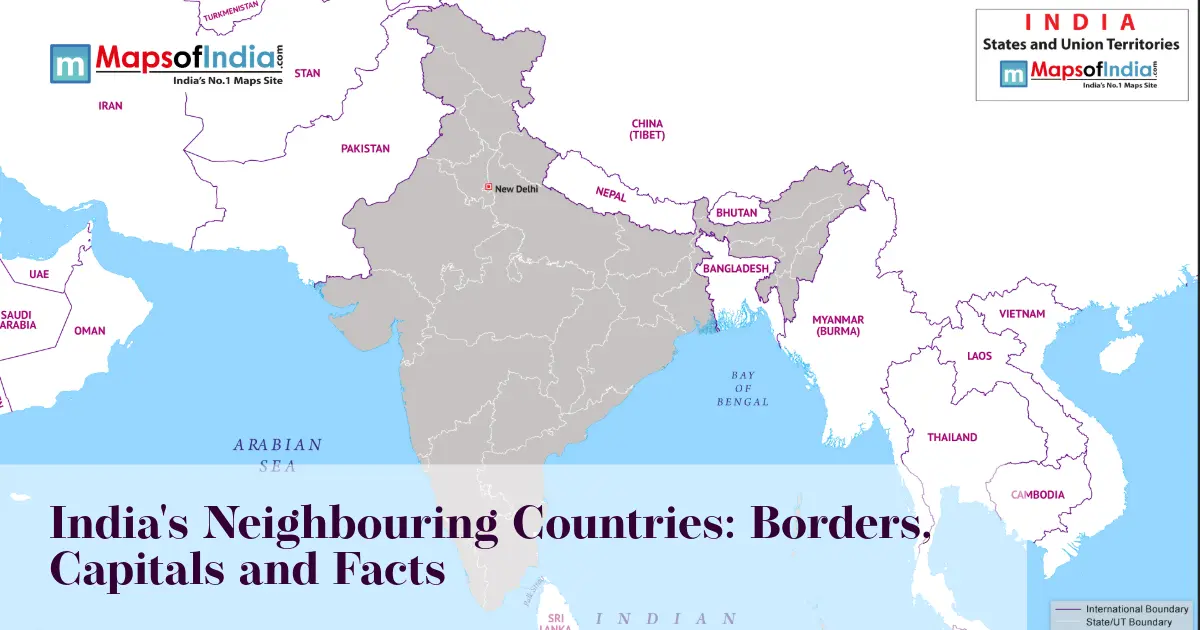
India is one of the countries with the highest number of land neighbours, as it shares its borders with seven countries. These are the countries with whom India shares its security, trade, culture and diplomacy. From the Himalayas to the forests of the east, India’s international boundary is extensive, covering about 15,200 km. In this article, you will get a list of neighbouring countries of India along with their capitals and some other facts. You will also get to know about the borders and geographical information about the neighbouring countries of India. It also includes neighbouring countries of India (land and sea).
How Many Countries Border India?
India is landlocked with seven countries: Pakistan, China, Nepal, Bhutan, Bangladesh, Myanmar and Afghanistan (via Pakistan-occupied Kashmir). The overall land boundary of India is approximately 15200 km long.
Pakistan has the biggest disputed border with India, while Bhutan has the shortest border with India. Borders with various countries have a length ranging from 1,643 km (Myanmar) to 4,096 km (Bangladesh). India's border is dotted with varied geographical features, from mountains with snow-capped peaks in the north that border China, to river terraces in the east that border Bangladesh. This is a geographical region that makes India a crossroad between Central Asia, East Asia and the Indian Ocean. However, India’s foreign policy and border management are of utmost importance to ensure national security.
List of India's Neighbouring Countries with Capitals
Country | Capital | Border Length with India (km) | States/UTs it Touches |
| Pakistan | Islamabad | 3,323 | J&K, Ladakh, Punjab, Rajasthan, Gujarat |
| China | Beijing | 3,488 | Ladakh, Himachal Pradesh, Uttarakhand, Sikkim, Arunachal Pradesh |
| Nepal | Kathmandu | 1,751 | Uttarakhand, Uttar Pradesh, Bihar, West Bengal, Sikkim |
| Bhutan | Thimphu | 699 | Sikkim, West Bengal, Assam, Arunachal Pradesh |
| Bangladesh | Dhaka | 4,096 | West Bengal, Assam, Meghalaya, Tripura, Mizoram |
| Myanmar | Naypyidaw | 1,643 | Arunachal Pradesh, Nagaland, Manipur, Mizoram |
| Afghanistan | Kabul | 106 | Ladakh (via PoK, disputed) |
Note: India has no other thin border with Afghanistan in the Wakhan Corridor through PoK, which is about 106 km. This border is not directly administered by India.
Country-Wise Details
Pakistan
Capital: Islamabad, Currency: Pakistani Rupee, Official Language: Urdu
It touches the following states/UTs: Jammu & Kashmir, Ladakh, Punjab, Rajasthan, Gujarat
The following are the international border check posts (IBCPs): Wagah-Attari and Munabao-Khokhrapar.
This border is the most heavily guarded one in the world, with a lot of history behind it.
China
Capital: Beijing, Currency: Renminbi, Official Language: Mandarin
The states and UTs it connects to are: Ladakh, Himachal Pradesh, Uttarakhand, Sikkim, Arunachal Pradesh
Nathu La, Lipulekh and Daulat Beg Oldi are the international border check posts.
The line of actual control is a subject of controversy between India and China. The border also runs through the hilly Himalayan region.
Nepal
Capital: Kathmandu, Currency: Nepalese Rupee, Official Language: Nepali
No states/UTs with which it shares its borders:
The following are the international border check posts: Raxaul-Birgunj, Banbasa-Mahendranagar
The India-Nepal border is considered the world’s most open border as it allows free movement of people.
Bhutan
Capital: Thimphu, Currency: Ngultrum, Official Language: Dzongkha
Lands/UTs adjoining it: Sikkim and West Bengal, Assam, and Arunachal Pradesh.
The final destination is: • International border check posts: Phuentsholing-Jaigaon
It has the closest ties with India of any of its neighbours. It's also a totally peaceful border.
Bangladesh
Capital: Dhaka, Currency: Bangladeshi Taka, Official Language: Bengali
All the States/UTs it touches are West Bengal, Assam, Meghalaya, Tripura and Mizoram.
Petrapole-Benapole is an international border checkpost.
It shares the longest international border with India, which is also the most intricate international land border.
Myanmar
Capital: Naypyidaw, Currency: Kyat, Official Language: Burmese
Rivers it flows through: Brahmaputra and Baramulla.
The international border crossing points are: Moreh-Tamu
Dense forests are also located on this border. It plays an important role in the Act East Policy of India.
Afghanistan
Capital: Kabul, Currency: Afghan Afghani, The official languages are: Pashto and Dari.
Area covered: 17,132.2 km², including the disputed territory of PoK with Ladakh (via PoK)
Afghanistan and India's border is really small, but it holds really great strategic importance.
India's Maritime Neighbours
India also borders four other countries by sea - Sri Lanka, the Maldives, Indonesia and Thailand. India is surrounded by island neighbours such as Sri Lanka, the Maldives and Indonesia and Thailand is located across the sea. India has a special relationship with all of the above four countries. It has several agreements with all maritime neighbours and maintains friendly relations with them.
Longest and Shortest Borders of India
India shares its longest border with Bangladesh (4096km), while the shortest one is with Afghanistan (106km). The India-Bangladesh border is the most complex one among India’s borders. This border mainly consisted of river enclaves until 2015. The length of the border between India and Pakistan is 3,323km, and with China it is 3,488km. The length of the border with other countries is from 1,643km to 4,096km. India’s borders have a significant impact on its security as well as trade with these countries.
Key Border Lines and Disputes
- Line of Control (LoC): Line separating Pakistan and India, but it is a ceasefire line of 1949, which was formalised in 1972.
- Line of Actual Control (LAC): It is an effective border between India and China. It runs through Ladakh and Arunachal Pradesh.
- Radcliffe Line: This line was drawn between Pakistan and India in 1947.
- The McMahon Line is the boundary between India and China in the east, which is not recognised by China.
The lines above have to do with the dispute over the territories or with the treaty between the countries that they reached a peace.
Quick Facts Summary
India shares its land borders with 7 countries and maritime borders with 4 countries. India has a total land boundary of approximately 15,200km. Bangladesh (4,096 km) has the longest land boundary with India, while Afghanistan (106 km) has the shortest land boundary with India. India has a tri-junction border with three neighbours, China, Myanmar and Bhutan. It also has the maximum number of neighbouring countries in South Asia.
Conclusion
The neighbouring countries are a factor in India's security, trade, culture and foreign policy. The length of the border with India is vast and includes snow-capped mountains, forests, etc., which are strategically very important. The article contains a short description of countries neighbouring India, with their capital cities and other important information. For more details on Indian States and Capitals, read our article on that. If you want to learn more about interesting geographical facts about India, read our article on geographical facts about India.
FAQs
1. Which countries share a land border with India?
India shares land borders with Pakistan, China, Nepal, Bhutan, Bangladesh, Myanmar, and Afghanistan.
2. Which neighbouring countries are separated from India by sea?
Sri Lanka and the Maldives are India's maritime neighbours, separated by the Indian Ocean.
3. Which is India's longest international border?
India's longest international border is with Bangladesh, stretching about 4,096 km.
4. What are the capitals of India's neighbouring countries?
Islamabad (Pakistan), Beijing (China), Kathmandu (Nepal), Thimphu (Bhutan), Dhaka (Bangladesh), Naypyidaw (Myanmar), Kabul (Afghanistan), Colombo (Sri Lanka), and Malé (Maldives).
5. Which neighbouring country does India share the shortest land border with?
India shares its shortest land border with Afghanistan, measuring about 106 km.
6. Why are India's neighbouring countries strategically important?
They play a key role in regional security, trade, connectivity, cultural ties, and diplomatic relations.