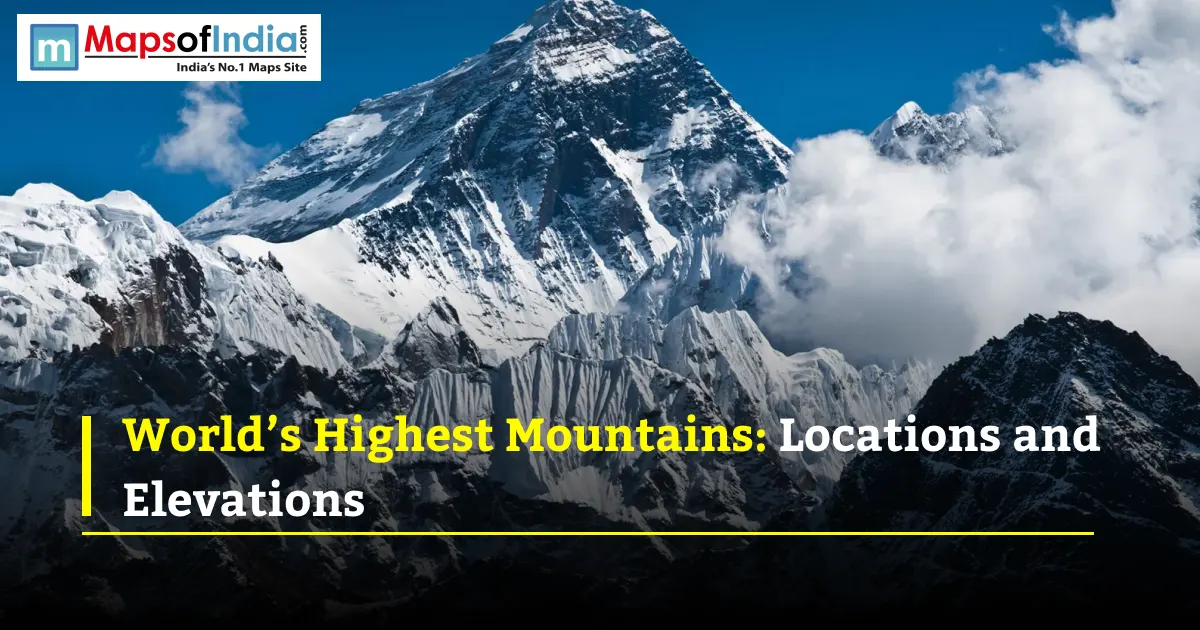
The world's highest mountain is Mount Everest, standing at 8,849 metres (29,032 ft) on the Nepal–China border. This guide runs through the full ranking of the world's highest mountains, along with their exact locations, elevations, and the stories behind each first ascent. Do keep in mind this list is elevation-based, measured from sea level, rather than based on topographic prominence, which is a slightly different way of ranking a mountain's overall size.
What Makes a Mountain "High"? Elevation vs. Prominence
How Elevation Is Measured (Sea Level Standard)
Elevation is simply the height of a summit above mean sea level. Surveyors use satellite positioning alongside gravitational data to pin this figure down, and that is exactly how Everest's official height was revised to 8,849 metres in a joint China-Nepal survey completed in 2020.
Elevation vs. Topographic Prominence - Brief Distinction
Elevation tells you how far above sea level a peak sits. Prominence tells you something different: how much a mountain rises above the surrounding terrain on its own. Everest wins on both counts, but plenty of mountains that rank high on elevation lists actually rank much lower once prominence gets factored in, since they sit close to an even taller neighbour.
World's Highest Mountains List (Ranked by Elevation)
Here is the full highest mountains list with height, covering the ten tallest peaks on the planet.
Rank | Mountain | Elevation (m/ft) | Location/Range | Country |
| 1 | Mount Everest | 8,849 m / 29,032 ft | Himalayas | Nepal/China |
| 2 | K2 | 8,611 m / 28,251 ft | Karakoram | Pakistan/China |
| 3 | Kangchenjunga | 8,586 m / 28,169 ft | Himalayas | Nepal/India |
| 4 | Lhotse | 8,516 m / 27,940 ft | Himalayas | Nepal/China |
| 5 | Makalu | 8,485 m / 27,838 ft | Himalayas | Nepal/China |
| 6 | Cho Oyu | 8,188 m / 26,864 ft | Himalayas | Nepal/China |
| 7 | Dhaulagiri | 8,167 m / 26,795 ft | Himalayas | Nepal |
| 8 | Manaslu | 8,163 m / 26,781 ft | Himalayas | Nepal |
| 9 | Nanga Parbat | 8,126 m / 26,660 ft | Himalayas | Pakistan |
| 10 | Annapurna I | 8,091 m / 26,545 ft | Himalayas | Nepal |
Mount Everest - 8,849 m
Sitting right on the Nepal–China border, Everest holds the title of the tallest of the world's highest mountains by a comfortable margin. Edmund Hillary and Tenzing Norgay made the first confirmed ascent back in 1953, and thousands have followed since, though the mountain still claims lives most seasons.
K2 – 8,611 m
K2 sits in the Karakoram range, straddling the Pakistan-China border. Climbers widely consider it far tougher than Everest, despite standing lower. Achille Compagnoni and Lino Lacedelli reached the summit first in 1954.
Kangchenjunga – 8,586 m
Kangchenjunga rises along the Nepal-India border, its name roughly translating to "five treasures of snow," a nod to its five distinct summits. Joe Brown and George Band completed the first ascent in 1955, and out of respect for local spiritual beliefs, many climbing parties stop just short of the true summit.
Lhotse – 8,516 m
Lhotse sits directly next to Everest, connected by the South Col at 7,986 metres. Fritz Luchsinger and Ernst Reiss achieved the first ascent in 1956. Many Everest climbers actually cross part of Lhotse's face on their way up.
Makalu – 8,485 m
Makalu forms a striking, isolated pyramid shape near the Nepal-China border, close to Everest but distinct enough to be considered one of the more demanding eight-thousanders. A French team completed the first ascent in 1955.
Cho Oyu – 8,188 m
Cho Oyu sits near the Nangpa La pass on the Nepal-China border, and is generally regarded as the easiest of the fourteen eight-thousanders to climb. Herbert Tichy led the team that made the first ascent in 1954.
Dhaulagiri – 8,167 m
Dhaulagiri sits entirely within Nepal. Between 1808 and 1838, before Kangchenjunga's height was properly measured, this peak was believed to be the tallest mountain on Earth. A Swiss-Austrian expedition finally summited it in 1960.
Manaslu – 8,163 m
Manaslu rises in west-central Nepal, its name meaning "mountain of the spirit" in Sanskrit. A Japanese team achieved the first ascent in 1956, and the mountain has remained closely tied to Japanese mountaineering history ever since.
Nanga Parbat – 8,126 m
Nanga Parbat sits in Pakistan, marking the western anchor of the Himalayan range. Hermann Buhl reached the summit alone in 1953, in one of the most remarkable solo pushes in mountaineering history.
Annapurna I – 8,091 m
Annapurna I sits in Nepal and holds a special place in climbing history as the very first eight-thousander ever summited. Maurice Herzog and Louis Lachenal reached the top back in 1950, three years before Everest itself was conquered.
The 14 Eight-Thousanders Explained
What Is an "Eight-Thousander"?
The term refers to any of the fourteen mountains rising above 8,000 metres, all found within just two ranges on Earth, the Himalayas and the Karakoram. These mountains above 8000 meters represent the most extreme high-altitude climbing challenges anywhere on the planet.
Countries Where They're Located (Nepal, Pakistan, China, India Border Zones)
Eight of the fourteen sit wholly or partly within Nepal. Five sit in Pakistan, four of those within the Karakoram, plus Nanga Parbat further west. Shishapangma stands alone as the only eight-thousander located entirely within Tibet, China. India shares a border claim on Kangchenjunga alongside Nepal.
Highest Mountain on Each Continent
Continent | Mountain | Elevation | Country |
| Asia | Mount Everest | 8,849 m | Nepal/China |
| South America | Aconcagua | 6,961 m | Argentina |
| North America | Denali | 6,190 m | USA |
| Africa | Kilimanjaro | 5,895 m | Tanzania |
| Europe | Mount Elbrus | 5,642 m | Russia |
| Antarctica | Vinson Massif | 4,892 m | Antarctica |
| Australia/Oceania | Puncak Jaya | 4,884 m | Indonesia |
Everest, of course, remains the global highest point of all, and the highest mountain in Asia by a huge margin over any of its neighbours on this table.
Highest Mountain Ranges in the World
The Himalayas
The Himalayas hold the record as the highest mountain range on Earth by a wide margin, home to Everest and most of the world's eight-thousanders, stretching across Nepal, India, Bhutan, and China.
The Karakoram Range
The Karakoram sits further west, straddling Pakistan and China, and packs an unusually dense cluster of extremely tall peaks into a relatively compact area, including K2 and three other eight-thousanders.
Comparison with the Andes and Rockies
The Andes stretch far longer than either the Himalayan or Karakoram ranges, running the length of South America, though its highest point, Aconcagua, still falls well short of the eight-thousander club. The Rockies, in North America, top out even lower, with Mount Elbert reaching just 4,401 metres, nowhere close to competing on a global elevation list.
Conclusion
Mount Everest remains the undisputed champion among the tallest mountains in the world, though K2 and Kangchenjunga push it closely in terms of sheer difficulty and prestige. Almost every one of the fourteen eight-thousanders sits within Nepal or Pakistan, concentrated across just two mountain ranges. Beyond elevation alone, prominence, difficulty, and first-ascent history all shape how climbers and geographers alike think about what truly makes a mountain "great."
FAQs
What is the highest mountain in the world?
Mount Everest stands at 8,849 metres on the Nepal-China border.
What is the second-highest mountain?
K2, reaching 8,611 metres in the Karakoram range, on the Pakistan-China border.
Which country has the most of the world's highest mountains?
Nepal is home to eight of the fourteen eight-thousanders, including Everest itself.
Is Mount Everest still growing?
Yes. Ongoing tectonic movement from the Indian Plate pushing into the Eurasian Plate adds roughly a few millimetres of height each year, though erosion offsets some of that gain.
What is the tallest mountain from base to peak (not sea level)?
Mauna Kea in Hawaii holds that title, measuring over 10,000 metres from its base on the ocean floor to its summit, even though only around 4,207 metres rises above sea level.
Why is K2 considered harder to climb than Everest?
K2's routes are steeper, more technical, and far less commercialised, with a notably higher fatality rate among climbers attempting the summit.
Which eight-thousander was climbed first?
Annapurna I was summited in 1950 by Maurice Herzog and Louis Lachenal, three years before Everest's first successful ascent.
Are all Seven Summits above 8,000 metres?
No. Only Everest crosses that mark. The other six continental high points range from under 2,000 metres to just under 7,000 metres.