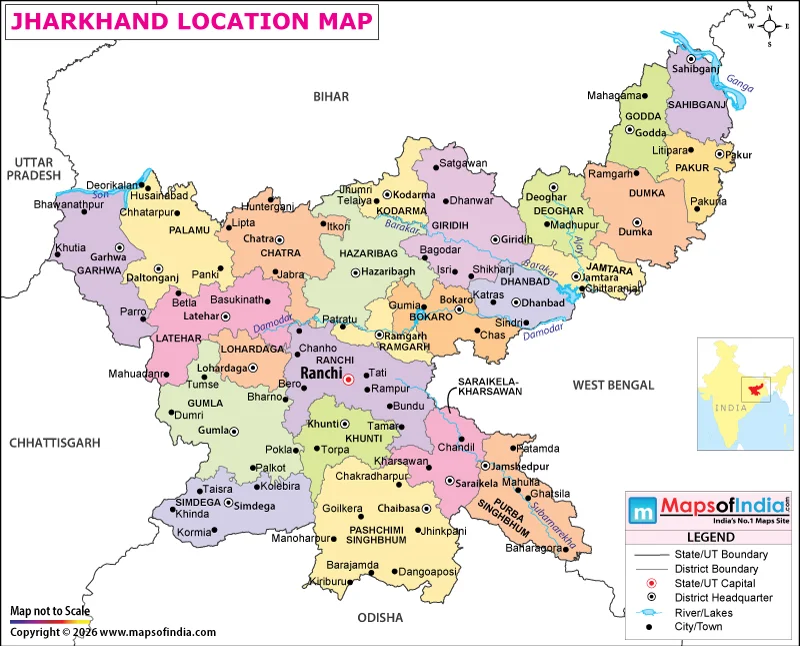
Jharkhand is a state in eastern India, known for its mineral-rich land, dense forests, waterfalls, and the Chota Nagpur Plateau. It is bordered by Bihar to the north, West Bengal to the east, Odisha to the south, Chhattisgarh to the west, and Uttar Pradesh to the northwest. Ranchi is the capital of the state of Jharkhand and is one of the largest urban centres of the state. The geographical position of the state makes it a valuable part of India's geological, industrial, and forest resources.
Geographical Location of Jharkhand
The state of Jharkhand is located in the eastern part of the Indian subcontinent, most of which lies on the Chota Nagpur Plateau, which is one of the important geographical features of the state. Its geographical extent is roughly between 21°58′ N and 25°18′ N latitude and 83°19′ E and 87°57′ E longitude. The state is about 79,716 km² in area.
The geographical position of Jharkhand links the eastern Gangetic plains to the central and eastern forested plateau of India. It has a topography of upland plateau, rolling hills, river valleys and forested areas. It receives contributions from the river systems Damodar, Subarnarekha, Barakar and Koel and is significant for agriculture, settlements and industry.
Neighbouring States of Jharkhand
Jharkhand shares boundaries with five Indian states. Its position between these states supports regional transport, trade, and cultural connections.
- Bihar: Located to the north, Bihar shares a long boundary with Jharkhand. The two states were part of the same state until Jharkhand was formed on 15 November 2000.
- West Bengal: Situated to the east, West Bengal provides important transport and commercial links with eastern India.
- Odisha: Located to the south, Odisha shares geographical and cultural connections with Jharkhand, particularly in tribal regions.
- Chhattisgarh: Lies to the west and connects Jharkhand with central India.
- Uttar Pradesh: Borders Jharkhand to the northwest, linking it with the northern part of the country.
Physical Features and Climate of Jharkhand
The Chota Nagpur Plateau is the most prominent geographical feature of Jharkhand. Its elevated terrain, rocky formations, and forested hills influence the state's climate and natural resources. Parasnath Hill is the highest peak of the state in the district of Giridih, and it is also an important pilgrimage place for Jainism.
The climate in Jharkhand is tropical and has three general seasons: summer, monsoon, and winter. The summers are mostly hot, and the southwest monsoon provides most of the rainfall for the state. The winters are relatively cold, especially at higher altitudes. The forests, waterfalls, and hills in the state give rise to ecological diversity and the potential for tourism.
Why Is Jharkhand's Location Important?
The state of Jharkhand is a significant state in the mineral and industrial geography of India. Coal, iron ore, copper, bauxite, and uranium deposits are found in large quantities within the state. These resources are used for mining, steel making, electricity generation, and other industries.
The major industrial and urban centres are Jamshedpur, Dhanbad, Bokaro and Ranchi. Dhanbad is known to many people for coal mining, whereas Jamshedpur is known as a steel manufacturing and a major manufacturing centre. The railway and road systems of the state are integrated with one another and with the other states and other parts of India.
Some of the other attractions of Jharkhand are forests, waterfalls, wildlife and tribal culture. It is a prominent state in eastern India due to its geographical location providing conducive conditions for agriculture, forestry, mineral-based industries and tourism.