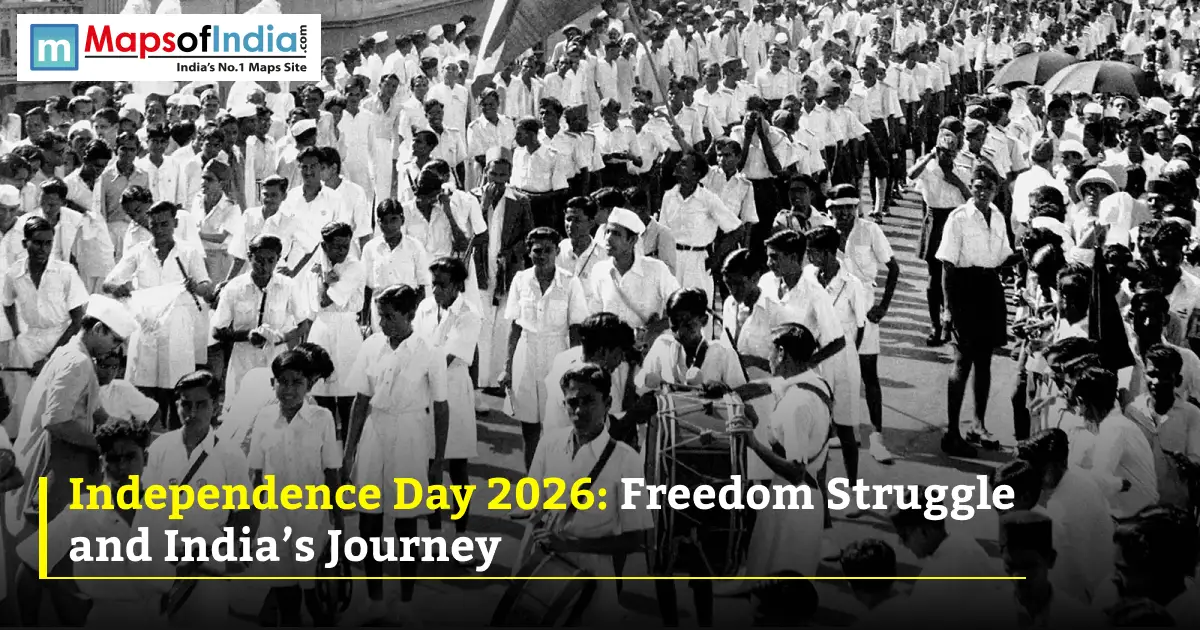
India will celebrate its 80th Independence Day on August 15, 2026, marking 79 years since the country became independent from British rule in 1947. Independence Day is a national holiday not just for celebrating independence, but to recall the prolonged struggle for independence, the sacrifices of many Indians and the progress India has made since independence.
Freedom fighters like Bose, Gandhi and F.D. Reddy spearheaded the rise of the freedom movement in India, from the first opposition to the rule of the British to a nationwide struggle for independence. Today, August 15 is celebrated with flag hoisting ceremonies, cultural programmes, patriotic activities and an address by the Prime Minister from the Red Fort, New Delhi.
Why Is Independence Day Celebrated on August 15?
India became an independent nation on August 15, 1947. The Indian Independence Act, passed by the British Parliament in July 1947, provided for the creation of India and Pakistan as independent dominions.
The transition marked the end of nearly two centuries of British colonial rule. Jawaharlal Nehru, India's first Prime Minister, delivered his historic "Tryst with Destiny" speech shortly before India formally became independent.
Since then, August 15 has been observed every year as India's Independence Day. The occasion reminds citizens of the country's difficult journey from colonial rule to sovereignty.
The Beginning of the Freedom Struggle
The Indian freedom movement developed over several decades. Resistance to British authority existed in different parts of the country even before the organized national movement emerged.
The most important early rebellions were the Revolt of 1857, which is sometimes considered the first great revolt against the British in India. The rebellion started among the Indian soldiers and spread to various areas. The leaders of the resistance were Rani Lakshmibai of Jhansi, Bahadur Shah Zafar, Nana Sahib and Tantia Tope.
The rebellion was eventually put down, but it served to be a symbol of resistance to colonial rule.
Indian National Congress was founded in 1885. Eventually, it became an important forum for political discourse in India and played a pivotal role in the struggle for Independence.
Rise of Nationalism in India
In the late 1800s and early 1900s, Indian nationalism blossomed. Leaders such as Dadabhai Naoroji, Bal Gangadhar Tilak, Gopal Krishna Gokhale, Lala Lajpat Rai and Bipin Chandra Pal played their role in sensitizing the people of India and raising their demands for more Indian participation in governance.
Another event that added to the feelings of nationalism was the partition of Bengal in 1905. The Swadeshi Movement inspired Indians to boycott British products and bring in Indian products.
The upswing of this movement reinforced the notion that political freedom was closely tied to economic self-reliance.
Mahatma Gandhi and Mass Movements
Mahatma Gandhi gave the freedom movement a new dimension as an important national leader. Gandhi preached non-violence and civil disobedience, and championed the idea of mass participation as a means of resistance.
The most significant movements of Gandhi were the Non-Cooperation Movement (1920-22), the Civil Disobedience Movement and the Quit India Movement of 1942.
Gandhi and his followers protested the British salt laws in the Dandi March of 1930, and it became an important symbol of civil disobedience. This was a movement that showed the effectiveness of bringing together a vast part of the population around a relatively simple matter like the payment of a tax on salt.
The Quit India Movement was started on 15th August, 1942 and demanded the withdrawal of the British from India. It used to have a popular slogan, "Do or Die", that personified the nationalist movement in the dying days of the struggle.
Contributions of Other Freedom Fighters
The freedom movement of India was a force of people of various ideologies, methods and backgrounds. Gandhi preached non-violence, but others were also prominent in the fight against colonial rule.
Subhas Chandra Bose and the Indian National Army became prominent symbols of resistance during the 1940s. Bose appealed to the world for support in the struggle against the British and galvanized many Indians into the war for independence.
Many other prominent personalities were there, such as Bhagat Singh, Chandrashekhar Azad, Ram Prasad Bismil, Ashfaqulla Khan, Sarojini Naidu, Annie Besant, Aruna Asaf Ali and many others.
Women contributed much in the struggle for freedom as well. Rani Lakshmibai (1857 uprising), Sarojini Naidu, Kasturba Gandhi and Aruna Asaf Ali were among the Indian leaders who actively engaged in political and social movements.
India Becomes Independent in 1947
The Second World War had a great effect on Britain's economic and political strength. Meanwhile, calls for independence in India were rising.
The Indian Independence Act 1947 was passed after negotiation between the leaders from India and the British government. British India was split into two separate independent dominions – India and Pakistan.
On 14th–15th August, at midnight, India gained independence. Jawaharlal Nehru, the new beginning of India, addressed the Constituent Assembly.
Yet, independence was accompanied by the sad Partition of India, leading to displacement, violence and loss of life. The newly established India-Pakistan borders were crossed by millions.
India’s Journey After Independence
India's path towards nation building did not end with Independence. The country was beset with gigantic problems such as rehabilitation of refugees, economic development, poverty, illiteracy and integration of the princely states.
On 26th January 1950, India became a sovereign democratic republic through the adoption of its Constitution. The Constitution came up with a framework of democracy, fundamental rights, equality and governance by law.
India has undergone tremendous changes over the decades. Major industries, increased educational institutions, enhanced infrastructure and the elevation of the country as an important economy and technology hub.
India has also made significant achievements in areas such as space exploration, information technology, agriculture, healthcare, manufacturing and digital services. From the Green Revolution to major achievements in space science, the country's post-independence journey has been marked by considerable progress.
Independence Day 2026: Remembering the Journey
Independence Day 2026 provides an opportunity to look back at both India's freedom struggle and its progress since 1947. The celebration of the nation highlights that independence was won through the efforts and sacrifice of citizens from various parts of the country, communities and backgrounds.
Normally, the Prime Minister's flag-hoisting ceremony at the Red Fort, the national anthem, cultural programmes and patriotic events are organized throughout the country. Flag-hoisting ceremonies, speeches, competitions and cultural performances are organized by schools, colleges, government institutions and communities.
Independence Day is especially significant for the younger generation as it is a link between the past and the emergence of the freedom struggle movement in India.
Conclusion
Independence Day 2026 is more than a celebration of the end of British rule. It is a reminder of India's long journey from colonialism to democracy and its continuing efforts toward development and national progress.
The freedom movement united different voices and movements, which paved the way to India's political future. On this day, which is being celebrated on August 15, the people of the country must appreciate the freedoms, democratic systems and duties that were won on independence.
India is still on the journey and has been defined by its past, its present and its future.
FAQs
1. When is Independence Day 2026 in India?
India will celebrate Independence Day 2026 on Saturday, August 15. The day commemorates India's independence from British rule in 1947.
2. Is 2026 the 79th or 80th Independence Day of India?
India will celebrate its 80th Independence Day in 2026, while completing 79 years of independence. The first Independence Day was celebrated on August 15, 1947.
3. Why does India celebrate Independence Day on August 15?
India celebrates Independence Day on August 15 because the country became independent from British colonial rule on August 15, 1947. The date marks the transfer of power and the beginning of India's journey as an independent nation.
4. Who were the major leaders of India's freedom struggle?
Major leaders of India's freedom struggle included Mahatma Gandhi, Jawaharlal Nehru, Subhas Chandra Bose, Sardar Vallabhbhai Patel, Bhagat Singh, Bal Gangadhar Tilak, Sarojini Naidu and Rani Lakshmibai, among many others.
5. What happened on August 15, 1947?
On August 15, 1947, India became independent from British rule. Jawaharlal Nehru became India's first Prime Minister and delivered his historic “Tryst with Destiny” speech during the transition to independence.
6. Where is the main Independence Day celebration held in India?
The main national Independence Day ceremony is held at the Red Fort in New Delhi. The Prime Minister traditionally hoists the national flag and addresses the nation from the historic monument.
7. What is the significance of Independence Day in India?
Independence Day commemorates India's freedom from British rule and honours the sacrifices of freedom fighters. It also celebrates India's unity, democracy, sovereignty and progress while reminding citizens of their responsibilities toward the nation.