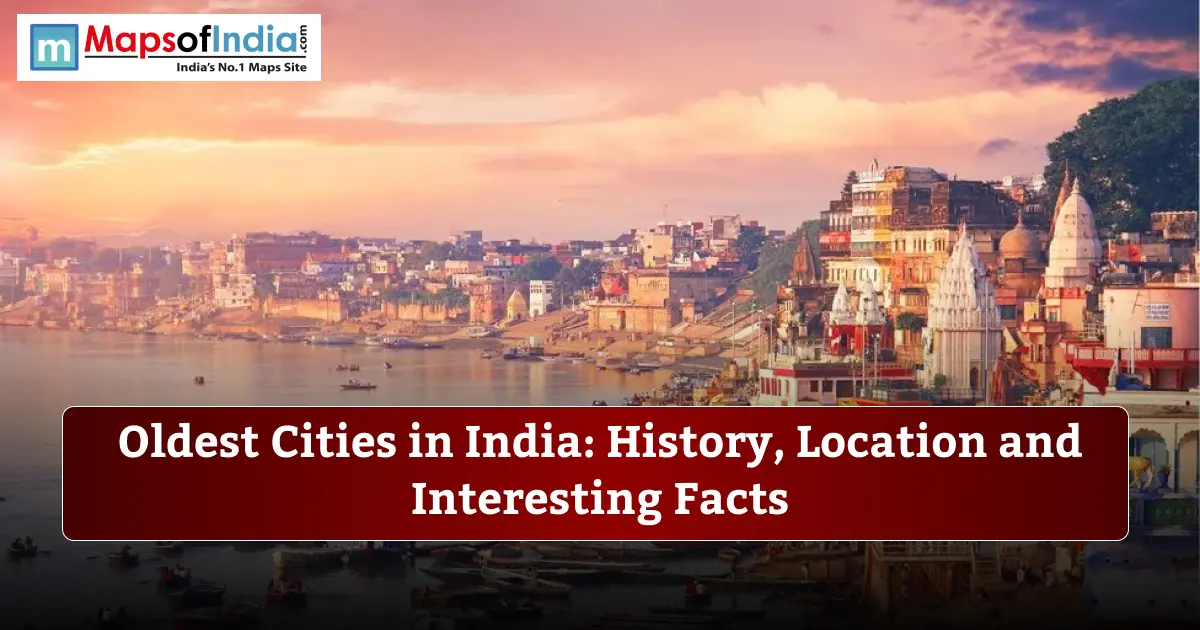
Varanasi is one of the oldest cities in India. A majority believes that Varanasi is at least 3,000 years old, based on historical research. Then again, with different kinds of traditions, it could even be that the age could be far more ancient. We will go into the top list of the oldest cities in India, get a feel of their history, geography, and what makes them unique. These ancient cities of India had such a major role in shaping the history of the country that by learning about the oldest cities in Indian history, we can get an insight into why so many ancient cities that existed live on today either as cities or just as towns.
How Do Historians Determine a City's Age?
Archaeological Evidence vs. Textual/Mythological References
Two very diverse tools are used by historians here. Physical remains such as pottery, seals and building foundations are dated by scientific techniques, such as radiocarbon dating. Textual evidence can be traced back to ancient scriptures, epics, and travel accounts, which can often be used to extend a city's age past what can be substantiated by excavation. Neither source is ideal, and most reliable estimates use a mixture of both.
"Continuously Inhabited" vs. "Founded In"
These two sentences have different connotations. The term “continuously inhabited” refers to a long continuous period of occupancy, generation after generation. The "founded in" does not indicate that a city was abandoned, but rather serves as a starting date, although the city may have been rebuilt later. This difference is significant in most discussions of the oldest cities in Indian history because a city may be "founded" at an early date, but lose this status at some point due to its abandonment.
City | State | Estimated Age/Era | First Mentioned In |
| Varanasi | Uttar Pradesh | 3,000+ years | Atharvaveda |
| Madurai | Tamil Nadu | 2,500+ years | Megasthenes' accounts |
| Patna | Bihar | 2,500+ years | Buddhist and Jain texts |
| Ujjain | Madhya Pradesh | 2,500+ years | Mahabharata |
| Ayodhya | Uttar Pradesh | 2,500+ years | Ramayana |
| Mathura | Uttar Pradesh | 2,500+ years | Puranic texts |
| Kanchipuram | Tamil Nadu | 2,000+ years | Sangam literature |
| Dwarka | Gujarat | Debated, mythologically ancient | Mahabharata |
Varanasi (Kashi), Uttar Pradesh
History and Ancient Origins
Varanasi's history facts start with its status as the spiritual capital of Hinduism. Legend credits Lord Shiva as its founder. It grew into a hub for silk weaving, ivory work, and Vedic learning, drawing scholars and pilgrims from across ancient India. During the time of Gautama Buddha, it served as the capital of the Kashi kingdom, and it remained an important centre through Mauryan and Gupta rule.
Location on the Ganges
It sits on the banks of the Ganges, in Uttar Pradesh, positioned between the Varuna and Assi rivers, which some believe gave the city its name. The riverfront ghats stretch for several kilometres along the water.
Interesting Facts
It houses over 2,000 temples and remains one of the oldest continuously inhabited cities on Earth. Hindus believe that dying here grants moksha, or liberation from rebirth. Mark Twain once wrote that Varanasi looks older than history itself.
Madurai, Tamil Nadu
History and the Pandya Dynasty
The Madurai ancient city story ties closely to the Pandya dynasty, which ruled the region from roughly the 4th to the 10th century. Megasthenes, a Greek traveller, wrote about the city over 2,000 years ago, describing it as a thriving centre of trade. The Cholas later took control, ruling from around 920 CE into the 13th century.
Location and Geography
Madurai sits along the Vaigai River in Tamil Nadu, functioning as a major trade and cultural hub for the entire south of the country.
Interesting Facts
The Meenakshi Amman Temple anchors the city today, drawing millions of pilgrims each year with its towering, sculpture-covered gopurams. Madurai has also earned the nickname "the city that never sleeps."
Patna (Ancient Pataliputra), Bihar
History - Capital of the Mauryan and Gupta Empires
Patna's history traces back to Pataliputra, capital of both the Mauryan and Gupta empires. Fortified walls and hundreds of watchtowers were what Megasthenes referred to as the greatest city on earth, at one time. Later, it was also used by the Shunga dynasty, continuing its status as a place of power.
Location on the Ganges
It sits along the Ganges in Bihar, close to Nalanda and Bodh Gaya, two other major centres of ancient learning and Buddhist pilgrimage.
Interesting Facts
Aryabhata and Chanakya both worked here, cementing Patna's place as an ancient centre of mathematics, philosophy, and statecraft. The city has also been known by several other names over the centuries, including Kusumpur and Azimabad.
Ujjain, Madhya Pradesh
History and Astronomical Significance
Ujjain, an ancient city, centres on astronomy. Ancient Indian astronomers used it as their reference meridian for centuries, treating it as the country's zero-longitude point for calculations. The city also appears in the Mahabharata and is linked to the legendary King Vikramaditya.
Location and Geography
It sits in Madhya Pradesh, along the Kshipra River, and gained further importance under rulers like Ashoka, who served here as Viceroy of Avanti.
Interesting Facts
Ujjain hosts one of India's four Kumbh Melas and remains home to the Mahakaleshwar Jyotirlinga temple, one of twelve such shrines across the country.
Ayodhya, Uttar Pradesh
History and Mythological Roots
Ayodhya is clearly linked with the Ramayana as the birthplace of Lord Rama and the ancient kingdom of Kosala. A sequence of occupations has been uncovered here, extending back many centuries.
Location and Geography
It sits on the Sarayu River in Uttar Pradesh, in the eastern part of the state.
Interesting Facts
Ayodhya ranks among the seven sacred Hindu pilgrimage cities, known as the Sapta Puri, alongside Varanasi and Mathura.
Mathura, Uttar Pradesh
History and Religious Significance
Mathura's ancient city history centres on its status as the birthplace of Lord Krishna. It also served as a major Buddhist and Jain centre during the Kushan period, producing distinctive red sandstone sculpture that spread across northern India.
Location and Geography
It sits on the Yamuna River, close to Vrindavan, and once connected major trade routes running across northern India.
Interesting Facts
Mathura remains one of the seven sacred Sapta Puri cities, alongside Varanasi and Ayodhya, and draws huge crowds every year during Janmashtami celebrations.
Kanchipuram, Tamil Nadu
History - City of a Thousand Temples
Kanchipuram's history earned it the nickname "City of a Thousand Temples," built largely under Pallava and later Chola rule between the 6th and 12th centuries. It once served as the capital for the Pallava dynasty.
Location and Geography
It sits inland in Tamil Nadu, not far from Chennai, along the Palar River basin.
Interesting Facts
Kanchipuram is still renowned for its silk weaving industry, and temple complexes continue to attract scholars of ancient architecture, as it is the legacy of the master craftsman families of Kanchipuram who have handed over the skill of weaving silk to the present generations.
Dwarka, Gujarat
History and Submerged City Discoveries
Dwarka, an ancient city, is linked to Lord Krishna, who is supposed to have constructed the city when he fled Mathura from repeated attacks. In 1983, archaeologist S.R. Rao began underwater excavations off the coast of Gujarat, which revealed underwater walls, stone anchors, and fortification structures. Researchers have differing views on the dating of these structures.
Location on the Arabian Sea
It sits on the Arabian Sea coast in Gujarat, near where the Gomti River once met the sea.
Interesting Facts
Dwarka remains one of the four Char Dham pilgrimage sites in Hinduism, and one of the seven sacred Sapta Puri cities.
Other Ancient Indian Cities Worth Knowing
Rajgir (Ancient Rajagriha), Bihar
Rajgir was an early capital of Magadha, and it witnessed the first Buddhist council following Buddha's death. It is also a pivotal place of early Buddhist history.
Thanjavur, Tamil Nadu
Under the Chola rule, Thanjavur was a flourishing city, and the Brihadeeswarar Temple, a UNESCO World Heritage Site, was constructed over a millennium ago.
Amaravati, Andhra Pradesh
Amaravati was a flourishing Buddhist centre under the Satavahana dynasty and won fame for its elaborate stone carvings and remains of stupas that are still the focus of study for historians today.
Oldest Cities in India - Comparison at a Glance
In terms of age, Varanasi is the oldest city in India, followed by Madurai and Patna, respectively. Ujjain and Ayodhya have rich astronomical and mythological significance. Religious value is the main attraction for Mathura and Kanchipuram, while Dwarka is the most controversial addition, between myth and underwater archaeology.
FAQs
1. Which is the oldest city of India?
This is held by Varanasi, where the majority of historians believe it to be more than three thousand years old.
2. Is Varanasi older than Rome?
Yes, according to most of the estimates. Varanasi is the oldest city in the world, older than Rome, which was traditionally founded in 753 BCE.
3. In ancient times, what was the name of Patna?
It was called Pataliputra and was the capital of the Mauryan Empire and the Gupta Empire.
4. Which is the oldest city in the world that is still occupied on a continuous basis?
That title is a matter of debate worldwide, as is the fact that Varanasi is always one of the great destinations, along with Damascus.
5. Which are the cities are related to the Indus Valley civilisation in India?
None of these is directly on this list, but sites such as Dholavira and Lothal in Gujarat are in the same time period as the earlier cities, but not these.
6. What is Madurai's exact age?
It looks like people have lived at the site for more than 2,500 years since around 500 BCE.
7. Why is there a lot of controversy regarding the age of Dwarka?
It's a mix of myth and undersea archaeology, and researchers have differing opinions on how old the submerged structures are.
8. The name of which ancient city is associated with the birth of Lord Krishna?
Mathura was the city that had that distinction, as well as its subsequent link with Dwarka.