

|
||||||||||
| ||||||||||
|





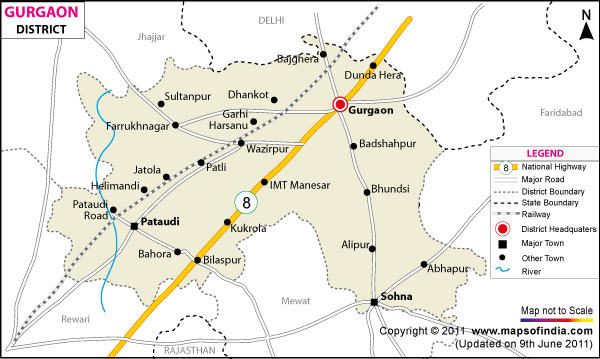
| *Gurgaon District map showing National highways, district headquarter, roads, towns, etc. |
About
Just beyond New Delhi, Gurugram thrives due to its spot inside the National Capital Region. Connected by wide highways, rapid transit lines, alongside quick access to the international airport, it draws both companies and households. Skyscraping offices rise beside housing complexes, while schools, hospitals, plus retail centers add layers to daily life there. The area evolves steadily - its character defined less by plans than by ongoing transformation. Home to the district administration, Gurugram city now ranks among India’s top hubs for IT, financial services, advisory work, property development, and business management. With multinational corporations, emerging ventures, and tech enterprises setting up base here, skilled workers across the country find new paths for career growth. Though once a quiet suburb, it draws talent through evolving infrastructure and diverse industry presence.
History and Culture
Long before modern times, Gurugram's roots took shape in the deep past of Indian culture. Tied through stories passed down generations, the land links directly to Guru Dronacharya - teacher of both Pandavas and Kauravas in the epic Mahabharata. Tradition holds that his pupils offered him this territory as a tribute.
From that gesture came "Guru Gram," translating to "village of the master." As centuries unfolded, speech patterns shifted; "Gurugram" emerged slowly from earlier forms once known as Gurgaon. Official recognition sealed the current spelling only recently.
Long ago, the area stayed mostly countryside - scattered farms dotting dry grasslands. Life centered around growing crops, raising animals. People relied on yearly harvests, exchange between nearby settlements. Customs in small towns guided how society functioned.
Back then, across medieval times, different rulers shaped life in the area - first Rajput states, then the Delhi Sultanate, followed by Mughal control, eventually giving way to British colonial authority. Close to Delhi, Gurugram quietly absorbed shifts in governance whenever power changed hands nearby.
Though infrastructure slowly expanded under British control, Gurgaon stayed mostly in the countryside during colonial times. While administration shifted and transit networks improved elsewhere, farming shaped daily life here. Urban expansion barely touched the area, even as larger colonies transformed into bustling centers. Growth crept forward at a quiet pace, leaving fields intact across decades.
Change swept through the area following India's independence, though shifts accelerated sharply toward the end of the 1900s. Starting in the 1990s, looser economic rules opened doors for private capital and city planning. Slowly, towering buildings, growing enterprises, alongside funding from large firms, began redefining how people saw Gurugram.
Once open fields, these zones now host clusters of offices and modern utilities. High-rise buildings replaced agricultural plots as city planning shifted direction. Firms offering tech support, financial solutions, advisory roles, or remote operations fueled growth patterns across regions. Skilled workers arrived alongside global corporations drawn by new housing and shopping centers built privately. Economic momentum increased under initiatives launched without public funding.
Even with progress, old ways still matter across the area. In countryside spots, people hold on to Haryanvi practices tied to farming, marriage rituals, yearly festivals, also community meetups. Folk music and local stage acts show up regularly at regional events plus harvest feasts. Though times change, these expressions stay part of daily life.
Where once only ancestral homes shaped the landscape, glass offices now rise nearby. Yet woven between them, age-old customs continue without fading. Homes built by generations past sit just beyond new transit hubs. Even so, festivals follow rhythms unchanged by digital clocks. Though steel frames define newer blocks, farming plots remain worked at dawn. What was valued long ago still finds space amid data centers.
Economy
Around Gurugram, the pace of city-based industry stands out across India, fueling much of Haryana’s broader financial rise. While not every region matches this momentum, its role remains central to state-level progress. Home to countless multinationals, Gurugram's business zones have grown into one of India’s key corporate centers. Information tech drives much of its activity, while finance, consulting, telecoms, online trade, outsourced work, and headquarter functions also thrive here instead.
Government Sector
Across districts, government jobs operate within administrative offices while schools rely on state-backed teaching roles. Municipal areas see workers managing waste alongside transit networks maintained by civil staff instead of private firms. Hospitals employ doctors funded publicly just as roads depend on transportation teams. Welfare programs function due to social service personnel whereas law enforcement units handle safety across regions. Each role exists because public systems require staffing beyond temporary solutions.
Public Sector
Though often overlooked, government-run banks help shape financial access across regions. Transportation networks move people efficiently, while metros link distant neighborhoods together. Hospitals backed by state funding serve large populations reliably. Schools operated publicly enable learning at scale. Agencies managing roads and utilities lay groundwork silently. Development gains stem largely from these bodies working behind the scenes.
Services Sector
Most jobs in Gurugram come from service-based work. Tech firms drive growth; alongside them sit financial agencies and advisors shaping daily operations. Retail spaces draw crowds while medical centers meet community needs. Fueled by customer demand, eateries thrive amid constant movement. Transport networks link locations efficiently. Corporate offices anchor neighborhoods. Each role connects - supporting livelihoods across the city.
Farming still takes place across the countryside areas of the region. Alongside wheat and mustard, crops like bajra, vegetables, and feed for animals hold steady importance. In addition to crop production, raising cattle for milk supports local economic life. Village income often depends on animal husbandry practices alongside field cultivation.
Tourism
While Gurugram draws attention for its corporate hubs, it also holds ruins from older times alongside parks where people walk. Shops line wide streets, yet temples stand quietly nearby. Culture peeks through in festivals held under open skies. History rests just beyond the glass walls of modern offices. Home to seasonal fliers, Sultanpur National Park draws visitors keen on quiet observation. While sheltering long-distance migrants, it opens space for low-impact outdoor learning. Some come for stillness, others for study - each finds footing among wetlands and scrub. Movement of wings marks the rhythm here, shaping how people move through the landscape.
Among city green spaces, Leisure Valley Park stands out for offering people a place to unwind. Whether walking paths wind through trees or open lawns invite quiet sitting, it draws both locals and tourists alike. Instead of bustling streets nearby, here voices soften, movement slows. Where daily routines press hard, this area offers pause - something rare yet needed. While some play sports, others simply watch clouds pass by. Because life moves fast elsewhere, such spots become quietly essential. Among urban attractions, retail complexes play a key role in drawing tourists.
Connected to hotels, city trips often include meetings, events, or leisure pursuits that boost local visitor numbers. While tied closely to accommodation options, urban journeys also involve work-related visits which add momentum to neighborhood economies. Because travelers attend gatherings or explore attractions, nearby areas benefit from increased spending. When people visit for professional reasons, they frequently stay longer, supporting shops and services around the center. Though recreation draws crowds, business itineraries shape much of the movement seen in metropolitan zones.
Demographics
Some time after Census 2011 recorded around 15 lakh residents, Gurugram's numbers began rising sharply. Growth in city limits, along with an influx of newcomers, pushed totals well beyond earlier counts. Numbers now sit much higher than they did back then. Movement into the area reshaped its demographic shape quickly.
Across the district, Hindi holds primary status among languages. In businesses and schools, English sees regular use. Alongside these, Punjabi along with regional Haryanvi forms appear frequently in conversation.
With around 84% of people able to read and write, education systems have expanded alongside city infrastructure. Though not universal, this level suggests progress shaped by long-term investment in schools and public services. Migration across India shapes how quickly the population rises here. Because people move in, the mix of residents becomes broader over time. Workers arrive seeking jobs, while others come to start businesses. Students settle into daily life, adding fresh energy. Each group brings distinct habits, changing neighborhood character slowly. Growth does not depend on births alone - movement matters just as much.
Administration
Gurugram holds the role of district headquarters alongside its function as an administrative hub.
Gurugram stands out among key tehsils, followed by Sohna where terrain shifts subtly. Pataudi lies further west, its boundaries shaped by older land patterns. Then comes Farrukhnagar, once a hub of regional trade routes. Manesar appears last on the list, positioned near evolving urban edges. Around every city block, clusters of small settlements spread outward just beyond the growing edges of town. Scattered across the region, rural communities sit close to zones where buildings rise faster each year.
Across towns and villages, local governments work alongside regional planners while rural councils handle public services. Sanitation systems get maintained through coordinated efforts as transport networks are monitored by oversight bodies. Education programs run where health initiatives also take place. Infrastructure grows steadily when planning aligns with community needs. Support flows from multiple directions yet outcomes depend on consistent coordination.
Urban planning stands high on the list, while traffic control follows closely behind. Environmental care shapes decisions just as much as transit systems do. Housing expansion moves hand in hand with efforts to boost local economies. Growth strategies often begin where infrastructure ends.
| Facts of Gurgaon District | |
|---|---|
| State | Haryana |
| District | Gurgaon |
| Population (2011) | 1514085 |
| Area (km2) | 1258 |
| Languages | Hindi, Haryanvi, Punjabi |
FAQs
Q1: How many villages are there in the district?
There are 123 villages in the district.
Q2: What is the population of the district?
The population of Gurgaon district is 1514085 according to the 2011 census.
Q3: What is this district famous for?
The district is famous for the corporate offices, IT industry, modern infrastructure, MNCs and rapid urban development.
Last Updated on : June 11, 2026
