




History
Mumbai, formerly known as Bombay, has a rich and complex history spanning over two millennia. The city did not start as one enormous landmass. Originally, it was a series of seven small islands off India's west coast. These islands were surrounded by the Arabian Sea and were characterized by mangroves, fishing communities, and marshy terrain.
The Koli fishing community, who are said to be Mumbai's first residents, lived in the area in antiquity. Fishing was their primary source of income, and many coastal areas of the city still retain the Koli culture. During the Mauryan period (3rd century BCE), Emperor Ashoka ruled Mumbai. Following the Mauryas, many dynasties ruled the region, including the Satavahanas, Chalukyas, and Rashtrakutas.
The Silhara dynasty ruled the islands from the ninth to thirteenth centuries. They built several temples and encouraged local commerce. Mumbai's coastal location helped its development as a modest commerce hub, with products transported via maritime routes.
Mumbai's history changed dramatically in 1534, when the Portuguese gained control of the islands from the Sultan of Gujarat. They dubbed the region "Bom Bahia," which translates to "good bay." The Portuguese established churches, forts, and spread Christianity. Many old churches in Mumbai now date back to this era. However, the Portuguese did not fully develop the islands, and they remained sparsely populated.
As part of a marriage treaty, the British gained control of Mumbai in 1661. The Portuguese princess Catherine of Braganza married King Charles II of England, and the islands were provided as a dowry. Later, in 1668, the British king leased Mumbai to the East India Company for a nominal annual rent. This began the start of Mumbai's makeover.
The British saw the city's spirit as a natural harbor. They began building ports, highways, and trading centers. Land reclamation efforts gradually connected the seven islands. This transformed Mumbai into a single connected city. By the 18th century, Mumbai had firmed itself as a major commerce center, especially for cotton and textiles.
The nineteenth century was a period of rapid development. The establishment of India's first railway line in 1853, between Bombay and Thane, bolstered Mumbai's commercial status. Cotton mills popped up, luring workers from all over India. During the American Civil War, cotton shipments from India grew, making Mumbai prosperous for a short time.
Mumbai also played an important role in India's independence struggle. Many important movements, protests, and gatherings were held in the city. Leaders like Dadabhai Naoroji, Bal Gangadhar Tilak, and, subsequently, Mahatma Gandhi were strongly identified with Mumbai.
The city became a site for political awareness, journalism, and reform. Following India's independence in 1947, Bombay began to expand swiftly. The state of Maharashtra was founded in 1960, with Bombay serving as the capital. Later, in 1995, the city was formally called Mumbai, after the local deity Mumbadevi.
In the years following independence, Mumbai grew as India's financial hub. Major institutions such as the Reserve Bank of India, stock exchanges, and corporate headquarters were built here.
At the same time, the city grew as the center of the Indian film industry, often known as Bollywood. This gave Mumbai a distinct blend of finance, culture, and entertainment. Mumbai is known to be the "City of Dreams." It attracts people from all across the country looking for work and better prospects. make minute grammar mistakes in this
Culture
Mumbai's culture is vibrant, diverse, and continually changing. It has been influenced by people who have come from various parts of India over the years. As a result, the city adheres to more than one custom or culture. Instead, it brings diverse civilizations together to live side by side in everyday life.
The culture revolves around its people. There will be Maharashtrians, Gujaratis, North Indians, North Indians, Parsis, Muslims, Christians, Jews, and many more. Each community contributed its own cuisine, language, festivals, and traditions. This combination has made it exceedingly open and accommodating. People from many origins coexist and work together, typically without much regard for their differences.
The region's culture heavily relies on food. Everyone enjoys local Maharashtrian dishes like poha, misal pav, and vada pav. There are vendors offering pav bhaji, bhel puri, and pani puri practically everywhere. Street food is highly popular. In addition, the city serves cuisine from all throughout India and even neighboring nations. Many Mumbaikars have a habit of eating outside, particularly at roadside vendors.
Festivals are enthusiastically observed. The city's most significant celebration is Ganesh Chaturthi. The streets are filled with lights, music, and devotion as large Ganesh idols are transported into houses and public areas. People of all religions also celebrate other holidays including Diwali, Eid, Christmas, Navratri, and Holi.
Bollywood, the Indian film industry, is headquartered in Mumbai. Everyday life is greatly influenced by movies, actors, and movie tunes. A lot of people aspire to work in movies, and movies have a great influence on language, dress, and trends. The city's cultural scene also includes musical performances, art exhibits, and theater.
Mumbai's fast-paced lifestyle is another significant aspect of its culture. Individuals are always rushing to catch local buses, trains, or cabs. Even though living here can be tough, people manage to support one another. People frequently characterize the city's spirit as resilient. Mumbaikars have a reputation for sticking together even in trying circumstances.
Mumbai still has traditional values, however they frequently blend with contemporary ideas. Although families may adhere to traditions, young people are receptive to novel concepts. Both modern lifestyles and traditional customs are respected in the city. Mumbai is distinct from many other cities because of this equilibrium. One can say that the culture is therefore dynamic. It continues to evolve over time. It is vibrant, boisterous, and occasionally hectic, but it is also friendly and cozy. Regardless of one's origins, living together, adapting, and moving forward are important to Mumbai culture.
Language
Every day, people in Mumbai speak a variety of languages, frequently on the same street or even in the same sentence. Since Mumbai is the capital of Maharashtra, Marathi is the primary language spoken in the area. Local houses, marketplaces, schools, and government offices all utilize Marathi extensively. Marathi is also used on a lot of government notices and public signs.
At the same time, a huge number of individuals speak Hindi. Hindi has become a prevalent language for everyday communication since North Indians have been relocating to Mumbai for employment for many years. Hindi is frequently used to communicate with people from various origins in businesses, offices, buses, and trains.
Another significant language in the city is English. It is mostly utilized in formal communication, business offices, education, and the media. Even if they don't speak English well, many people in Mumbai are able to comprehend basic English. In informal talks, it is frequently used with Hindi.
It is home to a wide variety of other languages. Business communities use Gujarati, although Muslim families frequently prefer Urdu. Migrant groups also speak Bengali, Punjabi, Tamil, Telugu, and Malayalam. Mumbai residents are accustomed to quickly switching between languages as a result of this mix. The daily blending of languages is a typical aspect of metropolitan life.
Geography
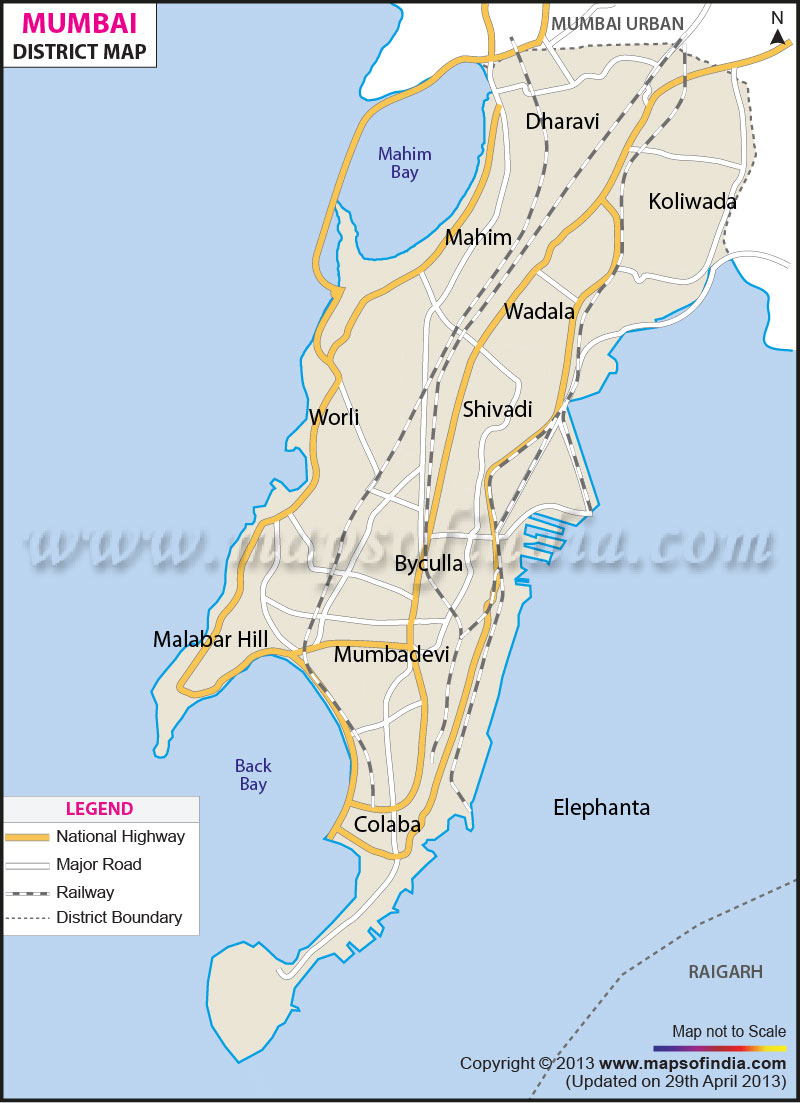
Mumbai is situated along the Arabian Sea on India's western coast. Originally consisting of seven tiny islands, the city was then connected by land reclamation. Mumbai has a lengthy coastline with beaches like Versova, Girgaum, and Juhu as a result. Although there are a few tiny hill areas, particularly in the northern parts of the city, the topography is generally flat.
The development of Mumbai has been to a large extent influenced by the sea that encircles it on three sides. During British administration, the natural harbor made it a major port city, and the water continues to play a significant role in transportation and commerce today. Creeks, rivers, and mangrove areas are also present in the city, however many of them have reduced over time as a result of construction.
The region has a tropical climate. For most of the year, it is typically hot and muggy. With temperatures frequently rising beyond 30 degrees Celsius, the summers, which run from March to May, may be extremely miserable. The heat feels more intense due to the humidity.
The monsoon season, which runs from June to September, is crucial. During these months, the city experiences significant rainfall. Rain relieves the heat, but in many places it also results in waterlogging and traffic issues. November through February is a brief and mild winter with good weather and chilly evenings.
| Particular | Details |
|---|---|
| Official Name | Mumbai |
| Location | Maharashtra |
| Area | 603.4 sq. km |
| Population | 12,442,373 |
| Language | Marathi |
FAQs
Q.1:Which language is most often spoken in Mumbai?
Although Hindi and English are widely spoken, Marathi is the primary language. Because of the city's diverse population, many other Indian languages are also spoken there.
Q.2:What makes Mumbai well-known?
Bollywood, financial markets, crowded local trains, street food, colonial structures, and a never-ending work lifestyle are all well-known aspects of Mumbai.
Q3: What impact does Mumbai's monsoon have?
During the monsoon season, Mumbai receives a lot of rain, which relieves the heat but also causes traffic problems, waterlogging, and delays in daily life.
Q4: What makes Mumbai crucial to the Indian economy?
Mumbai is the financial and economic hub of India, home to important banks, stock exchanges, corporate offices, and ports.
Last Updated on : May 12, 2026