Hyderabad District Map (Telangana) |
|
||||||||||
 | ||||||||||
|





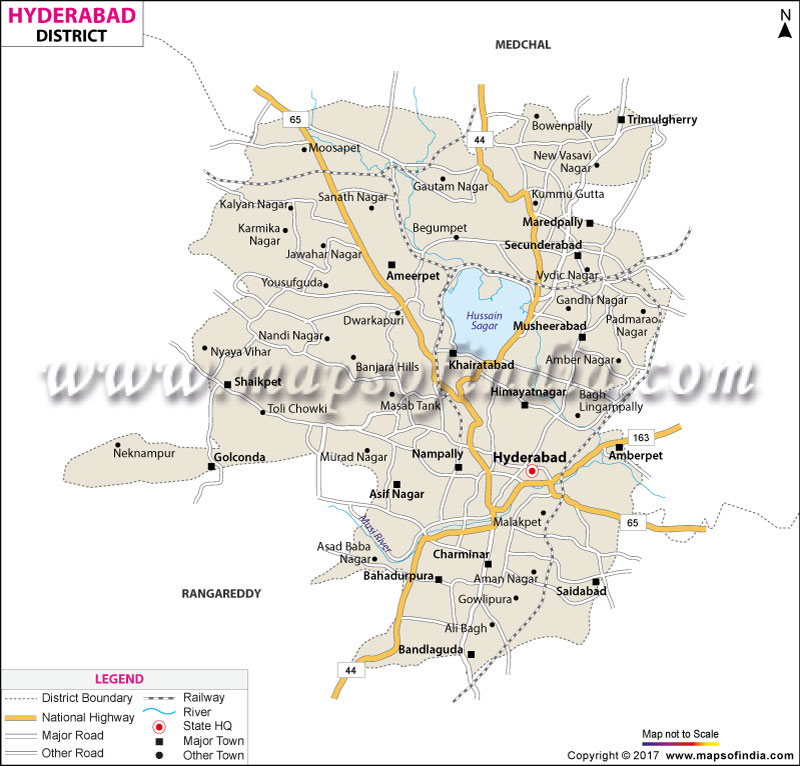
| *Hyderabad District Map highlights the National Highway, Major Roads, District Headquarter, etc in Hyderabad. |
| Districts of Telangana |
 |
 |
 |
 |
| Adilabad District Map | Nalgonda District Map | Mahbubnagar District Map | Medak District Map |
 |
 |
 |
 |
| Khammam District Map | Warangal District Map | Rangareddi District Map | Karimnagar District Map |
 |
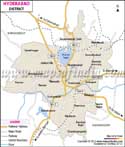 |
||
| Nizamabad District Map | Hyderabad District Map | ||
About
The small size of the Hyderabad district by area, however, doesn't detract from its importance in the state as a whole. It includes the historical areas of the walled city, Charminar, the old business areas and neighbourhoods developed around the Nizam-era establishment, before the more suburban areas encircle Rangareddy and Medchal-Malkajgiri. At only 217 square kilometres, it is one of the most densely populated districts in the country, and shows just how much life is crammed into this relatively small urban core.
District Hyderabad is the seat of the government of Telangana state and, before the bifurcation of Andhra Pradesh, the shared capital of two states, has a disproportionate importance in terms of administration and symbolism. It is completely urban in nature and does not have any villages in the traditional sense, but only mandals, wards and municipal divisions because it is completely within the jurisdiction of the Greater Hyderabad Municipal Corporation. The district's identity has been shaped over four centuries, from the city's inception by the Qutb Shahi dynasty, through the refinement under the Nizams, and now the city reinvents itself as one of India's leading hubs for technology, pharmaceutical and higher education.
History & Culture
The city of Hyderabad and by extension the district, dates back to 1591 when the fifth of the Qutb Shahi dynasty, Muhammad Quli Qutb Shah decided to shift the capital from the fort of Golconda on the hilltop to the banks of the Musi river. Built in the same year as the Charminar, the iconic building was said to be built due to the end of a plague that had swept through the region and this is what makes it even more historic and important. During the coming centuries, the city was occupied by the Mughals and from 1724 by the Nizams of Hyderabad, one of the richest and most powerful princely states of colonial India. The legacy of this Nizami era was indelible: grand palaces, mosques and civic institutions sprang up throughout the city and Hyderabad emerged with its own unique Deccani culture with an influence of Persian, Turkish and local Telugu culture.
After the Police Action of 1948, Hyderabad State was merged with India and the city became the capital of the newly formed states of undivided Andhra Pradesh in 1956 and the sole capital of the newly formed state of Telangana after 2014.
The district is still one of the most cosmopolitan cities in India. Its cuisine, particularly Hyderabadi biryani, is now internationally popular and festivals such as Bonalu and Bathukamma celebrate Telangana's traditions along with other Islamic festivals such as Ramzan, Milad-un-Nabi and others that are carried forward from the Nizami tradition. Yet many of the Old City's bustling bazaars, including Laad Bazaar and Charminar, are like a living museum of this Deccani history, even as other pockets of the district are full of a completely modern, tech-savvy lifestyle.
Economy
The government sector is the one that employs a large number in the district, as a large number of government offices are available in the district, including the secretariat of the government of Telangana state. It contains government ministries, the state assembly and other regulatory bodies, providing a solid, long-term career for a significant share of citizens.
Public Sector: Several public sector bodies and institutions are based in the district that have links with banking, insurance, defence research and telecommunications. Hyderabad, as the second financial hub of South India after Chennai and Bengaluru, has a significant number of public sector banks and financial institutions in the city with regional offices.
Services Sector: This is the sector that is the powerhouse of the district's modern economy. The district has also retained its status as a commercial centre, such as Abids and Koti, and is blessed with a large number of IT/ITES, pharmaceuticals and biotechnology establishments, even if they are physically largely located in the neighbouring Rangareddy and Medchal-Malkajgiri, which are also thriving business centres. Tourism is another significant source, and its hub of historical sites allows the district to be home to some of the oldest and most prestigious hospitals, colleges and research centers in the region, while its hospitality and retail businesses provide significant support to the old town.
Tourism
Most of the region's popular locations are situated in the Hyderabad district, the major tourist destination of the area.
The four-towered monument of Charminar built in 1591 is the city’s landmark and it is surrounded by busy streets of the Old City and the renowned Laad Bazaar that is a bazaar famous for bangles and pearls.
Adjacent to the Charminar is one of the oldest and the largest mosques of India which is named as the Mecca Masjid and it is said to be built out of bricks that are said to have originated from Mecca therefore holding an important value among the people visiting the place.
The Chowmahalla Palace, the former palace of the Nizams, is a massive palace complex with a number of vintage cars, royal relics and Durbar Hall and courtyards.
One of the world's largest one-man collections of antiques, including art, manuscripts and objects gathered by Salar Jung III from all over the world, Salar Jung Museum.
The Hussain Sagar lake is also in the city centre, has an excellent monolithic Buddha statue and a popular Tanak bund promenade.
The white marble hilltop temple, Birla Mandir, with its skyscraping height, provides a view of the city, while the Birla Planetarium is still a popular family attraction and school outing.
On the edge of the district, right on into Rangareddy, is Golconda Fort, the legendary diamond fort once famous for diamond trading, where the acoustics are so advanced that a voice can be heard echoing across the courtyard and where they do sound-and-light shows to entertain the crowds in the evenings.
Along with these displays, the Old City neighbourhoods around Charminar offer a treasure trove of slow, unhurried sightseeing — and what is not to love: narrow streets with perfume stores or silver shops or some of the city's most famous biryani and Irani chai spots.
The courts, libraries and railway architecture of Nampally and Abids provide a glimpse of the colonial and early 20th-century Hyderabad and at the same time the area surrounding the Public Gardens has the Telangana State Assembly and several museums within walking distance of one another.
Demographics
The total population of Hyderabad district is 3,943,323 according to the 2011 census
which includes 2,018,575 males and 1,924,748 females with a sex ratio of 954 females per 1000 males and that makes it a good statistics ratio. The literacy rate of the district is 83.25% which is slightly higher than the literacy rate of the state and out of this the male literacy rate is 86.99% and the female literacy rate is 79.35% showing how the national disparity resonated in the district data as well.
The two major languages in use in the district are Telugu and Urdu, reflecting the history of the Qutb Shahis and Nizamis, and Hindi and English are also widely used, especially in the commercial and administrative realm. The religious profile of the district also mirrors this multi-layered history, as it has a considerable Muslim population and also a majority of the population is Hindu with one of the more religiously diverse demographics of the district compared to Telangana districts.
These statistics help characterize a district which is not just a conventional administrative region, but a continuous organism of the city itself. There isn't even a rural/urban divide here: everyone lives within the metropolitan landscape of the city, impacting everything from housing to civic services to daily life. The high density and crowds in this small area are the same reason why Hyderabad district is the most populated urban district in the region and one of the most productive in the economy, and this continues to happen as the metro area is getting larger and spreading into neighbouring districts.
Administration
In Hyderabad district, there are 2 revenue divisions and 16 revenue mandals with 62 Mandal Praja Parishads. Unlike most parts of Telangana, there are no villages in the traditional sense in this district. The entire district is urbanised and is administered by a single civic body which is the Greater Hyderabad Municipal Corporation (GHMC) and serves as the sole municipal body in the district but the district is made up of 32 towns or urban settlements and this gives it a completely city-based administrative unit. The district collector's office oversees revenue administration and civic services and works closely with the GHMC and from the same geographical area the Telangana state secretariat handles the governance of the state. The civic services including water supply, sanitation, roads and town planning fall under the GHMC's review and the land records, revenue collection, law-and-order administration is the duty of district collector and mandal-level revenue officers.
| Facts of Hyderabad District | |
|---|---|
| Official Name | Hyderabad |
| Location | Telangana |
| Area (km2) | 217 |
| Population | 39,43,323 |
| Language | Telugu, Urdu |
FAQs
Q1: How many villages are there?
There are 67 revenue villages in the Hyderabad district.
Q2: What is the population of the district?
39,43,323 (2011 census).
Q3: What is it famous for?
Charminar, Golconda Fort, Chowmahalla Palace, Hussain Sagar Lake, the Nizami culture and the Hyderabadi biryani.
Q4: What is the literacy rate of the district?
83.25%.
Q5: Which languages are spoken in Hyderabad district?
Telugu, Urdu, Hindi and English.
Q6: In how many mandals and revenue divisions is Hyderabad district divided?
The district comprises 2 revenue divisions with 16 revenue mandals.
Q7: State the important industries of Hyderabad district?
The district is mainly dominated by government administration, banking and financial services, healthcare, education and IT and pharmaceutical-associated services.
Q8: What is the local administration of Hyderabad district like?
The entire district is administered through the Greater Hyderabad Municipal Corporation (GHMC) which is the only civic body in the district and the district collector's office for revenue administration.
Last Updated on : August 05, 2026
