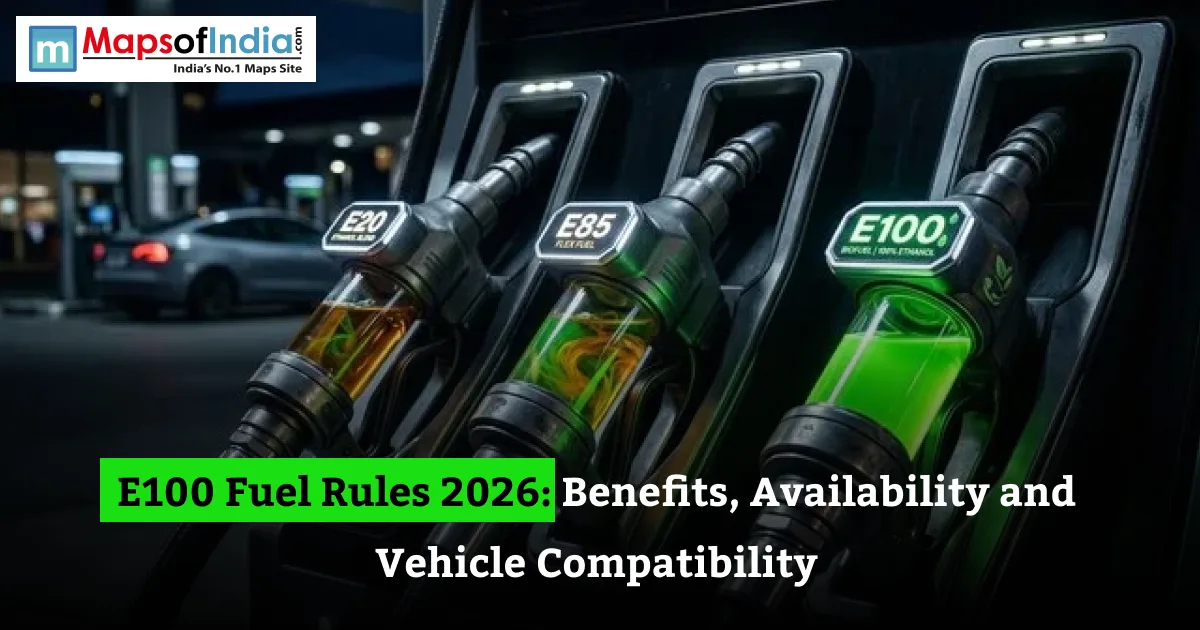
The government of India has just taken another step towards alternative transport fuels by formally approving E100 fuel for use in compatible flexfuel vehicles. On 26 October 2026, the Ministry of Road Transport and Highways released an amendment to the Central Motor Vehicles Rules, 1989, in which E100 has been added alongside E85 in appropriate emission certification requirements. The transfer paves the way for a more streamlined regulatory process for cars powered by high-ethanol fuels.
E100 fuel can play a role in slashing India's reliance on imported crude oil, aiding ethanol production in the country and offering an alternative to the auto sector. But it will be limited to vehicles that are compatible, fuel supply, cost, and refuelling station infrastructure development.
What Is E100 Fuel?
E100 is a high-ethanol fuel that is virtually pure ethanol and is derived from agricultural feedstocks like sugarcane and maize. The designation refers to the ethanol content, but the actual ethanol composition varies based on the fuel specifications.
Compared with conventional petrol, E100 is mainly composed of ethanol and not hydrocarbons. It is also different from E20 fuel (20% ethanol blended with petrol) and E85 fuel (85% ethanol).
E100 is for specially designed flex-fuel vehicles that are capable of running on approved ethanol-petrol mixes. The vehicles are equipped with fuel-system components and engine-management technology that are compatible with the various fuels.
What Are the E100 Fuel Rules in India in 2026?
The biggest development was the notification of the Ministry of Road Transport and Highways to make changes in the Central Motor Vehicles Rules, 1989. The notification was issued on 23.10.26 and published in the Official Gazette on 26.10.26.
The changes strengthen the emission certification provisions by adding E100 to the list of fuels. They also make clear that these fuels are for vehicles that were originally designed by the manufacturer to be flex-fuel. These vehicles have to comply with the emission and safety standards applicable to their category.
The change is not to say that there is no longer any restriction on the use of E100 fuel in petrol-based vehicles. Non-EFVH models of cars, motorcycles and scooters are not automatically fitted with the ability to run on E100. If a fuel meets fuel specifications for a lower ethanol content, that does not demonstrate its suitability for a higher ethanol content.
Furthermore, all vehicle owners are not required to make any changes to their existing vehicles or fuel sources. The fuel recommendations in the owner's manual should be followed, and the vehicle's compatibility label consulted when choosing fuel.
Benefits of E100 Fuel
1. Reduced Dependence on Crude Oil Imports
Transport fuel has also been a key component of India's energy security imports, a significant percentage of which comes from the country. Domestic ethanol production could be increased to substitute for some of the petroleum use and help eliminate dependence on foreign oil prices.
E100 is available to be used as a primary fuel source in compatible vehicles instead of petrol with a smaller percentage content of ethanol.
2. Support for Farmers and Rural Industries
The production of ethanol can generate a demand for agricultural raw materials such as sugarcane and maize. Increased demand may provide additional income opportunities for farmers and encourage investment in distilleries, processing facilities, storage and transportation.
Sustainable agriculture practices, production costs, water supply, and the ratio of fuel production to food will determine the benefits.
3. Potential Environmental Benefits
Ethanol does contain oxygen and will result in cleaner burning under proper engine operating conditions. Ethanol-based fuels are capable of decreasing some tailpipe emissions when used as a fuel, depending on the type of fuel, composition of the ethanol, and how the engine is operated.
The overall climate impact of E100, however, is affected by the whole production process, from farms to processing, to energy use and transportation. It should not be taken for granted that it is carbon neutral. To achieve meaningful lifecycle emission reductions, sustainable production will be vital.
4. Development of Alternative-Fuel Technology
An increased use of high ethanol fuels could support the development of new engines, fuel systems and electronic controls by automobile manufacturers. Indian manufacturers and component suppliers could be poised to derive opportunities to create flex-fuel technologies as per domestic requirements.
This may also provide a diversification of the transport-energy options for the country and also help in lessening dependence on a single fuel source.
E100 Fuel Availability in India
There is still a key factor to consider for motorists, and that is the availability of E100. IndianOil launched ETHANOL 100 at select outlets in March 2024 in Maharashtra, Karnataka, Uttar Pradesh, New Delhi and Tamil Nadu.
This is, however, not a nationwide rollout, but a limited rollout. However, not all petrol pumps that sell E20 will have E100, and the October 2026 change in regulation does not mandate that E100 will be available at all pump sales outlets.
Acceptability needs to be supported by suitable storage, dispensing and distribution infrastructure, alongside an adequate demand from compatible vehicles. If you are thinking of buying a flex-fuel vehicle, or are planning a long trip, motorists are urged to check with authorised fuel retailers for local supply of E100 fuel before using it.
Which Vehicles Are Compatible with E100?
E100 should be used in flex-fuel vehicles that are specifically designed and approved for use with high-ethanol fuels. These cars can run various blends of petrol and ethanol, depending on their approved specifications, within a certain range.
In June 2026, Maruti Suzuki launched its Wagon R passenger car that can run on ethanol-petrol blends from E20 to E100. It was initially reported for homologation of E85 fuel within the current regulatory procedures. The revised rules were amended in October, offering a route to E100-compatible vehicles.
E100 petrol should not be used in conventional petrol cars, motorcycles, and scooters unless the manufacturer has approved and certified them to run on E100. A wrong concentration may cause damage to fuel system parts, or engine operation or damage to seals and hoses.
Buyers should first verify the manufacturer's advertised fuel range, certification, warranty coverage, and service before purchasing E100.
E100 Fuel vs E20 Petrol
E20 petrol is around 20% ethanol and 80% petrol, and E100 petrol is nearly all ethanol. This difference impacts vehicle compatibility, energy content, and fuel consumption.
E20 is a part of India's larger petrol-blending initiative and is found in petrol stations much more widely. The use of E100 fuels demands the use of specifically labelled vehicles and the availability of dedicated fuels.
Ethanol also has less energy per litre than petrol. This means that an E100 vehicle could use more litres of fuel to travel the same distance, depending on how efficient the engine is and the conditions under which the car is driven. Rather than comparing prices per litre, it is important for consumers to also consider the cost per kilometre to understand if the fuel is cost-effective.
Challenges in Adopting E100 Fuel
Despite its potential advantages, E100 faces several challenges. Limited refuelling infrastructure could make it inconvenient for motorists to travel beyond areas with authorised outlets. The additional engineering required for flex-fuel vehicles may also affect their purchase price and maintenance needs.
Fuel economy is another consideration because ethanol's lower energy content can increase consumption by volume. In addition, expanding ethanol production sustainably will require careful management of agricultural resources, water use and processing energy.
The long-term success of E100 will depend on affordable vehicles, reliable fuel supplies, clear compatibility information and consistent fuel-quality standards.
What E100 Fuel Rules Mean for Motorists
The 2026 amendment is an important regulatory step towards expanding high-ethanol fuel use in India. It formally incorporates E100 into relevant vehicle emission-certification provisions and provides a pathway for manufacturers to introduce compatible flex-fuel vehicles.
For existing motorists, there is no immediate requirement to change vehicles, modify engines or start using E100. Conventional petrol and E20 vehicles must continue using fuel grades approved by their manufacturers.
Consumers considering flex-fuel vehicles should evaluate fuel availability, expected mileage, purchase costs and service support before making a decision.
E100 could contribute to India's energy diversification and support domestic ethanol production, but its wider adoption will depend on practical implementation. Regulatory recognition is an important beginning; accessible refuelling infrastructure, suitable vehicles and sustainable fuel production will determine how widely E100 is used across the country.
FAQs
1. What is E100 fuel in India?
E100 is a high-ethanol fuel consisting almost entirely of ethanol. It is intended for specially designed flex-fuel vehicles that can operate on high-ethanol fuel grades. India is exploring E100 as part of its efforts to reduce dependence on imported crude oil and promote alternative transport fuels.
2. What are the E100 fuel rules in India for 2026?
In October 2026, amendments to the Central Motor Vehicles Rules, 1989, incorporated E100 alongside E85 in relevant vehicle emission-certification provisions. The rules provide a regulatory pathway for vehicles designed and certified to use these fuels. They do not make E100 compulsory for motorists or permit its use in every petrol vehicle.
3. Can existing petrol cars and bikes use E100 fuel?
No, not unless the vehicle manufacturer has specifically approved and certified the vehicle for E100. Conventional petrol cars, motorcycles and scooters may have fuel-system components that are incompatible with high ethanol concentrations. Owners should check their vehicle manuals and manufacturer guidance before using alternative fuel grades.
4. Where is E100 fuel available in India?
E100, marketed as ETHANOL 100, was introduced at selected IndianOil retail outlets in March 2024. Availability remains dependent on the location and authorised fuel supply. Motorists should contact local fuel stations to confirm whether E100 is available before planning to use it.
5. What are the main benefits of E100 fuel?
The main potential benefits include reduced dependence on imported crude oil, support for farmers and domestic ethanol producers, diversification of transport fuels and the potential reduction of certain emissions. The actual economic and environmental benefits depend on fuel production methods, vehicle efficiency, pricing and sustainable agricultural practices.
6. What is the difference between E100 and E20 petrol?
E20 petrol contains approximately 20% ethanol blended with 80% petrol, whereas E100 consists almost entirely of ethanol. E20 is widely used in India's petrol-blending programme, while E100 requires specifically compatible vehicles. E100 also has lower energy content per litre than petrol, which can affect fuel consumption.
7. Is E100 fuel mandatory for vehicles in India in 2026?
No. India's 2026 E100 regulatory changes do not require all vehicles to use E100. The provisions concern vehicles specifically designed and certified for high-ethanol fuels. Existing vehicle owners should continue using the fuel grades approved by their manufacturers.