China's Medog Hydropower Station is now the largest active megaproject still being built close to its original scale, with a projected cost of $137 to $170 billion. Saudi Arabia's NEOM once held that title, but its scope has been significantly scaled back since late 2025. This guide covers the world's biggest infrastructure projects under construction right now, what they cost, where they stand, and why a surprising number of them are running behind schedule or shrinking in ambition.
What Counts as a "Megaproject"?
Criteria Used for This Ranking
Researchers generally define a megaproject as any construction effort costing more than $1 billion, running across multiple years, and requiring complex coordination between governments, private companies, and often international partners. This list ranks projects by total cost and physical scale, and includes only projects with construction genuinely underway, not ones still in the planning or proposal stage.
Top 10 Biggest Infrastructure Projects Under Construction
1. Medog Hydropower Station — China
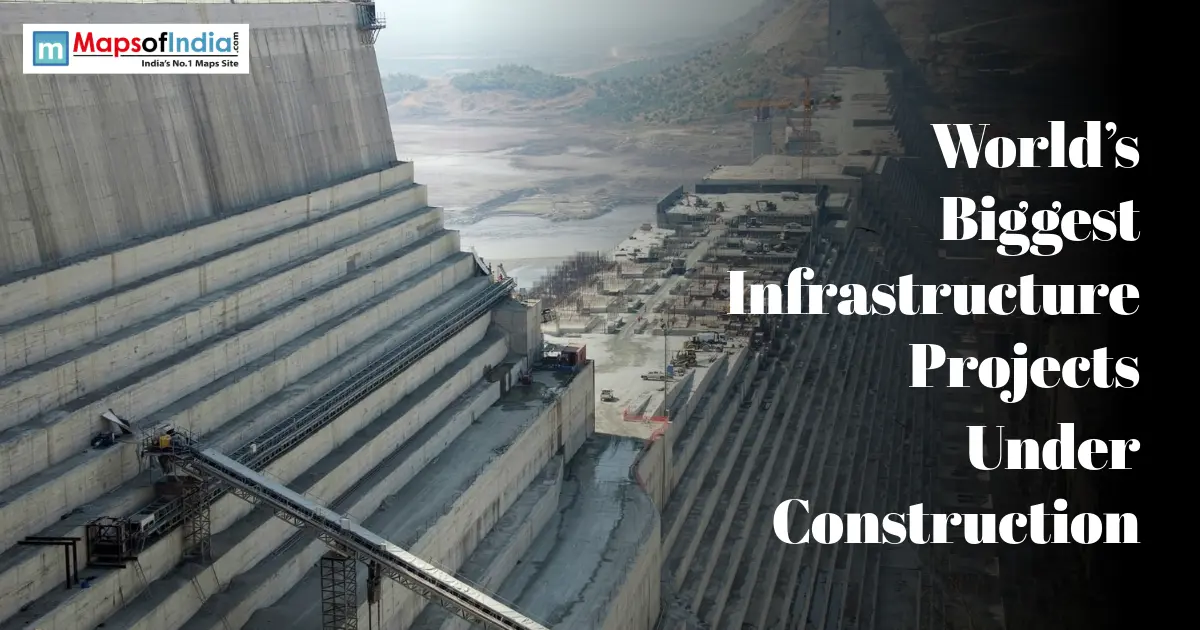
Construction began in July 2025 on the Yarlung Tsangpo River in Tibet. The project costs an estimated $137 to $170 billion, depending on the source. Once complete, likely around 2033, it will generate roughly 60 gigawatts, close to three times the output of China's own Three Gorges Dam. It is also genuinely controversial, given real concerns from India and Bangladesh over downstream water security.
2. Stargate AI Infrastructure Project — United States
This $500 billion project is currently the most actively funded megaproject anywhere in the world. Centred on a massive campus in Abilene, Texas, it is building out AI data centre and energy infrastructure at enormous scale. It already employs over 6,400 construction workers, with more than 100,000 total jobs expected once fully built out.
3. NEOM — Saudi Arabia
The original planned total cost of NEOM is currently estimated to be more than $500 billion, making it the largest construction project in the world. It has been drastically cut, however, in the 2026 report. Its flagship idea of a linear city, The Line, was halted in September 2025. The project is now turning a new page with AI data centres and green hydrogen infrastructure.
4. Gulf Railway (GCC Railway) — Saudi Arabia, UAE, Qatar, Kuwait, Bahrain, Oman
This aims to achieve a rail network that is roughly $250 billion in value and will link all six members of the Gulf Cooperation Council with a view to increasing freight efficiency and strengthening regional economic integration in the Gulf.
5. King Abdullah Economic City (KAEC) — Saudi Arabia
It is estimated that KAEC will cost $100 billion, with a projected completion date of 2029. It is one of the largest economic diversification ventures of Saudi Arabia, an undertaking to diversify its oil-based economy.
6. California High-Speed Rail — United States
This project is building the first true high-speed rail line in the US, linking the Central Valley to the Bay Area and Los Angeles. Cost estimates vary significantly by source and project phase, ranging from roughly $12 billion for current active segments to well over $100 billion for the full original vision. It has already generated more than 16,100 construction jobs.
7. Chuo Shinkansen Maglev Line — Japan
This high-speed maglev line is meant to connect Tokyo and Nagoya in about 40 minutes. It has faced repeated delays, largely tied to environmental disputes over water resources in Shizuoka Prefecture, and no firm new completion date has been confirmed.
8. South-North Water Transfer Project — China
This massive, multi-decade project moves water from southern China to the water-scarce north through several major engineered routes. Different phases remain under construction, and the total investment across the full project runs into the hundreds of billions of dollars.
9. Al Maktoum International Airport Expansion — United Arab Emirates
Dubai is expanding this airport toward an eventual capacity of roughly 260 million passengers a year, positioning it to become the world's largest airport by passenger volume once complete.
10. HS2 — United Kingdom
The UK's high-speed rail project is also facing cuts, as plans for the Birmingham to Manchester route were dropped in 2023. Work is ongoing on the final stage from London to Birmingham.
| Rank | Project | Country | Cost (Est.) | Sector | Target Completion |
| 1 | Medog Hydropower Station | China | $137–170B | Energy/Dam | 2033 |
| 2 | Stargate AI Infrastructure | USA | $500B | Data/Energy | Ongoing, phased |
| 3 | NEOM | Saudi Arabia | $500B+ (scaled back) | Smart City | Ongoing, reduced scope |
| 4 | Gulf Railway | GCC Nations | $250B | Rail | Ongoing |
| 5 | King Abdullah Economic City | Saudi Arabia | $100B | Urban Development | 2029 |
| 6 | California High-Speed Rail | USA | $12B–$100B+ | Rail | Phased, delayed |
| 7 | Chuo Shinkansen (Maglev) | Japan | Unconfirmed | Rail | Delayed, no firm date |
| 8 | South-North Water Transfer | China | Hundreds of billions | Water Infrastructure | Phased, ongoing |
| 9 | Al Maktoum Airport Expansion | UAE | Unconfirmed | Airport | Ongoing |
| 10 | HS2 | United Kingdom | Reduced from original scope | Rail | Phased, delayed |
Biggest Infrastructure Projects by Region
Asia
China dominates this region, with the Medog Hydropower Station and South-North Water Transfer Project both ranking among the most ambitious engineering efforts on Earth. Japan's Chuo Shinkansen, despite its delays, remains one of the region's most technically advanced rail projects.
Middle East
Saudi Arabia and the UAE together account for a huge share of global megaproject investment, roughly two-thirds of total spending across the world's biggest projects, led by NEOM, the Gulf Railway, KAEC, and Dubai's airport expansion.
North America
The US leads here through two very different kinds of megaprojects: Stargate's AI infrastructure buildout and California's High-Speed Rail, one racing to meet AI-driven demand, the other still working through decades-old transportation ambitions.
Europe
The UK's HS2 represents Europe's most prominent current rail megaproject, even after significant scope reductions, alongside continued investment across the EU's broader TEN-T transport network.
Biggest Infrastructure Projects by Sector
Transportation (Rail, Bridges, Tunnels)
The Gulf Railway, California High-Speed Rail, Chuo Shinkansen, and HS2 all represent this category, and all four have faced real cost or timeline pressure at some point during construction.
Energy & Dams
Medog Hydropower Station leads this category by a wide margin, followed by continued global investment in renewable and grid infrastructure tied increasingly to AI data centre demand.
Airports & Ports
Al Maktoum International Airport's expansion stands out here, aiming for the title of the world's largest airport by passenger capacity once complete.
Smart Cities & Urban Development
NEOM and King Abdullah Economic City both represent this category, though NEOM's scaled-back ambitions show just how speculative and financially risky this type of megaproject can be.
Why These Megaprojects Matter
These projects create real, large-scale employment, often tens of thousands of jobs per project, and they reshape regional economies for decades. They also carry serious geopolitical weight. Medog's downstream impact on India and Bangladesh, and the Gulf states' shared investment in regional rail integration, both show how infrastructure decisions ripple well beyond a single country's borders.
Challenges Facing Megaprojects
Cost overruns are common, not exceptional. California's High-Speed Rail and HS2 have both seen dramatic cost and scope changes since their original announcements. Delays are just as common, as Chuo Shinkansen's stalled timeline shows clearly. Environmental concerns run through several of these projects too, from Medog's impact on Tibet's ecosystem and downstream neighbours to the water disputes slowing Japan's maglev line. Labour availability and coordination across governments and private partners add further complexity, especially on projects spanning multiple countries like the Gulf Railway.
Conclusion
The world's biggest infrastructure projects tell two different stories at once. Some, like Medog and Stargate, are moving forward at genuinely enormous scale. Others, like NEOM, California High-Speed Rail, and HS2, have all faced real scope reductions or delays since their original announcements. Megaprojects rarely go exactly to plan, and 2026's landscape makes that clearer than ever.
FAQs
What is the largest infrastructure project in the world?
NEOM was the clear leader in original planned cost, with a total cost of more than $500 billion. But the scope of the project was cut significantly in late 2025, and China's Medog Hydropower Station is now the world's biggest megaproject to be constructed with its original goals intact, at $137 to $170 billion.
Which country is building the most megaprojects?
In terms of total investment, both Saudi Arabia and China share the lead. Two-thirds of the world's megaproject expenditure is in Saudi Arabia and the UAE, and China is the world leader in energy and water megaprojects.
How much do megaprojects typically cost?
In general, a megaproject is considered any project with a price tag exceeding $1 billion, although the most massive projects on this list are in the hundreds of billions, with several exceeding half a trillion dollars.
When will the world's biggest projects be completed?
Timelines vary enormously. Medog targets 2033. KAEC targets 2029. The other projects, such as Chuo Shinkansen and HS2, have no concrete completion date in the near future, as they continue to experience delays.
Why do megaprojects so often go over budget or fall behind schedule?
Many megaprojects tend to exceed their original estimates of cost and time due to factors such as complex engineering, environmental conflicts, the need for multi-level government or private sector coordination, and changing political agendas.
Is NEOM still being built?
Yes, but on a much smaller scale than originally announced. The project has been temporarily stalled, with the focus now shifting towards the development of AI data centres and green hydrogen infrastructure, as part of The Line's flagship linear city project was suspended in September 2025.
What is the biggest energy megaproject currently under construction?
The largest of these is China's Medog Hydropower Station, which will have a capacity of 60 gigawatts, close to that of the Three Gorges Dam.
Are AI data centres becoming a major category of infrastructure megaproject?
Yes. The global trend towards investing heavily in AI infrastructure has led to the Stargate AI Infrastructure Project in the United States reaching an estimated cost of $500 billion, making it the most funded megaproject in the world.