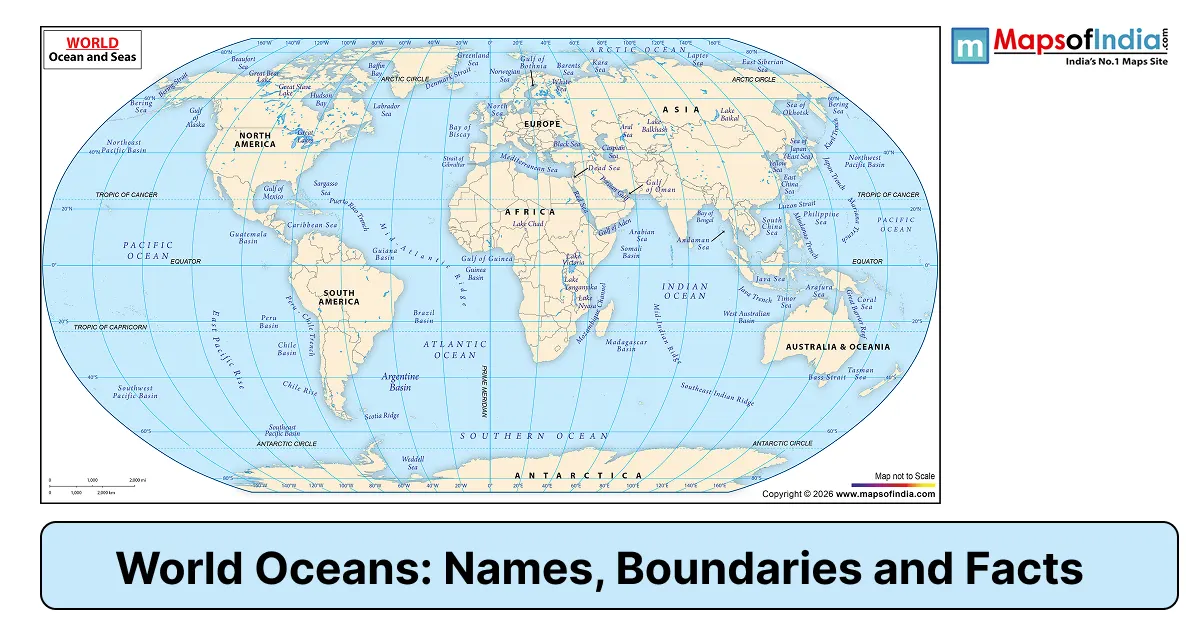
There are 5 Oceans that make up the world, collectively referred to as the 5 oceans of the world. Pacific, Atlantic, Indian, Southern, and Arctic. If you have ever looked at a world oceans map and thought to yourself, "Why did all of the oceans seem to pour over all of the land masses in the world? All five oceans are interconnected, and for purposes of this classification, these five oceans have been subdivided into five regions, as can be shown in the world ocean map. In this article, you will see in-depth information on all of the world's oceans. This article will give you a better understanding of the geography of the world's waters, as depicted on any world map, oceans and continents illustration.
How Many Oceans Are There in the World?
There are 5 oceans in the world. But this was not always the case. There used to be four known oceans. It was once thought that the waters around Antarctica were part of the Pacific, Atlantic and Indian oceans. However, this was changed in 2000 when the International Hydrographic Organization officially recognized the Southern Ocean.
One should be aware that the ocean boundaries of the world vary somewhat from one organization to another. Not all groups recognize the Southern Ocean. The IHO, NOAA and National Geographic each have slightly different criteria for defining the northern boundary of the Southern Ocean. The lines can be anywhere from 60 degrees South to the Antarctic Convergence. Note that if you compare two maps which have the oceans labelled, then the boundaries may be slightly different. These southern ocean boundaries remain the most debated of the five.
The Five Oceans of the World
Since you know that there are 5 oceans of the world, let's learn about the names of oceans and the locations of each of these.
Pacific Ocean
The Pacific Ocean is the largest ocean in the world and is bordered by Asia and Australia to the Americas. It has an area of approximately 165,200,000 km² and contains the deepest part of any ocean, the Mariana Trench.
Atlantic Ocean
The second largest of the world's oceans is the Atlantic Ocean, which is located between the Americas, Europe and Africa. The Atlantic Ocean encompasses an area of approximately 106,460,000 km² and contains the second deepest point, the Puerto Rico Trench.
Indian Ocean
The Indian Ocean is the third largest ocean in the world, located between Africa, Asia and Australia. The total area of the Indian Ocean is approximately 70,560,000 km². It has the warmest waters of any ocean and the Java Trench, the deepest point in this ocean.
Southern (Antarctic) Ocean
The Southern Ocean is the fourth largest of the oceans in the world, which encircles Antarctica. The Southern Ocean is approximately 20,327,000 square kilometres in size, depending on the particular measurements used, and contains the South Sandwich Trench. The Southern Ocean boundaries here follow the 60-degree South convention used by most cartographers.
Arctic Ocean
The Arctic Ocean is the 5th largest and shallowest ocean in the world. It is situated near the North Pole, and has an area of approximately 14,056,000 sq km. It contains the Molloy Deep, the deepest in this ocean.
World Oceans Comparison Table
Ocean | Area (sq km) | Avg Depth | Deepest Point | Bordering Continents |
| Pacific | 165,200,000 | 4,000 m | Mariana Trench (10,935 m) | Asia, Australia, N. & S. America |
| Atlantic | 106,460,000 | 3,646 m | Puerto Rico Trench (8,376 m) | N. & S. America, Europe, Africa |
| Indian | 70,560,000 | 3,741 m | Java Trench (7,290 m) | Africa, Asia, Australia |
| Southern | 20,327,000 | 3,270 m | South Sandwich Trench (7,236 m) | Antarctica |
| Arctic | 14,056,000 | 1,205 m | Molloy Deep (5,550 m) | N. America, Europe, Asia |
How Are Ocean Boundaries Defined?
One should be aware that the limits of the oceans of the world, as shown on any world map oceans and continents chart, are not sharp, definite lines. There are no fences in the water to indicate the boundaries between one ocean and another. Rather, such lines are arbitrary ocean boundaries, determined by organisations such as the IHO. These organisations study the currents and climates of the world's oceans and make recommendations for the placement of borders. These recommendations may change as well. With the advancement of technology and climate change, the IHO have had to make several revisions to their boundary recommendations since its first publication.
Oceans vs. Seas vs. Gulfs vs. Bays: What's the Difference?
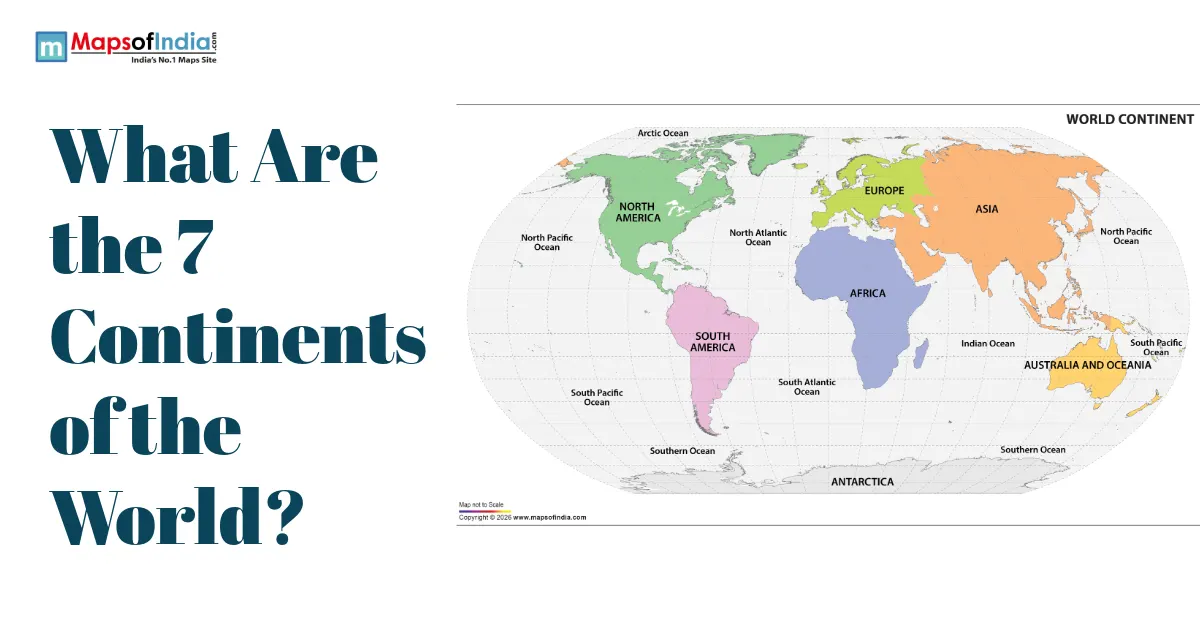
Oceans, seas, gulfs and bays can sometimes be confused. The simplest one is an ocean, one of the five great bodies of water that surround the world, and a sea is a smaller body of water surrounded by land on several sides. Seas are typically connected to an ocean, such as the Mediterranean Sea and the Caribbean Sea. A gulf is similar in form to a sea but is more enclosed by land than the sea; for example, the Gulf of Mexico. A bay is even smaller than a gulf or a sea, usually with a narrow entrance. All seas, gulfs and bays, however, are joined to one of the five oceans, as any world map oceans and continents reference will show.
Interesting Facts About the World's Oceans
The following are interesting facts about the world's oceans, many of which you can spot on any world oceans map.
The oceans of the world make up about 71 per cent of the Earth's surface and contribute to the Earth's iconic blue appearance from space. The Pacific Ocean holds more water than all of the other oceans combined, and remains the largest ocean in the world. The Arctic Ocean is the shallowest and smallest ocean in the world. The saltiest ocean is the Atlantic Ocean. The Mariana Trench in the Pacific Ocean is the deepest point in any of the world's oceans, and is deeper than Mount Everest is tall.
FAQs
1. What is a world ocean map?
A world ocean map shows the locations of the Earth's five oceans and their relationship with the surrounding continents.
2. What are the five oceans shown on a world ocean map?
The five oceans are the Pacific Ocean, Atlantic Ocean, Indian Ocean, Southern Ocean, and Arctic Ocean.
3. Which is the largest ocean in the world?
The Pacific Ocean is the largest and deepest ocean on Earth.
4. Which ocean lies south of India?
The Indian Ocean lies to the south of India and is the third-largest ocean in the world.
5. Why is a world ocean map important?
A world ocean map helps users understand the location, extent, and significance of the world's oceans for education, navigation, and geography.
6. What is the difference between an ocean and a sea?
An ocean is a vast body of saltwater, while a sea is a smaller body of saltwater that is usually partially enclosed by land.