
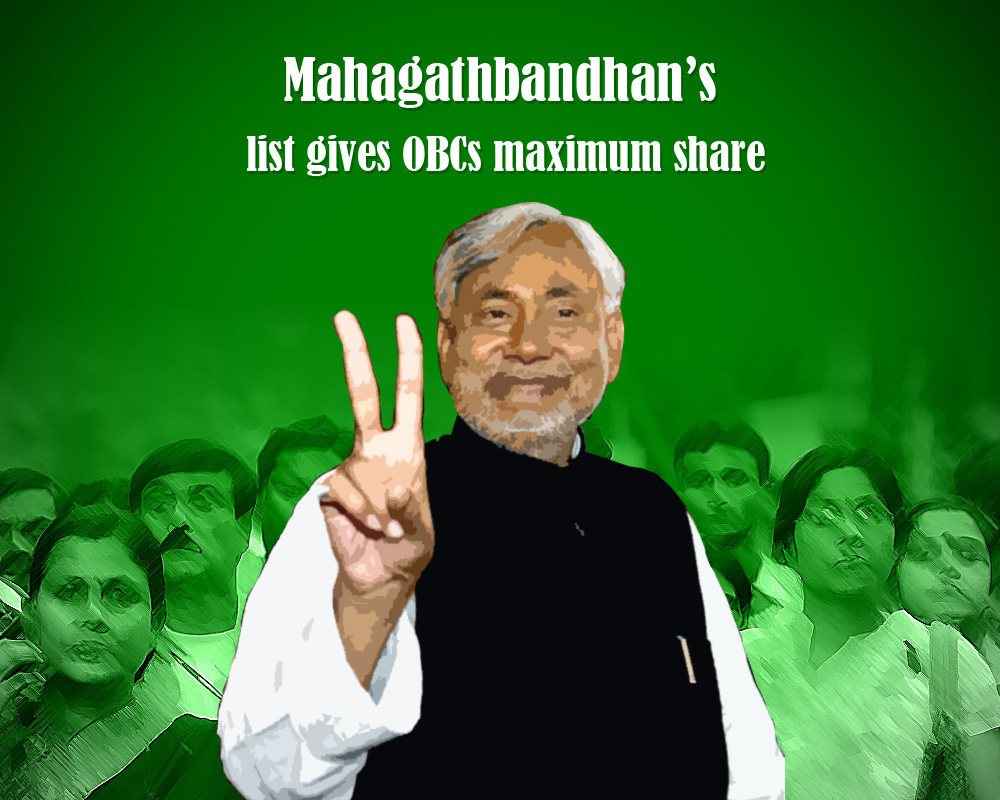
 The Grand Alliance announced its ‘joint’ list of 242 candidates yesterday giving the maximum seats to OBCs. Only the Rajgir (SC) seat will be announced later. 55% of the seats have gone to OBCs, 15% to SC/STs, 14% to Muslims and 16% to the General category.
A close look of the seat break-up shows a three-pronged strategy to capitalise on each party’s advantage. Nitish Kumar has concentrated on consolidating the Kurmi votes, which is his community, while JD(U) has focused its attention on the Kushwaha community, leaving RJD to concentrate on consolidating its hold on Muslim and Yadav communities, which have traditionally been its strength. The General category has been left to Congress.
Unfortunately, the seat break-up reveals only 10% seats have been allocated to women. While, CM Nitish Kumar made the announcement that all communities were well represented, he has missed the opportunity to capitalise on his largest support base. If he could have allocated a larger share of seats to women, within each of his ‘caste/community’ share categories, the Grand Alliance would have had a distinct edge over the NDA, since women comprise almost 50% of voters in Bihar. Given his strong goodwill amongst women voters, this was his chance to make a statement of support that would have seen him emerge as a leader of higher stature, with appeal beyond Bihar.
Nitish Kumar used the occasion to launch a blistering attack on the BJP saying that it was the political arm of RSS and that RSS was its Supreme Court, in a reference to Mohan Bhagwat’s recent statement on reservation.
JD(U) and RJD are contesting 101 seats each, while Congress is contesting from 41 seats.
The Grand Alliance announced its ‘joint’ list of 242 candidates yesterday giving the maximum seats to OBCs. Only the Rajgir (SC) seat will be announced later. 55% of the seats have gone to OBCs, 15% to SC/STs, 14% to Muslims and 16% to the General category.
A close look of the seat break-up shows a three-pronged strategy to capitalise on each party’s advantage. Nitish Kumar has concentrated on consolidating the Kurmi votes, which is his community, while JD(U) has focused its attention on the Kushwaha community, leaving RJD to concentrate on consolidating its hold on Muslim and Yadav communities, which have traditionally been its strength. The General category has been left to Congress.
Unfortunately, the seat break-up reveals only 10% seats have been allocated to women. While, CM Nitish Kumar made the announcement that all communities were well represented, he has missed the opportunity to capitalise on his largest support base. If he could have allocated a larger share of seats to women, within each of his ‘caste/community’ share categories, the Grand Alliance would have had a distinct edge over the NDA, since women comprise almost 50% of voters in Bihar. Given his strong goodwill amongst women voters, this was his chance to make a statement of support that would have seen him emerge as a leader of higher stature, with appeal beyond Bihar.
Nitish Kumar used the occasion to launch a blistering attack on the BJP saying that it was the political arm of RSS and that RSS was its Supreme Court, in a reference to Mohan Bhagwat’s recent statement on reservation.
JD(U) and RJD are contesting 101 seats each, while Congress is contesting from 41 seats.
The Grand Alliance announced its ‘joint’ list of 242 candidates yesterday giving the maximum seats to OBCs. Only the Rajgir (SC) seat will be announced later. 55% of the seats have gone to OBCs, 15% to SC/STs, 14% to Muslims and 16% to the General category.
A close look of the seat break-up shows a three-pronged strategy to capitalise on each party’s advantage. Nitish Kumar has concentrated on consolidating the Kurmi votes, which is his community, while JD(U) has focused its attention on the Kushwaha community, leaving RJD to concentrate on consolidating its hold on Muslim and Yadav communities, which have traditionally been its strength. The General category has been left to Congress.
Unfortunately, the seat break-up reveals only 10% seats have been allocated to women. While, CM Nitish Kumar made the announcement that all communities were well represented, he has missed the opportunity to capitalise on his largest support base. If he could have allocated a larger share of seats to women, within each of his ‘caste/community’ share categories, the Grand Alliance would have had a distinct edge over the NDA, since women comprise almost 50% of voters in Bihar. Given his strong goodwill amongst women voters, this was his chance to make a statement of support that would have seen him emerge as a leader of higher stature, with appeal beyond Bihar.
Nitish Kumar used the occasion to launch a blistering attack on the BJP saying that it was the political arm of RSS and that RSS was its Supreme Court, in a reference to Mohan Bhagwat’s recent statement on reservation.
JD(U) and RJD are contesting 101 seats each, while Congress is contesting from 41 seats.
The Grand Alliance announced its ‘joint’ list of 242 candidates yesterday giving the maximum seats to OBCs. Only the Rajgir (SC) seat will be announced later. 55% of the seats have gone to OBCs, 15% to SC/STs, 14% to Muslims and 16% to the General category.
A close look of the seat break-up shows a three-pronged strategy to capitalise on each party’s advantage. Nitish Kumar has concentrated on consolidating the Kurmi votes, which is his community, while JD(U) has focused its attention on the Kushwaha community, leaving RJD to concentrate on consolidating its hold on Muslim and Yadav communities, which have traditionally been its strength. The General category has been left to Congress.
Unfortunately, the seat break-up reveals only 10% seats have been allocated to women. While, CM Nitish Kumar made the announcement that all communities were well represented, he has missed the opportunity to capitalise on his largest support base. If he could have allocated a larger share of seats to women, within each of his ‘caste/community’ share categories, the Grand Alliance would have had a distinct edge over the NDA, since women comprise almost 50% of voters in Bihar. Given his strong goodwill amongst women voters, this was his chance to make a statement of support that would have seen him emerge as a leader of higher stature, with appeal beyond Bihar.
Nitish Kumar used the occasion to launch a blistering attack on the BJP saying that it was the political arm of RSS and that RSS was its Supreme Court, in a reference to Mohan Bhagwat’s recent statement on reservation.
JD(U) and RJD are contesting 101 seats each, while Congress is contesting from 41 seats.


