




Introduction
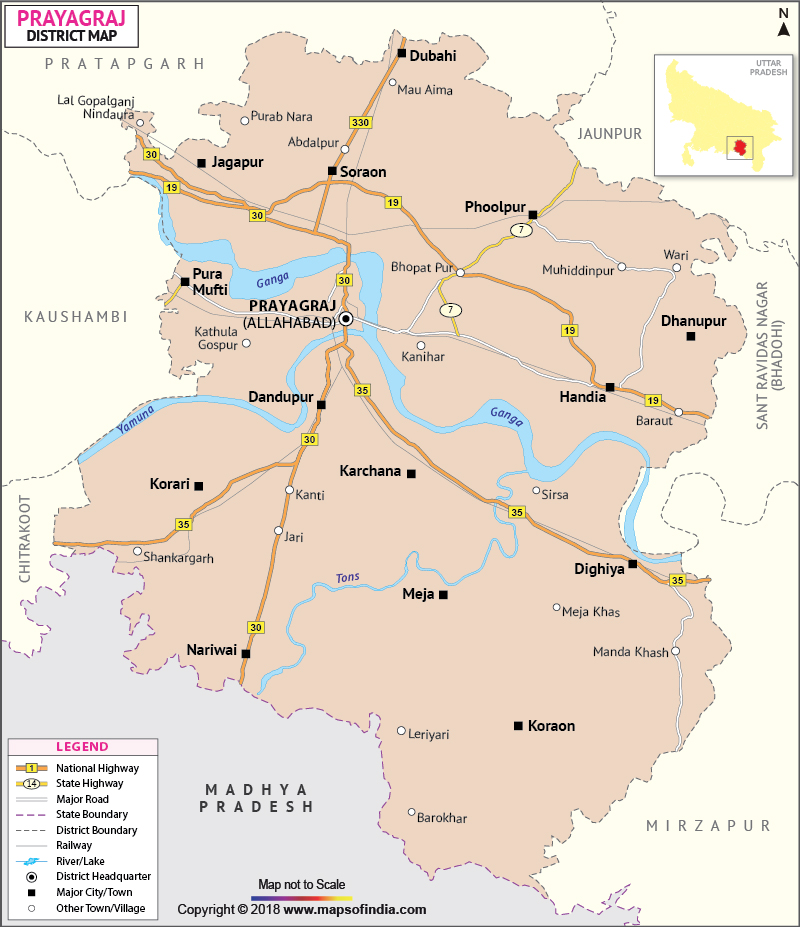
Prayagraj district is located on a strategic position in the political, religious and intellectual life of northern India, in its southern region of the state, clearly visible on the prayagraj district map. The Uttar Pradesh map highlights Prayagraj’s location as a major district situated near the confluence of the Ganga and Yamuna rivers, reflecting its unique geographical and cultural importance in the state. The location at the junction of the rivers, Ganga and Yamuna, and the mythical Saraswati, clearly visible on the prayagraj district map, a sacred junction, the Triveni Sangam also contributes immensely to the charm of the district. This crossroads has over centuries attracted pilgrims, scholars, rulers and travellers across the subcontinent and beyond making this a spiritual centre of long-term eminence. The allegory of the waters converging into one place has influenced the identity of the district as a place of meeting, communication and flow.
History
The region, which was called in the ancient times as Prayag, is referred to in the ancient Hindu scriptures and Puranic texts as a holy place of sacrifice and pilgrimage. The sacredness of it was due to the fact that it was the point of contact of rivers, which was considered a spiritually charged place, the intersection of earthly and divine worlds. Now its fame as one of the most important sacred centres in northern India is based on references to Prayag in classical writings.
In the third century BCE, the area was annexed to the Mauryan Empire. The Allahabad Pillar is currently located in the Allahabad Fort with inscriptions of Emperor Ashoka stating the expansion of the Mauryan rule and spreading of imperial decrees that promoted ethical governance. In subsequent centuries, the Gupta Empire had an influence in the region. The pillar is also decorated with the Prayaga Prashasti, written by Harisena in commemoration of Samudragupta, as offering historians much information regarding the political growth and statecraft of the fourth century.
In the medieval times, the land was placed under the influence of the Delhi Sultanate and later Mughal Empire. In 1583, the Mughal emperor, Akbar commissioned a massive fort to be built at the ford of the rivers and called the town Ilahabas, which was renamed Allahabad. The fort was constructed of sandstone and with a view of Sangam, it fulfilled strategic and administrative roles as well as represented the imperial power in an area which had religious significance. The influence of the Mughal strengthened the political centre of the district.
As the power of Mughals fell in the eighteenth century, the area underwent political changes and was transferred to the British rule in the early nineteenth century. Allahabad became a great seat of administration, law and education during the colonial rule. The new role of a legal and intellectual centre was further enhanced by the creation of the Allahabad High Court and the University of Allahabad. The district was linked to significant achievements in Indian freedom movement where political discussions were made and leaders were borrowed by the national cause. Following independence, Prayagraj remained an administrative and judicial centre and in 2018 its ancient name was formally returned.
Culture
The district of Allahabad also has a culture which represents a long-term interweaving of religious piety, educational and daily social culture. The cultural and spiritual center of the district is still the Sangam. Kumbh Mela is a peaceful Mela held under certain astrological calculations and has been noted to be one of the biggest in the world. Hindus and non-Hindus all around India and the world gather to take a bath in the sacred waters, which they think cleanses the soul and gives the spiritual merit. The Magh Mela also attracts huge masses of people, who spend the holy days camping on the banks of the rivers, clearly visible on the prayagraj district map building a unique seasonal culture of tents, ceremonies and shared living.
Hindu celebrations like Diwali, Holi, Dussehra and Makar Sankranti are celebrated with much fervour that light up the streets and houses with colour and light. The Muslim people celebrate Eid and other Islamic festivals, and the trends of interrelationships are very old. The plural character of the district is indicated by the presence of temples, mosques and other places of worship all over the district. The common involvement in the markets, fairs and civic spaces depicts daily cultural exchange.
Allahabad has been considered to be the seat of learning and literature. Scholars, writers, jurists and figures have been nurtured by the University of Allahabad and other institutions that are associated with it. The district has been the seat of Hindi and Urdu literary traditions and it has been linked with great authors and poets whose literary works have influenced the modern Indian literature. It has long been part of the civic culture to hold public lectures, recitations of poetry and scholastic debates. The educational culture of the district has helped it to develop the reputation of being a city of intellect and civic discussion.
Devotional singing and local performance traditions contribute to the enrichment of the community life especially during festivals and religious gatherings through music. The food in the district is a mix of Awadhi, eastern Uttar Pradesh food traditions, and has a range of breads, rice dishes, lentils and sweets. The markets and local restaurants in the streets add to the bustling urban culture, whereas the countryside keeps the traditions of culinary culture that is associated with the agricultural cycle.
Language
The major language in the Allahabad district is Hindi which also serves as the major language of administration, teaching and communication in general. The dialect spoken in the area in informal situations is the Awadhi which has its own unique phonetic and lexical peculiarities concerning the greater Hindi linguistic group. Awadhi literature has its own literary heritage and to this day influences the speech used in the rural and semi-urban regions in a daily routine.
The Urdu language is also used by some part of the population and especially the Muslim people, the language has a history of being called the poetry language and prose and high literary expression. Hindi and Urdu have coexisted, and this coexistence has resulted in a common pool of culture as evidenced in literature, music and talk. Introduction of the English language in the colonial era has remained significant in the area of higher education, litigation, and formal communications. The diversity of languages spoken in the district can be described as a result of the centuries of contact between cultures and the development of the administrative system.
Geography
The Allahabad district lies in the southern region of Uttar Pradesh, clearly visible on the prayagraj district map and in the large Indo-Gangetic Plain, clearly visible on the prayagraj district map which is one of the most fertile and populated regions in the world. Its geographical identity cannot be separated with its river system, most of which is the confluence of Ganga and Yamuna rivers at the city of Prayagraj, clearly visible on the prayagraj district map. Although the Saraswati is not physically visible, it is traditionally thought to combine with these rivers at the Sangam, and provides the physical landscape with the symbolism of depth. The rivers have long been natural divisions and trade routes as well as sources of irrigation and this has affected the ways of settlement and economic organisation.
The district topography is also mainly level with a deep alluvial soil deposited over the several centuries due to the activities of the rivers. This is a fertile soil used in large scale farming activity in the rural regions whereby wheat, rice, pulses and oilseeds are cultivated as per the season. It is possible to think of the district as a series of tracts that are defined by the courses of the rivers with some parts being in the middle of the two rivers and others going farther than their banks. Monsoon seasonal flooding can impact the low-lying regions, but monsoon floods also replenish soil fertility and support the long-term agricultural output.
The weather is characterized by high level of seasonal variance. The heat tends to be enormous during summers, and the temperature levels increase significantly before the monsoon sets in. The main part of the annual rainfall that renews the rivers and groundwater is received during the monsoon season which lasts usually between June and September. Winters are cool and foggy at times especially during the months of December and January forming unique seasonal rhythms of the day-to-day life. Such weather patterns affect the time of planting and harvesting of crops, water supply and timing of major religious events along the river banks.
The vegetation has been, in a large measure, replaced by cultivation and settlement, though some groves, orchards and trees here and there still cover the district. The Sangam form a unique geographical feature and Sandy as it stretches is growing and shrinking as the rivers rise and fall. These sandy plains are made into organised temporary settlements, with roads, lighting and public facilities, during large-scale fairs, as evidence of adaptive use of the riverine landscape.
The district is strategically located in northern India, in relation to connectivity. Prayagraj city also serves as a large railway crossing point in the eastern, western and central parts of the country. There is a road network where the district is connected to other key cities within Uttar Pradesh and the neighbouring states which facilitate trade, travel and administrative coordination. The fertile plains, river systems and established transport infrastructure have been the historical factors that have made the district to be economically and administratively relevant.
| Facts of Prayagraj District | |
|---|---|
| State | Uttar Pradesh |
| District | Allahabad |
| District HQ | Allahabad |
| Population (2011) | 5954391 |
| Growth | 20.63% |
| Sex Ratio | 901 |
| Literacy | 72.32 |
| Area (km2) | 5482 |
| Density (/km2) | 1087 |
| Tehsils | Allahabad, Bara, Handia, Karchhana, Koraon, Meja, Phulpur, Soraon |
| Lok Sabha Constituencies | 2-Allahabad, Phulpur |
| Assembly Constituencies | Allahabad North, Allahabad South, Allahabad West, Bara, Handia, Karachhana, Karaon, Meja, Phaphamau, Phulpur, Pratapur, Soraon |
| Languages | Hindi, Urdu, English |
| Religion | Hinduism, Islam |
| Rivers | Ganga, Yamuna |
| Lat-Long | 25.353955,81.952114 |
| Travel Destinations | Triveni Sangam, Alfred Park, All Saints Cathedral, Allahabad Fort, Allahabad High Court, Allahabad Museum, Anand Bhavan, Civil Lines, Jawahar Planetarium, Khusro Bagh, Kumbh Mela, Mayo Memorial Hall, Minto Park, New Yamuna Bridge, Thornhill Mayne Memorial etc. |
| Government Colleges/Universities | University Of Allahabad (Au), Motilal Nehru Medical College, Kamla Nehru Memorial Hospital, Ewing Christian Institute Of Management & Technology, United College Of Engineering & Research, C.M.P. Degree College, Mahendra Pratap Singh Degree College etc. |
FAQs
Q1: What is the significance of the Triveni Sangam in Prayagraj district?
It is regarded as one of the holiest sites in Hinduism and hosts major gatherings such as the Kumbh Mela.
Q2: When was Allahabad officially renamed Prayagraj?
The official renaming took place in 2018.
Q3: Which ancient inscription is found on the Allahabad Pillar?
The pillar bears inscriptions of Emperor Ashoka and the Prayaga Prashasti of Samudragupta.
Q4: Why is Prayagraj important in India’s judicial system?
It is the seat of the Allahabad High Court, established in 1866.
Q5: Which rivers meet at Prayagraj?
The Ganga and Yamuna meet there, and the Saraswati is traditionally believed to join them at the Sangam, clearly visible on the prayagraj district map.
Last Updated on : July 02, 2026
