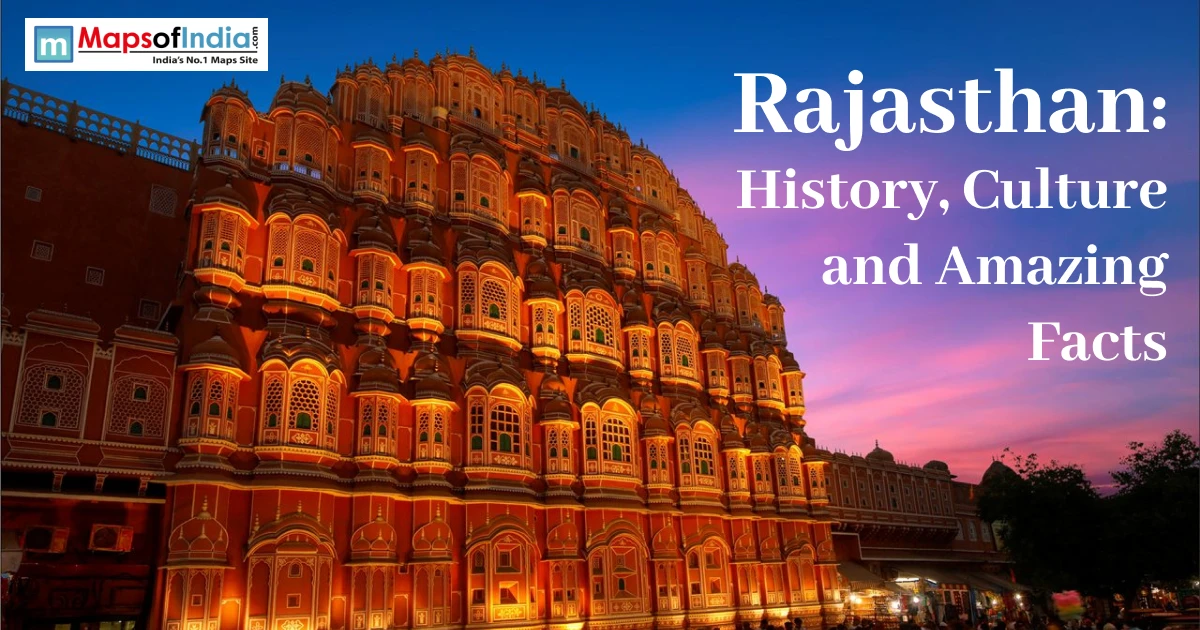
Rajasthan, the land of kings, is one of the most colourful and captivating states of India. Rajasthan is a land with many wonders; its culture and traditions are exceptionally alive, with royal palaces and magnificent forts, and also the vast arid lands. The state's heritage is the golden sands of the Thar Desert and majestic Aravalli hills, which narrate tales of courage, honour, and hospitality. You'll find a place where royalty is still alive and every corner is a legend.
Geography and Landscape
Rajasthan extends in the north-west of India, the widest of any of the states. To the west, the vast Thar desert stretches out, and the central ridges of the Aravalli range run across the land. Easterly, the flat areas are rich soil interspersed with small communities. It is surrounded by five countries: India and Pakistan. Very little rain here, hard scenes, dunes come close to stony rises, dry river beds lie waiting, the Luni creeps on the cloud break. A few lands are still dry after the monsoons, while other areas are green. In this place, nature is silent and becomes an active and living presence, one that is constantly evolving, from sand and sun.
Ancient and Medieval History
The history of Rajasthan began even before known history. The valiant Rajput families made it strong and proud. Some kingdoms like Mewar defied the change. Some shivered with fear, while Marwar showed no fear. Amber ascended to a position of power, but in silent and subtle ways. Rumblings of mutinies broke out on the hills, especially within the confines of Chittorgarh. Smart partnerships were made when it was most needed to be done, by the leaders of the Kachwaha line. The echoes of the Mughals have survived, stone by stone, with colonial overtones. Visualise a brave and courageous land: A land of courage and honour was the land of the past.
The Age of Rajput Kingdoms
Huge forts have been constructed by the rulers of Rajputana all over the land of India. In an act of resistance, Maharana Pratap held his position and thwarted the Mughals from Mewar's rugged hills. The city of Jodhpur emerged as a gateway to the desert, and Bikaner as a city of trade, and Jaipur grew prosperous in the heart of the desert. These royal courts proved to be a safe haven for art. There are still stories on the stone within the palace's halls. Today, the buildings of their departure rise above, silent sentinels with a niche in the sky. The legends of old kings and queens continue long after sundown, when they're heard around the campfire.
Rich Cultural Heritage
Colour bursts in all corners of Rajasthan, dancing in the Ghoomar and Kalbelia. The music is slow and deep, and the voice is reminiscent of old rhythms. The handmade crafts are handed down from generation to generation; each one is made with care, and it is stitched or carved following a pattern. They wear bright turbans and round skirts with swirling mirrors, and bright silver jewellery. These are details that say nothing, shout joy, identity and history. Here, life is a festival, communities coming together again and again, with the fairs. The meetings are akin to a painter's strokes on a painting that is continually evolving.
Festivals and Traditions
There are many festivals in the state of Rajasthan. As Diwali approaches, each and every corner is filled with excitement: Holi brings colour to towns, and Teej brings rhythm. Camels come in hundreds to Pushkar; people come from all over the world. Jaisalmer's desert is no longer just a desert, but comes alive mid-winter with songs and dances. Gangaur is a well-known and popular festival among all the festivals, even outside the state. Brightly glitters with heritage outfits. With open skies, old stories are danced. There are drums beating and people celebrating, parades going down the street. Festivals bring people together and aid the maintenance of traditional ways of life.
Famous Cuisine of Rajasthan
Here, meals pack intense flavours that can hold up to the heat of the desert. What about Dal Baati Churma, Gatte ki Sabzi, Ker Sangri, let alone Laal Maas? When water is scarce, they use ghee, hot spices and items from their dry food stash. Sweets like Ghevar and Feeni come from that land, giving a different taste to sweets. They have the feel of palace feasts, but are comfortable on a farmhouse table. Taste is the result of 'spice' and 'depth', of foods that have been experienced over many years.
Iconic Tourist Attractions
The history of Jaipur beats in marble corridors at the sunset-painted Ramparts of Amber Fort. City Palace rises in pride, with the towering silhouette of Mehrangarh, which overlooks Jodhpur's skyline. Udaipur sings elegance with its floating Lake Palace, emerging from the shimmering water. Golden dunes embrace the fortress town of Jaisalmer, with its wonderful sky under endless golden dunes. The holy lake of Pushkar attracts serene visitors, and the untamed tigers are free in the green embrace of Ranthambore. The markets are filled with colour and spices; the old stone walls are alive with trade. Winds in the desert lead the way for camels as they wave their tails in the direction of travel.
Economy and Modern Rajasthan
In addition to the fields, the mines, and the travellers, there are the factories that make Rajasthan rich. Here, the marble flows much more, and along with it, zinc and sheep's fleece. New schools are built in areas like Jaipur, next to workshops filled with people making things. Today, more power from the sun is trapped in solar panels constructed on dry land. A location where old palaces are located near roads that point ahead.
Amazing Facts About Rajasthan
Ranthambore National Park is the first large Tiger Reserve in India in Rajasthan. More forts than any other state, its landscape tells stories through stone towers rising from sand. The rare Great Indian Bustard is seen here, and nowhere else. Plant and animal life grow where it's least expected across the ebbing and flowing sands of the Thar Desert. A place that is like an old map unfolds, each fold a wild old thing.
Rajasthan stands out
Rajasthan has an air of royalty. Not only because of those high-walled fortresses but because of the friendliness of the people. Through markets, festivals, loud and proud lives, colour spills. Even silence is rich here; between the sand dunes, the steps of a temple, a quiet courtyard at dusk. Adventure is in camel trails, secret havelis, and sudden storms over the barren lands. Peace comes (and goes) without warning, possibly by a lake, in banyan shade, while a folk song is softly sung. It's a kingdom that still reigns with grace in the face of the wind and the passing of time.
FAQs
1. Why is Rajasthan called the "Land of Kings"?
Rajasthan is known as the "Land of Kings" because it was ruled by several powerful Rajput kingdoms. The state is famous for its royal heritage, magnificent forts, grand palaces, and stories of bravery and valor.
2. What is the geographical significance of Rajasthan?
Rajasthan is India's largest state by area. It is home to the Thar Desert, the Aravalli Range, and diverse landscapes ranging from sand dunes to fertile plains, making it one of the country's most geographically unique states.
3. Which are the most popular tourist attractions in Rajasthan?
Some of Rajasthan's top tourist attractions include Amber Fort, City Palace Jaipur, Mehrangarh Fort, Lake Palace Udaipur, Jaisalmer Fort, Pushkar Lake, and Ranthambore National Park.
4. What are the famous festivals celebrated in Rajasthan?
Rajasthan celebrates several vibrant festivals, including Gangaur, Teej, Pushkar Camel Fair, Desert Festival, Diwali, and Holi, which showcase the state's rich culture, music, dance, and traditions.
5. What are the traditional foods of Rajasthan?
Popular Rajasthani dishes include Dal Baati Churma, Gatte Ki Sabzi, Ker Sangri, Laal Maas, Ghevar, and Feeni. These dishes are known for their rich flavors and use of spices suited to the desert climate.
6. What makes Rajasthan's culture unique?
Rajasthan's culture is renowned for its folk dances like Ghoomar and Kalbelia, traditional music, colorful attire, handicrafts, vibrant festivals, and warm hospitality, reflecting centuries of royal heritage.
7. What are some amazing facts about Rajasthan?
Rajasthan is India's largest state by area, has the Thar Desert, the Aravalli Range, numerous UNESCO-listed hill forts, rich wildlife including Ranthambore National Park, and is one of the country's leading producers of marble and solar energy.