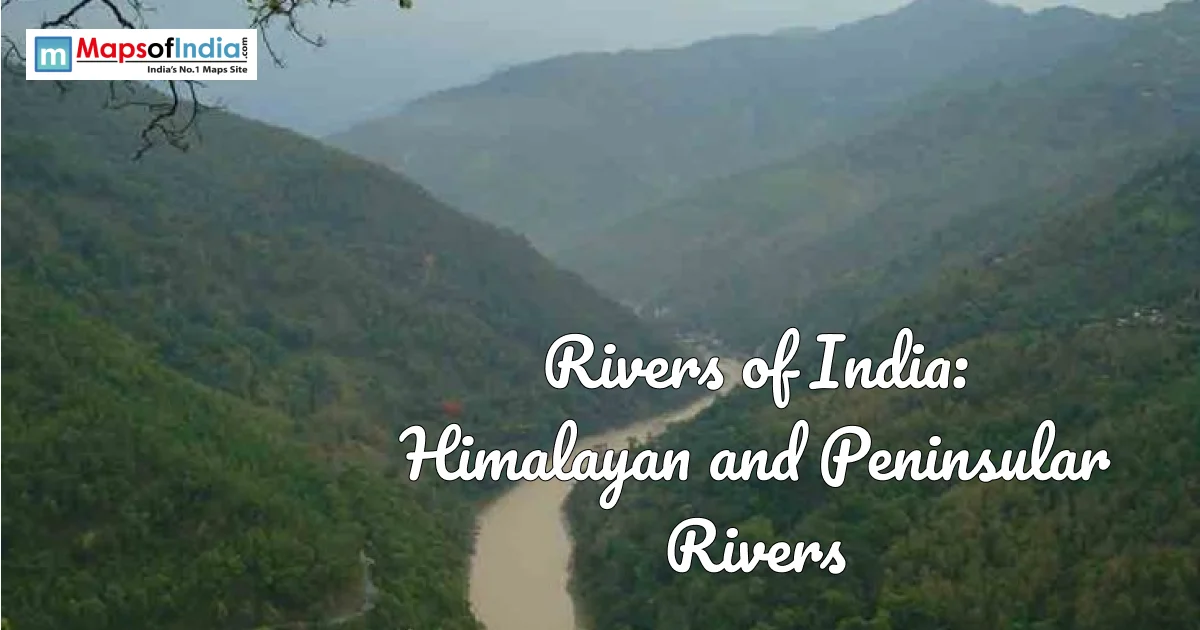
The rivers of India's origin nourish the lives of the people of the land. These waters provide food for massive tracts of crops, sustain life, and, for many, have a serene spiritual value. The mighty meltwater streams of the ice-capped heights flow northwards, while down south the older streams cut through harder rock. Northern rivers are fed by the seasonal thaw and flow throughout the year, creating wide, fertile lowlands through which they meander. The rivers on the Deccan Plateau run in time with the rains, flowing only when the rains fall.
Himalayan Rivers: The Mighty Northern Lifelines
Rivers flow from high, snowy mountains in the Himalayas, capturing water from the melting ice, as well as the seasonal rains. Flowing nonstop every season is what makes them different from many others. They are filled with fine soil and form rich flatlands in northern India in their passage. Of these, the Indus goes west, the Ganga runs through the central regions, and the powerful Brahmaputra enters the far east. Cities, farms and river after river in fertile plains. Water flows from high peaks to water fields, moulds beliefs, and rhythm villages down below.
The Ganga River System
From high up in the Himalayas, the Ganga begins its journey at the Gangotri Glacier. It is the Bhagirathi when it reaches Devprayag, where it joins with the Alaknanda. It flows down through four states: Uttarakhand, then Uttar Pradesh, Bihar and finally West Bengal. Along its banks, it provides water, work and a profound sense of faith to countless lives. It travels into the Bay of Bengal, bearing tales of yesteryear. It runs northwards, passing through towns like Varanasi and Haridwar. This river is unchanging and deep, and it brings life, not water but meaning, to millions.
The Yamuna River
From the Yamunotri Glacier begins the Yamuna, the biggest branch feeding into the Ganga. It passes through Uttarakhand and then bypasses the borders of HP before crossing the borders of Haryana. Delhi is a city where the river flows through streets, congested banks, a lifeline constantly hustled and bustled. South of the lake, Uttar Pradesh holds its precious end, but only for a while until fusion occurs at Prayagraj, where the Ganga is met. Stories are linked to Lord Krishna, echoes of old songs along muddy edges. It gives strength to the farms and strength to the cities; it gives strength to those who are burdened now.
The Brahmaputra River
The Brahmaputra is born in Tibet as the Yarlung Tsangpo and enters India through Arunachal Pradesh. It crosses Assam state and enters Bangladesh at the Ganga River. It is so wide and has such strong currents that it forms Majuli, the largest river island on earth. Life is here by the river's flow, grow the farms that its banks surround, fishers work the waters, boats ride its currents, life is here by the rhythm of the river. The power that transcends mountains, the power that forms the lowland fields with rich soil.
Peninsular Rivers: The Southern Plateau Rivers
Western Ghats or the central highlands are the sources of peninsular rivers that start their journey in the Deccan Plateau. They are fed by the rains and fluctuate drastically between wet and dry seasons. On the other hand, during monsoon surges, water swells, and after the monsoons, streams shrivel rapidly. As time passed, the gorges were dug into the stone, and show how long these flows have shaped the stone. Waterfalls form at places where the pathway of the cliffs is interrupted. They bring what grows needs to flourish, both in the field and in the woods. Downstream, power stations utilize the downhill flow. They transport what makes life flourish along their banks.
The Godavari River
The Godavari is also known as the Ganga of the South and is born at Trimbakeshwar in Maharashtra. It travels across landscapes; cuts through Maharashtra, then into Telangana, through Andhra Pradesh, through Odisha and finally to the Bay of Bengal. This is the longest river south of the Great Plains. Where its waters flow, its farms are spread out. On its perimeter are temples silent, old, guarded by stone gods. Like a silent giant in the Deccan, without asking, it gathers in the fields, and it feeds the people.
The Krishna River
The Krishna River starts from the Mahabaleshwar hills in Maharashtra. It traverses the landscapes and cuts through Maharashtra into Karnataka. Then Telangana and finally parts of Andhra Pradesh. Its course passes through large dams, including Nagarjuna Sagar, which provides water to the farms and electricity. This river is a place where rice is grown heavily, and a lot of people who live nearby are fed by the rice. It's more than just water, and it quietly supports entire regions that it has downstream.
The Cauvery River
From its start in the hills of Kodagu, the Cauvery begins near Talakaveri within Karnataka's forested highlands. It winds through fields of rice, with the warm sun shining overhead, as it extends south-east through agricultural areas. Tensions have escalated between states about the amount of water each can use, but people still view it as more than a water source for irrigation purposes. It cascades into waterfalls like Shivanasamudra among rocks and trees, attracting the gaze through vibration and noise. Communities have for generations been located on its banks, moulded by the banks' rhythm of the seasons and tradition.
Narmada and Tapi Rivers
The Narmada originates near Amarkantak in Madhya Pradesh on the west, and runs to the Arabian Sea at the coast. The Tapi, much like the Narmada, flows along a similar course, not far off. They are important not only for the carving of deep valleys but for supporting tribes along their banks, too. Bhedaghat is one of the many sites formed by the flow of the Narmada that glistens with marble cliffs. Central India's heart has been enriched with quiet strength and distinct landscapes by rivers that face the west.
Why These Rivers Matter?
The inhabitants of India have been affected by the mountains and plateau rivers of India as it descends from the higher elevations to the lower ones. The streams run through fields, farms and houses, providing water to them from time to time. Birds, fish and plants inhabit their midst, all in harmony with the river's rhythms. They are walked on, used and gathered about for more than one purpose. They have deep spiritual meaning, ingrained in the community's understanding of nature. It is even more vital to clean rivers during uncertain rain and weather.
FAQs
1. What are the two main river systems in India?
India has two major river systems: Himalayan Rivers and Peninsular Rivers.
2. What is the difference between Himalayan and Peninsular rivers?
Himalayan rivers are glacier-fed and perennial, while Peninsular rivers are rain-fed and mostly seasonal.
3. Which are the major Himalayan rivers?
The major Himalayan rivers are Ganga, Yamuna, Brahmaputra, and Indus.
4. Which are the major Peninsular rivers?
The major Peninsular rivers are Godavari, Krishna, Cauvery, Narmada, and Tapi.
5. Why are rivers important in India?
Rivers provide water, irrigation, electricity, transportation, and support biodiversity.
6. Which is the longest river in India?
The Ganga is the longest river flowing entirely within India.
7. Why is river conservation important?
River conservation ensures clean water, healthy ecosystems, and sustainable livelihoods for future generations.