

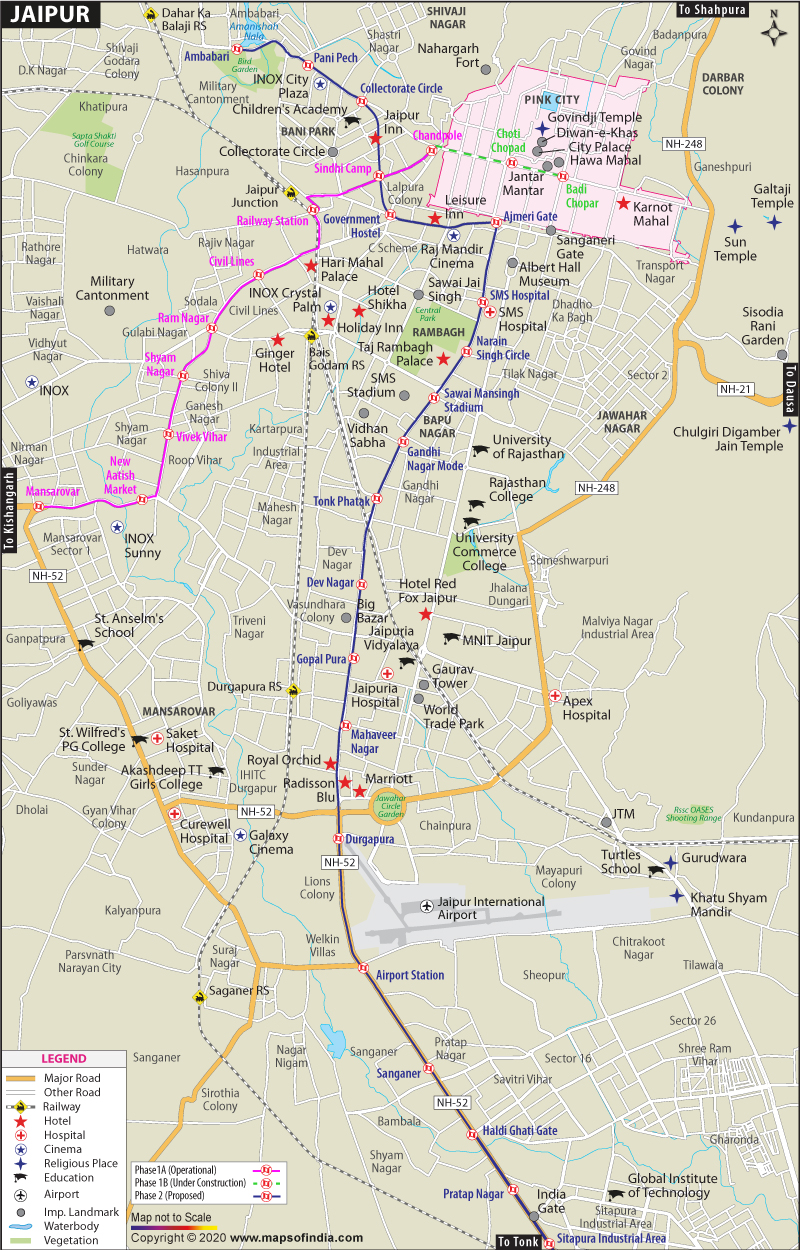



About
Home to Rajasthan’s capital, Jaipur City District captures centuries of cultural depth through its buildings, governance shifts, and regal past. Though newly defined in boundary terms, it covers the central urban zone along with nearby metro areas. Situated across dry lowlands in the eastern part of the state, terrain shapes much of its identity. Sheltered by the ancient rocky ridges of the Aravallis, the location alone helped elevate its role over time. Power, trade, and movement – these followed naturally from where it sits.Founded as the "City of Victory" by Maharaja Sawai Jai Singh II, Jaipur was envisioned to push the boundaries of traditional urban design. Yet, despite its triumphant origins, history chose to define the city not by a legacy of battle, but by the iconic, vibrant color that still swathes its streets today. In 1876, dust turned into warmth when buildings blushed pink under orders meant for one royal guest: Albert Edward. Since then, eyes around the world see roses where stone once stood bare. Layout matters here; the way roads cross reflects ancient precision now honoured by UNESCO. Not only does order define it, but commerce too – the trade of gems pulses steadily beneath market canopies. Power also rests within these borders, quietly steering the course of Rajasthan from an unassuming seat.
History and Culture
Starting differently sets Jaipur apart - its form came not from gradual growth, yet followed deliberate choice. A young designer named Vidyadhar Bhattacharya, educated in Bengal, received responsibility for mapping every part. Ancient thinking shaped his work; not just homage to custom, rather principles drawn from Vastu Shastra’s ordered layouts. His approach reflected method more than myth, grounding choices in measured arrangement. He wove these with observations tied to planetary motion, aligning streets and sectors accordingly. Its character draws strength from ongoing artistic practice rather than static displays. One key example stands out: the Jaipur Gharana of Kathak emerged here, known for rapid rhythmic patterns and expressive turns. Clothing speaks just as clearly—women drape bright Poshak, while men tie distinctive pagris, each piece carrying meaning across generations. Sound fills the gaps between moments, with melodies from instruments like the Kamayacha and Sarangi echoing through gatherings and quiet corners alike.Under golden morning light, streets swell with people celebrating together. As one festival ends, another takes its place without pause - Gangaur unfolds through narrow lanes where processions move slowly. Silken fabrics wave from elephant backs, catching breezes between buildings. Rhythms rise from stomping feet, echoing off stone worn smooth by time. Joy spreads quietly, carried in song and step alike. Processions crawl forward, pulled by wooden chariots older than memory, honouring Parvati in quiet reverence. Monsoon air hums next as Teej arrives—not with fanfare but with laughter, swings swaying under trees, and plates filled with honey-laced Ghewar passed hand to hand. Decades shift, tastes change; now words draw crowds just as powerfully, attracting scribes and speakers across continents each year for JLF’s sprawling talks beneath canvas tents.
Economy
Backbone of Rajasthan’s economy, Jaipur City District runs on constant change. Powering growth here means blending large-scale government jobs with agile business initiatives. While public systems anchor stability, privately driven ventures fuel momentum across sectors. This mix shapes how money moves through the region. Not static, the setup evolves under pressure and opportunity alike.
Government Sector
Home to Rajasthan’s highest political offices, Jaipur anchors state power in its institutions. With operations centred at key sites – the Secretariat, Vidhan Sabha, and High Court – public administration fuels widespread job access. Not limited to local governance, the area also hosts pivotal arms of federal presence. Among them stands the North Western Railway division, alongside several central departments, operating across sectors. Employment flows steadily into households because of these entrenched systems. Thousands rely on roles shaped by institutional continuity rather than market shifts.
Public Sector
Among the key features of the area is its strong government workforce, hosting central hubs for several public enterprises. RSRTC, JDA, and JVVNL operate major offices here, employing many people focused on building infrastructure and managing essential services. Not far behind, big institutions such as LIC and prominent public banks anchor their regional activities within Jaipur, reinforcing the long-term economic backbone. Operations spread across these bodies help shape consistent growth patterns through steady institutional support.
Services Sector
Nowhere is the shift towards service-based economies more visible than in Jaipur, where expansion has accelerated due to technological upgrades. Housing a significant cluster of IT and BPM operations, the city draws much of its momentum from Mahindra World City – an expansive SEZ widely regarded as one of Asia’s leading multi-sector industrial hubs. Though rooted in tradition, recent gains stem largely from digital infrastructure advances. This zone not only hosts offices; it shapes how business evolves across northern India. What boosts the tech scene here is a celebrated craft-based economy. Not far behind digital innovation stands Jaipur, globally recognised for age-old craftsmanship in textiles – especially hand-blocked fabrics using methods such as Bagru and Sanganeri printing. Another pillar thrives quietly but powerfully: blue pottery shaped by skilled hands passed through generations. Above all else, this place dominates one rare domain – gem cutting and fine jewellery work – drawing vast export earnings each year simply by mastering a precision few others match.
Tourism
Founded on princely tradition, Jaipur emerges within India’s famed tourist circuit as more than just a stopover. Its layout – famed for geometric precision – draws global attention through deliberate urban design centuries old. Recognition by UNESCO highlights what locals long understood: structure here speaks across time. Palaces unfold stories not only of power but also of observation and astronomy woven into daily life. What stands today was never meant merely to impress – it was built to endure. Standing since 1799, the Hawa Mahal’s honeycomb-like exterior marks Jaipur with an image hard to miss. Its five storeys of red sandstone hold 953 latticed openings – crafted so air could flow through, yet women of royalty might watch daily scenes without being seen.Just beyond stretches the vast City Palace, where Rajput strength blends with Mughal grace through architecture and design. Though parts house a museum filled with royal arms and attire, elsewhere within lives the family of the city’s symbolic rulers. Stone tells stories where power once walked, yet still walks today.Just beside it stands Jantar Mantar, an observatory from the 1700s designed for watching stars move across the sky. Nineteen huge stone tools lie within its grounds – recognised by UNESCO – and among them stands the world’s biggest sundial, still measuring time and skies with striking precision. Winding alleys hum with movement – Johari and Bapu Bazaars fill fast as buyers haggle over handmade silver trinkets. Colourful fabrics stamped by hand catch sunlight on open-air stalls. Blue pottery, shaped centuries ago, still lines shopfronts today. History lives loudly here – not frozen, but part of daily trade. Visitors arrive for palaces yet stay because the streets breathe differently. A place where old customs serve modern footsteps without slowing down
Demographics
About 6,626,178 people lived in the Jaipur district of Rajasthan in 2011. Growth trends suggest numbers may rise to nearly 8,047,400 by 2026. Covering 11,143 square kilometres, the region has an average population density of 595 individuals per square kilometre. For every thousand males, there are roughly 911 females. Literacy stands at 75.51 per cent across the population. Among children, the female-to-male ratio is 861 per 1000 boys. Hindus make up 87.83 percent of residents. Nearly half speak Hindi, specifically 45.85 per cent who use it as their primary tongue. Of the district's residents, 3,471,847 live in urban areas, while 31,54,331 reside in rural zones – urban making up 52.40% of the whole. Households number 11,77,096 across the region. .What emerges is not just history meeting modernity - but daily interaction between them. Movement into the region adds variety, yet roots remain visible in neighbourhood rhythms. Urban intensity defines much of how people live here.
Administration
Nowhere has administrative refinement shown clearer results than in the splitting off of Jaipur City District from the broader Jaipur region. With a tighter territorial scope, officials find it easier to manage roads, water, and power systems across dense city blocks as well as adjacent residential zones. Because attention is less spread, responses to maintenance issues come faster while policing grows more consistent. Services once delayed now reach residents through channels fine-tuned to local patterns rather than one-size-fits-all models. Within the district, administrative control follows set areas called Tehsils - Jaipur leading these, while parts of Sanganer and Amer tie closely into the city's continuous spread. Local governance is managed through independent administrative units, each tailored to its specific zone. Unlike its expansive neighbour, Jaipur Rural, this district is almost entirely urbanised. Its rural presence is limited to roughly 72 or 73 villages situated on the outer edges, where rural fields are gradually being absorbed by city growth.
FAQs
Q.1:What is the total number of Villages in Jaipur City District?
Around 2,180 census villages still exist on the outskirts of Jaipur City District, even though most of its land falls within formally laid-out municipal zones managed by urban authorities.
Q.2:What is the population of Jaipur District?
Approximately 6,626,178 people live in the district, based on 2011 census data.
Q.3:What are the famous landmarks and cultural heritage in Jaipur City District?
Long before modern cities rose, Jaipur drew eyes worldwide through buildings painted in soft pink tones. Not just color defines it - its old city earned UNESCO status due to lasting heritage significance. Rising above the rest sit the intricately carved Hawa Mahal and Amer Fort perched on sloping ground. Far from fading, local artistry lives strong in fabrics shaped by hand presses. Length remains unchanged, detail preserved. Gem processing defines much of the city’s identity, drawing traders from distant markets. Renowned workshops shape rare stones into refined pieces, anchoring global jewellery networks.
Jaipur Facts
| City Name | Jaipur |
| State | Rajasthan |
| District | Jaipur |
| District Headquarters | Jaipur |
| Tehsil/Taluk | Jaipur |
| Ward | 77 |
| Zone | Moti Dungri Zone, Hawa Mahal East, Hawa Mahal West, Vidyadhar Nagar, Civil Line, Sanganer, Amber, Mansarovar |
| Lat Long | 26.908787, 75.781631 |
| Area | 11,143 Sq. Km. |
| Population as per 2011 | 66,26,178 |
| Languages | Hindi, Rajasthan , Dhundari,Marwari , Urdu |
| Time zone | IST (UTC+5:30) |
| STD Code | 0141 |
| Transport | Air, Road, Rail, Metro |
| Vehicle registration | RJ-14 (Jaipur), RJ-45 (Jaipur North) |
| Food and Cuisine | Dal, Baati, Lashun-Ki-Chutney, Mirchi-Bada, Gatte-Ki-Sabji, Bajre Ki Roti, Kadhi, Churma, Gujia, Halwa, Imarti, Ghevar etc. |
| Religion | Hindus, Muslim, Jains |
| Festival | Camel Festival, Beneshwar Fair, Nagaur Fair, Desert Festival, Elephant Festival, Mewar Festival, Gogaji Fair, Kaliteej, Ramdevra Fair, Marwar Festival, Dusshera, Pushkar Fair, Kolyat Fair, Gangaur Fair, Kaila Devi Fair, Mahavir Ji Fair, Summer Festival Mt.Abu (June), Teej Festival, Kite Festival, Baneshwar Fair, Mewar Festival etc. |
| Monuments | Amber Fort, City Palace, Gaitore, Jal Mahal, Rambagh Palace, Albert Hall Museum, Hawa Mahal, Jaigarh Fort, Jantar Mantar, Nahargarh Fort, Statue Circle etc. |
| Places of interest | Hawa Mahal, Amber Fort, Jantar Mantar, Jal Mahal, Jaigarh Fort, Albert Hall Museum, City Palace, Nahargarh Fort, Birla Mandir, Govind Devji Temple, Raj Mandir Cinema, Rambagh Palace - Taj Hotels, Jaipur Zoo, Sawai Mansingh Stadium etc. |
| Markets | Johari Bazaar, Kishanpole Bazaar, Chaura Rasta, Tripolia Bazaar, Chandpole Bazaar, Chameliwala Market - Gems, Bapu Bazaar, Nehru Bazaar, Jauhari Bazar (Jeweller's Market), Choti Choppad, Badi Choppad, Indira Bazaar etc. |
| Hospital | Jaipur Hospital, Santokba Durlabhji Memorial Hospital, Monilek Hospital, Jaipur Hospital, Fortis Hospital, Apex Hospital Pvt. Ltd., Imperial Hospital, Aanchal Fertility and Mother Care Hospital, Bhagwan Mahaveer Cancer Hospital and Research Centre etc. |
| Hotel | Raj Palace, Mansingh Hotel, Hotel Jaipur Palace, Hotel Sarang Palace, Umaid Mahal, Hotel Silver Plaza, ITC Rajputana, Hotel Umaid Bhawan, Hotel Jaipur City, Rambagh Palace, Radisson Blu Hotel, Arya Niwas Hotels, Sheraton Hotel, Jaipur Marriott Hotel, The Oberoi Rajvilas, Nana-Ki-Haveli, Shahpura Hotels Jaipur, Trident Jaipur, Jaipur Hotels, Hotel Kalyan, Amer City Heritage Hotel etc. |
| Industries | Jaipur Stock Exchange, Anand Industries, Tarun Industries, Rajasthan Electric Industries, Shree Vishwakarma Industries, Jaipuria Group of Industries Private Limited, Jaipur Industrial Services, Jaipur Time Industries, Summer Internship Training, Software Industrial Project Work, Jaipur Textile Industries, Aditya Autolamp India Pvt Ltd, Netescape Technologies Pvt Ltd, CMC Limited, Next Step Web Solution etc. |
| University/College | University of Rajasthan, Manipal University Jaipur, National Institute of Ayurveda, Indian Institute of Health Management Research, The LNM Institute of Information Technology Jaipur and Malviya National Institute of Technology, Subodh College, Rajasthan Technical University (RTU), Swami Keshvanand Institute of Technology (SKIT), JECRC, Poornima College of Engineering, Gyan Vihar College etc. |
| Notable people | Rajeev Khandelwal - Actor and TV Presenter, Model, Irrfan Khan - Actor, Ila Arun - Singer, Asrani - Actor, Rajeev Khandelwal - Actor, TV presenter, Model, Diya Kumari - Politician, Saawan Kumar Tak - Director, Screenwriter, Producer, Lyricist etc. |
UBST240715
