

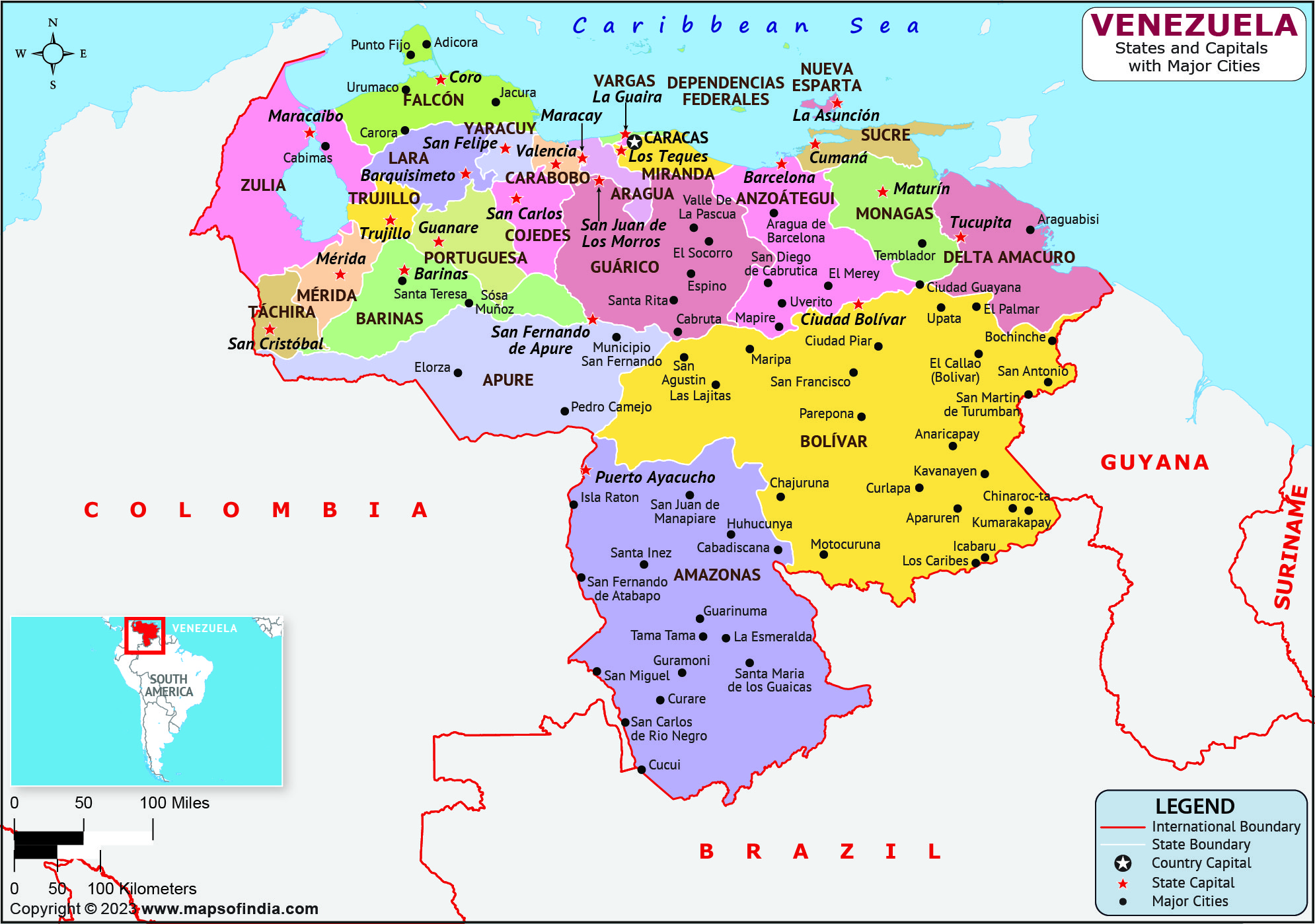





Venezuela is a country situated in the northern portion of South America. As depicted on the Venezuela map, it is surrounded by Colombia to the western front, Brazil to the southern front, Guyana to the eastern front, and the Caribbean Sea to the northern front.
History
Venezuela has a rich history that spans thousands of years. The country was originally inhabited by various indigenous groups, including the Caribs and the Arawaks. In 1498, Christopher Columbus became the first European to explore Venezuela. The country was then colonized by Spain in the 16th century, and remained a Spanish colony until 1811, when Venezuela declared its independence and that was how venezuela map came into existence.
Since gaining its independence, Venezuela has experienced a turbulent political history, including military coups and political unrest. In recent years, the country has been in a state of economic and political crisis, with hyperinflation, food and medicine shortages, and widespread poverty.
Culture
Venezuela has a vibrant and diverse culture, with influences from its indigenous, African, and Spanish heritage. The country is known for its music, including salsa, merengue, and reggaeton, and its cuisine, which includes arepas (cornmeal cakes), empanadas (stuffed pastries), and pabellón criollo (a traditional rice and bean dish).
Language
The majority language of the country is Spanish, which is spoken by the vast majority of the population. Indigenous languages, such as Wayuu and Warao, are also spoken in some regions of the country.
Geography:
Venezuela is situated on the northern coast of South America and covers an area of approximately 916,445 square kilometers. A look at the venezuela map reflects a diverse range of landscapes, including the Andes Mountains, the Amazon rainforest, and the Caribbean coast. The country is also home to the world's highest uninterrupted waterfall, Angel Falls, which is located in the southeastern part of the country.
Quick Facts (From the Venezuela Map)
| Official Name | Bolivarian Republic of Venezuela |
| Capital | Caracas |
| Population | 29,789,730 |
| Area | 916,445 km2 |
| Currency | Bolivar |
| Religion | Christianity |
| Language | Spanish |
| Major Cities | Maracaibo, Barcelona, Barinas |
FAQs
Q1: What is Venezuela famous for?
Venezuela is famous for its spectacular waterfalls, Caribbean coastline, Andes Mountains, vast plains, and rich biodiversity. It is also home to some of South America's most distinctive natural landscapes.
Q2: Why is Angel Falls important to Venezuela?
Angel Falls (Salto Ángel) is the world's highest uninterrupted waterfall, with a total height of about 979 metres. It is located in Canaima National Park and is one of Venezuela's most famous natural attractions.
Q3: What is the geography of Venezuela like?
Venezuela has highly varied geography, including the Andes Mountains, Guiana Highlands, Orinoco plains (Llanos), tropical forests, wetlands, and Caribbean coastal areas.
Q4: What is the Orinoco River's importance to Venezuela?
The Orinoco River is one of South America's major rivers and a central feature of Venezuela's geography. Its extensive basin supports ecosystems, agriculture, transportation, fisheries, and numerous communities.
Q5: What are the major natural regions of Venezuela?
Venezuela can broadly be divided into the Maracaibo Lowlands, the Andes, the Llanos, the Guiana Highlands, and the coastal mountain ranges. Each region has distinct landscapes, climates, and ecosystems.
Q6: What is Canaima National Park known for?
Canaima National Park is renowned for its vast tepuis, waterfalls, rivers, forests, and unique wildlife. It covers a large area of southeastern Venezuela and is a UNESCO World Heritage Site.
Q7: What natural resources is Venezuela known for?
Venezuela has some of the world's largest proven crude oil reserves. Other important resources include natural gas, iron ore, bauxite, gold, and hydroelectric potential, making natural resources central to its economy.
Last Updated on: September 11, 2026

