

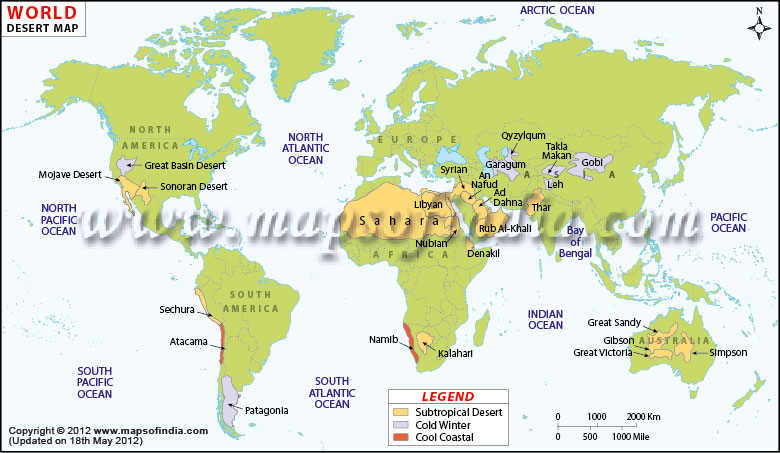





A location where life forms are known for their endurance and resilience is what makes deserts an astounding physical relief feature. From being a witness to undulating sand dunes to housing intricate rock formations, the topography of this region is severely different from other arenas of the world and can be explored on a world map. A desert is a region that obtains an incredibly low amount of precipitation, or it can also be defined as an area where more water is lost by evaporation than water received by precipitation. Most deserts receive an average precipitation of less than 400 mm annually.
The deserts in the world are divided into three types :
- Subtropical deserts - They are the hottest deserts with dry terrain and rapid evaporation rates.
- Cool coastal deserts - The average temperature in these deserts is much cooler because of cold offshore oceanic currents.
- Cold winter deserts - They are striking with harsh temperature differences ranging from 38°C in summers to -12°C in winters.
Apart from these, the Polar Regions are also measured as deserts because virtually all the moisture in these parts is accumulated in the form of ice.
| DESERT | SIZE | LOCATION | FACTS |
| SUBTROPICAL DESERTS | |||
| Sahara | 9,400,000 km2 | Egypt, Algeria, Eritrea, Chad, Libya, Mauritania, Mali, Morocco, Sudan, Niger, Tunisia, Djibouti and Western Sahara | The world's largest hot desert. The desert climate is very extreme with scorching days and frigid nights. |
| Kalahari | 930,000 km2 | Namibia, Botswana and South Africa. | It's a huge semi-arid sandy savannah. |
| Libyan | 1,100,000 km2 | Eastern Libya, northwestern Sudan and southwestern Egypt. | This desert is mostly sandy or stony plain. |
| Nubian | 400,000 km2 | northeastern Sudan | It's an arid region with virtually no rainfall and oases. |
| Danakil | 150,000 km2 | northeast Ethiopia, south Eritrea and Djibouti | It's known as the "Cruelest Place on Earth" the desert is known for its extreme heat and in-hospitability atmosphere. |
| Rub al Khali | 650,000 km2 | Saudi Arabia, United Arab Emirates, Oman and Yemen. | The largest sand desert in the world. The desert is the most oil-rich site in the world. |
| Syrian | 500,000 km2 | Iraq, Jordan, Syria and Saudi Arabia. | It's also known as the Syro-Arabian. The desert is very rocky and flat. |
| An Nafud | 103,600 km2 | Saudi Arabia | It's known as the great arc of reddish sand desert in central Saudi Arabia. |
| Ad Dahna | 650,000 km2 | Saudi Arabia | With frequent sandstorms the desert is known for its sudden violent winds. |
| Thar | 200,000 km2 | India, Pakistan | It is largely a barren region of shifting sand dunes, scrub flora and a rural economy. |
| Great Victoria | 424,400 km2 | Australia | It's the largest desert in Australia. |
| Great Sandy | 284,993 km2 | Australia | It's the second largest desert in Australia |
| Simpson | 176,500 km2 | Australia | It's a large area of dry, red sandy plain and dunes |
| Gibson | 155,000 km2 | Australia | It is the home of Aboriginal Indigenous Australians, Red Kangaroos and Emu. |
| Sonoran | 311,000 km2 | United States, Mexico | The desert has basins, plains, mountain ridges & is home to the Saguaro cactus. |
| Mojave | 124,000 km2 | United States | Although the desert is sparsely populated, several cities can be found here, including the largest 'Las Vegas'. |
| Sechura | 188,735 km2 | Peru | The desert is composed of equatorial dry forests. |
| COLD WINTER DESERTS | |||
| Great Basin | 492,000 km2 | United States | It's the largest United States desert. |
| Patagonian | 670,000 km2 | Argentina and Chile | It is the largest desert in Argentina and is the 7th largest desert in the world. |
| Karakum / Garagum | 350,000 km2 | Turkmenistan | As the name says 'black sand', the area has significant oil and natural gas deposits. |
| Kyzyl Kum / Qizilqum | 298,000 km2 | Kazakhstan, Turkmenistan and Uzbekistan. | Important natural-gas deposits are found in this red sand desert. |
| Taklamakan | 337,000 km2 | People's Republic of China | The desert has very little water making it is hazardous to cross. |
| Gobi | 1,300,000 km2 | People's Republic of China and Mongolia | It is the largest cold winter desert and is made up of diverse geographic regions based on difference in climate and topography. |
| Leh / Ladakh | 86,904 km2 | India | Scant rainfall makes Leh/Ladakh a high-altitude desert with extremely scarce vegetation. |
| COOL COASTAL DESERTS | |||
| Atacama | 140,000 km2 | Chile, Peru, Bolivia, Argentina | It is the driest desert in the world. The land is often compared with the land on the planet Mars. |
| Namib | 81,000 km2 | Angola, Namibia and South Africa. | Most of the precipitation is from fog from the Atlantic Ocean. Unusual species of plants and animals are found only in this desert. |
Ecosystems and thriving forms of life
Semi-arid and arid zones are often known to be areas that have low agricultural productivity and often witness limited plant growth. This is primarily due to the absence of adequate rainfall, the existence of extreme temperatures, and the phenomenon of sand dunes. Erosional activities are also quite common in desert areas, due to which vegetation is sporadically distributed across the region.
Plant species face various challenges apart from those dealing with the weather conditions. The extreme climate causes a significant loss of water in the process of photosynthesis. To counter this, plants often have small leaves or are marked by the absence of leaves. In addition to this, certain species are also covered with a waxy coating to minimize water loss owing to the presence of transpiration. Over the years, these forms of plants have come to acquire the name xerophytes. Also, to prevent being eaten by predators, certain species have evolved to acquire thorns and spines to ward off animals. This is common to plants such as cacti.
The variety in animal life is also notable, and those who become adapted to live in deserts are termed xerocoles. These species show unique adaptations to make do through their time in the arid regions. These include the development of specializations in their kidneys, having higher metabolic rates, and developing an insulation layer under the fur covering. Many animals adapt to being nocturnal and come out of their burrows during the night, when the climatic conditions are relatively cooler. The various animal species that can be found in deserts include emperor penguins, oryx, sangrouse, kangaroo, camel, flies, beetles, ants, termites, locusts, lizards, and snakes.
The intricate balance of the desert ecosystems is maintained by these varied adaptations that include advanced water conservation techniques, temperature-regulating activities, hibernation practices, and camouflage techniques. These adaptations help the animals to traverse difficult terrains and continue their species even in harsh climates. The forms of life carve their existence amidst the odds and are a case in point of the variability and diversity that prevail in nature.
Significance of Deserts
Often seen as dry, barren, and unwelcome areas of land, deserts in their entirety possess various dimensions and are important to the sustenance of the planet and certain forms of life. They can serve as a refuge for tourists as well as natives and every other being that goes out to admire its striking beauty. In addition to fulfilling aesthetic needs, the landscape is of importance in various other domains. These can be segregated in terms of various dimensions such as ecological, cultural, scientific, and spiritual.
Ecological Importance -These areas serve as biodiversity hotspots and are home to diverse forms of flora and fauna despite the prevailing harsh conditions. Plants such as cacti and animals such as rats, scorpions, and camels are well adapted to live a life in arid to semi-arid climatic conditions. It is also a site of various ecosystems such as salt flats, sand dunes, and metamorphic formations. The soil found in these regions is also known for its ability to recycle nutrients and conserve the limited amount of water resources available.
Cultural and Historical Significance -These areas have resided within themselves various ancient civilizations, which speak of the communities’ resilience, valor, and endurance. They are also chief sites of archaeological discovery, as several artifacts, manuscripts, and treasures have been discovered here. These treasures offer an insight into the lives of the ancient societies that resided in the desert regions. In addition to this, the ideas of religions such as Islam, Christianity, and Judaism are said to have begun in deserts.
Scientific Research and Development -Deserts act as a prime laboratory that offers an opportunity to study adaptation and exclusion in seclusion. They also provide an account of how various animals develop in order to ease their sustenance in extreme climatic conditions. Along with this, the clear skies form ideal locations for stargazing, such as that in the Atacama Desert in Chile.
Mineral Resources -Being rich in minerals, they also attract various mining operations that are aimed at obtaining resources such as salt, gypsum, uranium, manganese, and other precious metals. These minerals are significant for the economic prosperity of the nation and also contribute greatly to its gross domestic production.
FAQs
Q1: What does a world desert map show?
A world desert map shows the locations of major deserts across different continents, along with their geographical distribution and surrounding countries.
Q2: How many types of deserts are shown on the world desert map?
The world desert map classifies deserts into three main types—subtropical deserts, cool coastal deserts, and cold winter deserts. It also identifies the Polar Regions as deserts because they receive very little precipitation.
Q3: Which is the largest hot desert shown on the world desert map?
The Sahara Desert is the largest hot desert shown on the world desert map, covering a vast area across North Africa.
Q4: Which is the driest desert in the world?
The Atacama Desert in South America is widely recognized as the driest desert in the world due to its extremely low rainfall.
Q5: Why are some deserts located near the coast?
Cool coastal deserts develop where cold ocean currents reduce evaporation and rainfall, creating dry climatic conditions despite their proximity to the sea.
Q6: Why are polar regions considered deserts?
Polar regions are considered deserts because they receive extremely little precipitation, with most of the available moisture remaining frozen as ice throughout the year.
Q7: How is a world desert map useful?
A world desert map helps students, teachers, researchers, and travellers understand the global distribution of deserts, their types, and their geographical locations.
Last Updated on : July 03, 2026


