

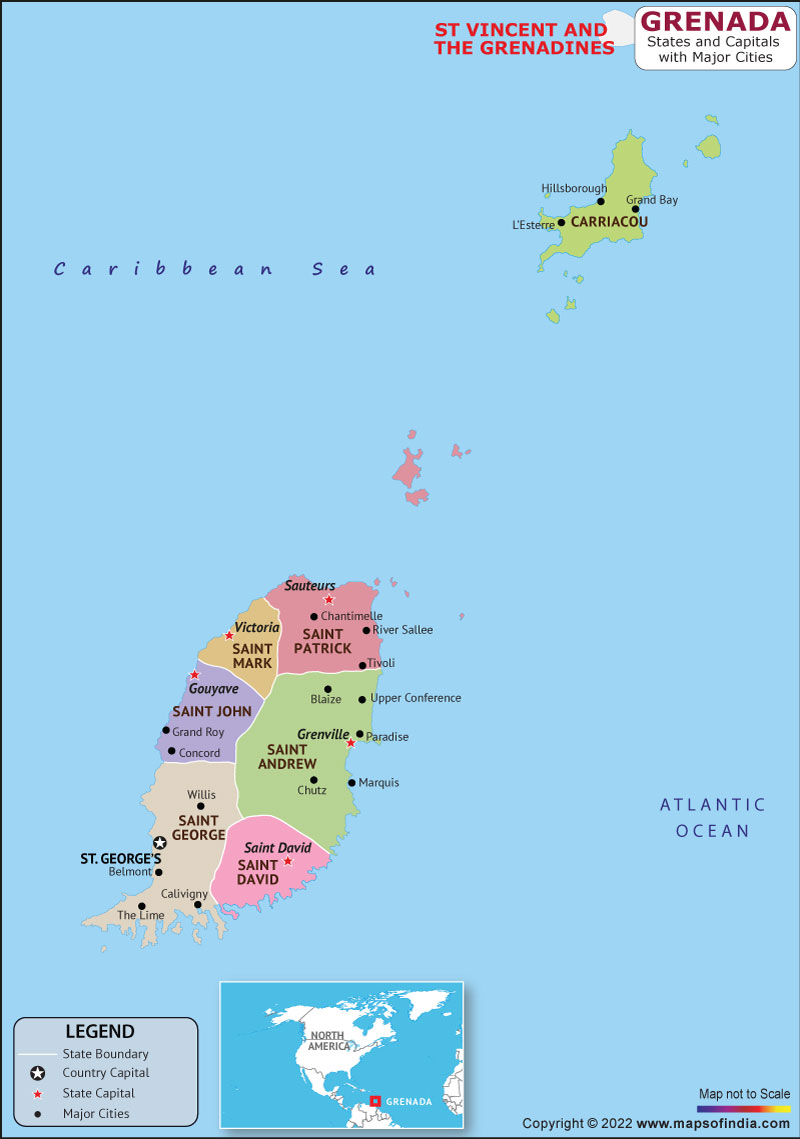





Grenada is an island country which lies in the West Indies in the Caribbean Sea. It is situated at the southern end of the Grenadines Island chain. It has the islands of Grenada itself, two smaller islands named Petite Martinique and Carriacou, and various other small islands which lie to the north of the main island. Grenada is located northeast of Venezuela, northwest of Trinidad and Tobago and southwest of Saint Vincent and the Grenadines.
History
Grenada was inhabited by indigenous peoples from South America before the arrival of Europeans in the Americas. After several unsuccessful European attempts to colonize the island, French settlement and colonization began in 1649 and continued throughout the next century. Grenada was ceded to the British on February 10, 1763, under the Treaty of Paris. British rule continued in Grenada until 1974. It got full autonomy on March 3, 1967, over its internal affairs as an Associated State. Grenada was part of the Federation of the West Indies from 1958 to 1962, which was a short-lived federation of British West Indian colonies. Grenada got its independence on February 7, 1974, under the leadership of Eric Gairy. He became the first Prime Minister of Grenada a sovereign state.
Culture
The island's culture is heavily influenced by the African roots of most Grenadians, along with the long experience of British colonial rule. French influence on Grenada's culture is less visible than on other Caribbean islands, but French surnames and places remain, and the everyday language is a mix of French and the local Creole, or patois.
The seasoned spicy food has a French influence, and the cooking styles are like New Orleans. Calypso, Soca, and Reggae are popular music genres which are played at Grenada’s annual Carnival. The tradition of storytelling with folk tales bearing both French and African influences, stand as an important aspect of the Grenadian culture.
Language
The country’s official language is English but the main spoken language is either of two creole languages- Grenadian Creole English and Grenadian Creole French. It reflects the European, African, and native heritage of the nation. The creoles contain elements from a variety of French, English, and African languages. Smaller rural areas mainly speak Grenadian Creole French.
Geography
Grenada is the southernmost island of the Antilles, bordering the eastern Caribbean Sea and the western Atlantic Ocean, about 140 km (90 mi) north of Venezuela and Trinidad and Tobago. The southern section of the Grenadines are covered with its sister islands, which includes Petite Martinique, Carriacou, Caille Island, Ronde Island, Large Island, Diamond Island, Firgate Island and Saline Island.
Grenada is of volcanic origin, with numerous craters showing its soils, mountainous terrain, Lake Antoine, Lake Grand Etang, and Pond Levera. The highest point of Grenada is Mount St. Catherine, and other major mountains include South East Mountains and Mount Granby. It is home to four ecoregions- Leeward Islands dry forests, Windward Islands moist forests, Windward Islands xeric scrub, and Windward Islands dry forests.
| Official name | Grenada |
| Capital | St. George's |
| Population | 1.25 Lakhs (2021) |
| Area | 344 sq km |
| Currency | East Caribbean Dollar |
| Religion | Christianity |
| Language | English |
| Major cities | Saint George's, Gouyave, Grenville |
FAQs
Q.1. Why is Grenada called the “Spice Isle”?
Ans. Grenada is known as the "Spice Isle" because of its long-standing production of spices such as nutmeg, mace, cloves, cinnamon, and ginger. Nutmeg is particularly important to the country's agricultural identity.
Q.2. Where is Grenada located in the Caribbean?
Ans. Grenada is an island country in the southeastern Caribbean Sea, located north of Trinidad and Tobago and south of Saint Vincent and the Grenadines. It includes the main island of Grenada and several smaller islands.
Q.3. What are the main islands of Grenada?
Ans. The country consists mainly of Grenada, Carriacou, and Petite Martinique, along with several smaller islands. Carriacou and Petite Martinique are part of the Grenada island group known as the Grenadines.
Q.4. What is the highest point in Grenada?
Ans. Mount Saint Catherine, rising to about 840 metres, is the highest point in Grenada. The mountain is located in the interior of the main island and is surrounded by lush tropical landscapes.
Q.5. What is Grenada's geography like?
Ans. Grenada has a volcanic landscape featuring mountains, dense forests, valleys, waterfalls, crater lakes, and coastal areas. Its interior is considerably more mountainous than its coastal plains.
Q.6. What is Grand Anse Beach famous for?
Ans. Grand Anse Beach is one of Grenada's best-known beaches, famous for its long stretch of white sand and clear Caribbean waters. It is also close to St. George's and is a major tourism area.
Q.7. What is the significance of Grenada's underwater sculpture park?
Ans. Grenada's Molinere Underwater Sculpture Park is an underwater collection of sculptures that has become a distinctive attraction for divers and snorkelers. The sculptures also form part of an artificial reef environment supporting marine life.
Last Updated on: September 10, 2026

