

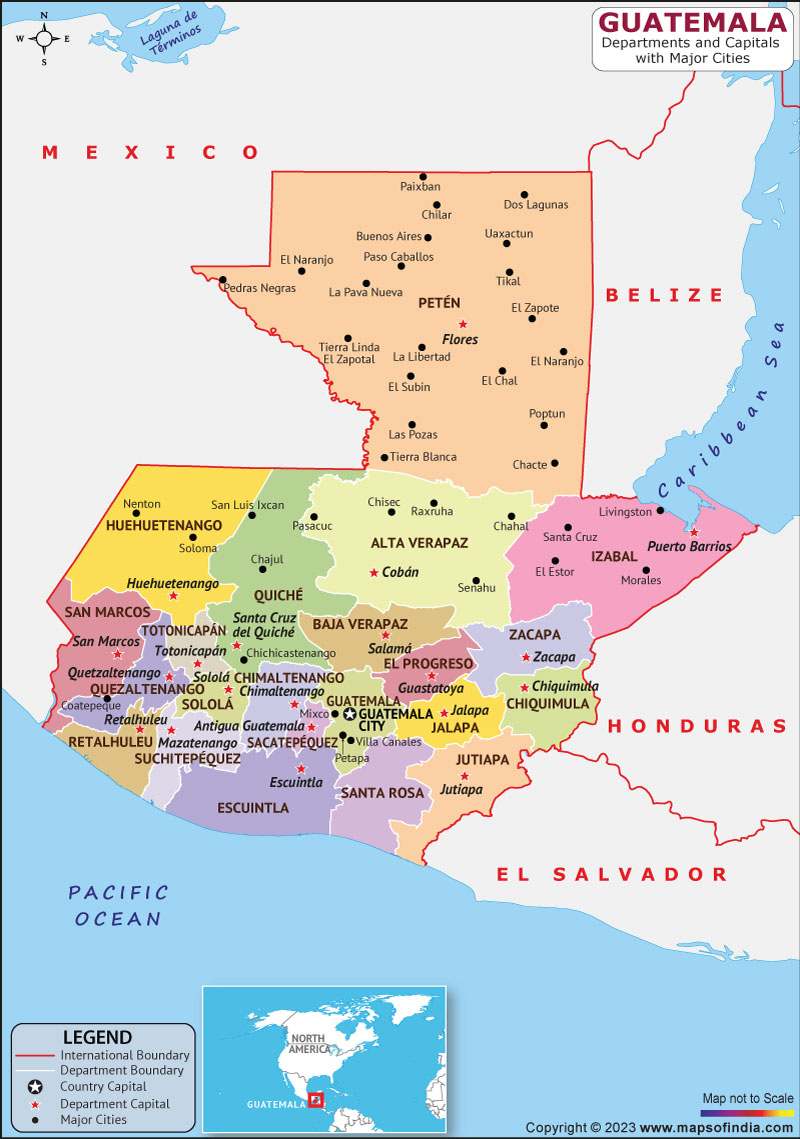





Guatemala is a nation situated in the North American continent, bordered by Belize to the northeastern front, Honduras to the eastern front, Mexico to the northern front and western front, and El Salvador to the southeastern front. It has a rich history and culture, and its diverse geography includes rainforests, mountains, and volcanoes.
History
The region now known as Guatemala was inhabited by various indigenous groups for thousands of years before the arrival of the Spanish in the early 16th century. The Spanish conquered the region and established a colonial government that lasted for over 300 years. In 1821, Guatemala gained independence from Spain and became part of the Central American Federation.
In the 20th century, Guatemala experienced political turmoil and violence, including a 36-year-long civil war that ended in 1996. The war had a profound impact on the country, with many people being killed or forced to flee, and the effects of the conflict are still felt today. Guatemala is now a democratic republic, but it continues to face challenges related to poverty, inequality, and violence.
Culture
Guatemala has a rich and diverse culture that reflects its indigenous, Spanish, and African roots. The country is known for its colorful traditional dress, which varies from region to region, as well as its lively music and dance. The marimba, a type of xylophone, is a popular instrument in Guatemalan music, and the traditional dance of the country is known as the "marimba" or "son" dance.
Guatemala is also known for its unique cuisine, which combines indigenous and Spanish flavors. Popular dishes include tamales, chiles rellenos, and pepian, a meat stew made with a special blend of spices.
Language
The primary language of Guatemala is Spanish, which is spoken by the majority of the population. However, there are also over 20 indigenous languages spoken in the country, including K'iche', Kaqchikel, and Mam. Many Guatemalans are bilingual, with Spanish and an indigenous language.
Geography
Guatemala has a diverse geography, with highlands, rainforests, and coastal areas. The country is home to a number of active volcanoes, and many of these volcanoes are popular tourist destinations. Lake Atitlan, located in the highlands, is another popular destination, known for its natural beauty and indigenous communities.
| Official Name | Republic of Guatemala |
| Capital | Guatemala City |
| Population | 17608483 |
| Area | 108,889 km2 |
| Currency | Quetzal |
| Religion | Christianity |
| Language | Spanish |
| Major Cities | Antigua Guatemala, Quetzaltenango |
FAQs
Q1: Where is Guatemala located?
Guatemala is located in Central America, bordered by Mexico to the north and west, Belize to the northeast, Honduras and El Salvador to the east, and the Pacific Ocean and Caribbean Sea.
Q2: What makes Guatemala geographically unique?
Guatemala has a highly diverse landscape that includes volcanoes, highlands, tropical rainforests, lakes, coastal plains, and river valleys. Its location at the meeting point of several tectonic plates contributes to its volcanic and mountainous terrain.
Q3: Which volcanoes are active in Guatemala?
Guatemala has several active volcanoes, with Fuego, Pacaya, and Santa María-Santiaguito among the best known. Volcanic activity is an important part of Guatemala's geography and landscape.
Q4: Why is Lake Atitlán famous?
Lake Atitlán is a large volcanic lake surrounded by mountains and volcanoes. It is known for its scenic landscape, Indigenous Maya communities, traditional villages, and cultural tourism.
Q5: Why is Tikal important to Guatemala?
Tikal is one of the most significant archaeological sites of the ancient Maya civilization. Located in the Petén rainforest, it contains monumental temples, pyramids, palaces, and plazas and is a UNESCO World Heritage Site.
Q6: What are Guatemala's main geographical regions?
Guatemala can broadly be divided into the Pacific coastal plain, central highlands, eastern lowlands, and northern Petén region. The Petén is largely covered by tropical forests and contains many important Maya archaeological sites.
Q7: What is the highest point in Guatemala?
Volcán Tajumulco, reaching approximately 4,220 metres, is the highest point in Guatemala and the highest peak in Central America. It is located near the country's border with Mexico.
Last Updated on: September 10, 2026

