

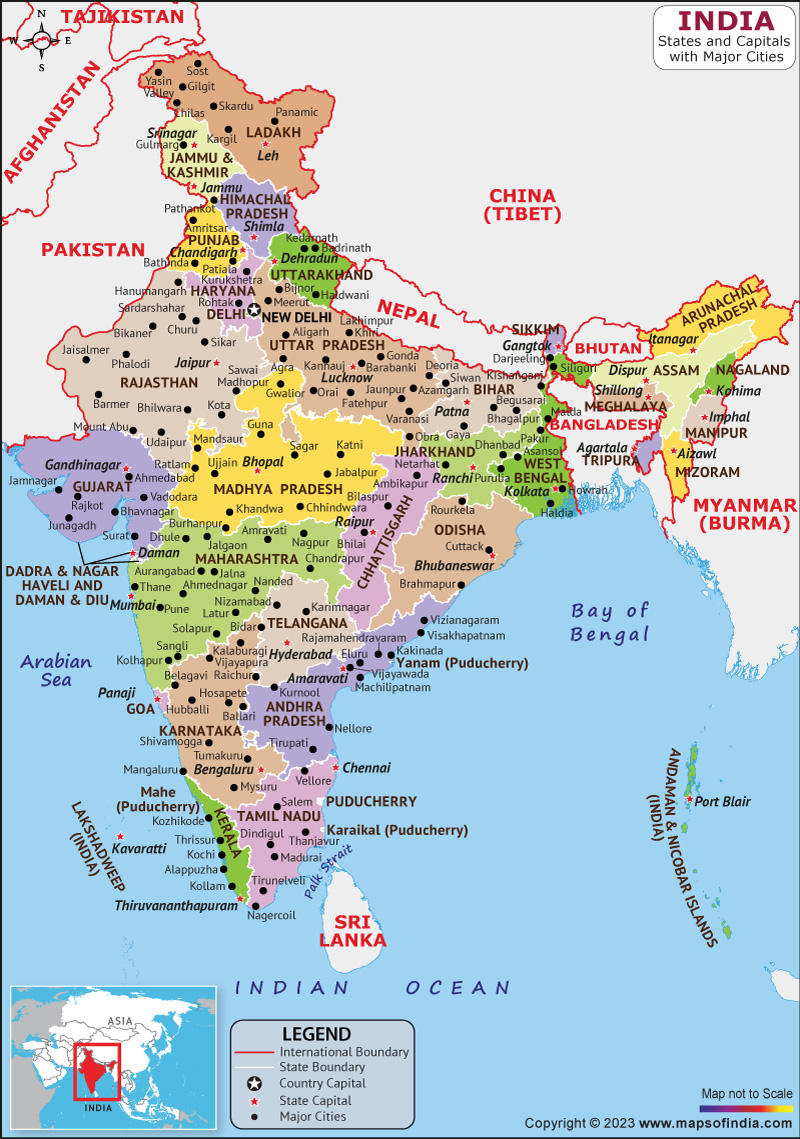





India, officially the Republic of India, is a country in South Asia and the world's most populous nation, with an estimated 2026 population of over 1.48 billion. Home to one of the world's oldest civilizations, India spans 28 states and 8 union territories and is known for its vast cultural, linguistic and religious diversity.
History:
India has a long and complex history that dates back to the world’s oldest civilization, which flourished between 2600 BCE and 1900 BCE. The country was ruled by various empires and kingdoms, including the Maurya, Gupta, and Mughal empires. The British colonized India in the 19th century, and India gained independence in 1947 after a long struggle led by Mahatma Gandhi. The history of India begins with the Indus Valley Civilization, one of the world’s earliest urban cultures, located in present-day Pakistan and northwest India. Major cities like Harappa and Mohenjo-Daro featured advanced urban planning, drainage systems, and standardized weights and measures. The civilization was primarily agricultural, trading with distant regions, including Mesopotamia. The Indo-Aryans brought forth the Vedic Period once the Indus Valley Civilization began to fall. The Vedas, ancient sacred texts, were composed during this time, laying the foundations for Hindu philosophy and culture. This period saw the formation of various kingdoms and the establishment of a social hierarchy that evolved into the caste system. The Maurya Empire, founded by Chandragupta Maurya, unified much of the Indian subcontinent. The most notable ruler, Ashoka the Great, expanded the empire to its greatest extent and later embraced Buddhism, promoting non-violence and social welfare. His edicts, inscribed on pillars and rocks, spread messages of peace and tolerance. The Gupta Empire, which produced notable advances in science, mathematics, literature, and the arts, is sometimes referred to as India's "Golden Age." Notable achievements include the concept of zero, advancements in astronomy, and the flourishing of Sanskrit literature. The period also saw the rise of Hinduism as a dominant religious force, with the construction of magnificent temples.
The commencement of Muslim dominance in India was the foundation of the Delhi Sultanate. Several dynasties, including the Mamluks, Khiljis, Tughlaqs, Sayyids and Lodhis ruled during this time. This period saw significant cultural exchanges, with Persian influence on art, architecture, and administration. The Mughal Empire, founded by Babur, brought about a significant transformation in India. The most illustrious rulers, Akbar, Jahangir, and Shah Jahan, expanded the empire and promoted a syncretic culture. A rich cultural environment was established by Akbar's initiatives to merge disparate cultures and his policy of religious tolerance. The construction of architectural marvels like the Taj Mahal exemplified Mughal art and culture. However, because of internal conflict and outside invasions, the empire started to fall in the 18th century.
The arrival of European traders, particularly the British, altered India’s socio-economic landscape. The British East India Company gradually expanded its control through trade and military might, culminating in the Battle of Plassey (1757), which marked the beginning of significant British influence in India. The discontent culminated in the Indian Rebellion of 1857, a significant uprising against British rule. Although it was ultimately suppressed, the rebellion marked a turning point, leading to the dissolution of the East India Company and the establishment of direct British rule over India, known as the British Raj. Nationalist movements became more prominent in the early 20th century. Leaders like Mahatma Gandhi, Jawaharlal Nehru, and Subhas Chandra Bose played crucial roles in mobilizing the masses against colonial rule. The Non-Cooperation Movement (1920) and the Quit India Movement (1942) showcased widespread resistance to British policies. Gandhi’s philosophy of non-violence became a cornerstone of the independence struggle. India gained independence from British domination on August 15, 1947, but this was accompanied by the traumatic division of the subcontinent into Pakistan and India. The partition led to widespread communal violence and the displacement of millions, resulting in significant loss of life and deep-rooted communal tensions. The newly independent India faced numerous challenges, including establishing a stable government, integrating princely states, and addressing issues of poverty and inequality. The adoption of the Constitution in 1950 marked India as a democratic republic, emphasizing secularism, social justice, and individual rights.
Culture & Religion:
India is home to several of the world's major religions and has long been a center of spiritual and cultural diversity. Hinduism is the largest religion, followed by Islam, Christianity, Sikhism, Buddhism, and Jainism. The Constitution of India guarantees freedom of religion, and places of worship representing different faiths can be found across the country.
Festivals such as Diwali, Holi, Eid-ul-Fitr, Christmas, Guru Nanak Gurpurab, Buddha Purnima, and Mahavir Jayanti are celebrated across India, reflecting its rich cultural heritage and traditions. The country is also renowned for its classical arts, including dance forms like Bharatanatyam, Kathak, and Kathakali, as well as its Hindustani and Carnatic music traditions.
Indian cuisine is equally diverse, with each region offering distinct flavors and specialties. Popular dishes such as biryani, dosa, and a variety of regional curries showcase the country's culinary richness and have earned global recognition.
Language:
India is one of the world's most linguistically diverse countries. The Constitution of India recognizes 22 scheduled languages, while hundreds of other languages and dialects are spoken across different regions. Hindi, written in the Devanagari script, is the most widely spoken language, while English is widely used for administration, higher education, business, and the judiciary.
The languages of India belong primarily to four major language families:
- Indo-European (Indo-Aryan) – including Hindi, Bengali, Marathi, Punjabi, Assamese, Gujarati, Odia, Konkani, Kashmiri, Nepali, Sanskrit, Sindhi and Urdu.
- Dravidian – including Tamil, Telugu, Kannada and Malayalam.
- Austroasiatic – represented by languages such as Santali.
- Tibeto-Burman – represented by languages such as Bodo and Manipuri (Meitei).
Geography:
India's landscape ranges from the Himalayan mountain system in the north to the fertile Indo-Gangetic Plain, the Deccan Plateau in the south, and an extensive 7,500-kilometre coastline along the Arabian Sea, Indian Ocean, and Bay of Bengal. This remarkable geographical diversity supports a wide variety of ecosystems, climates, and natural resources.
India is the seventh-largest country in the world, with a diverse landscape that includes the Himalayan mountains, the Thar desert, and the Indian Ocean coastline. The country spans approximately 3.287 million square kilometers (1.269 million square miles) and is bordered by Pakistan to the northwest, China and Nepal to the north, Bhutan to the northeast, and Bangladesh and Myanmar to the east. The Indian Ocean encircles it in the south. The world's highest mountain range, the Himalayas, which include peaks like Kanchenjunga and Nanga Parbat, dominate India's northern border. These mountains play a crucial role in influencing the climate of the region and act as a barrier against cold winds from Central Asia. South of the Himalayas lies the vast Indo-Gangetic Plain, one of the most fertile regions in the country. This level, alluvial plain—which is essential for agriculture—was created by the sediment that large rivers like the Yamuna, Brahmaputra, and Ganges deposited. The Deccan Plateau, located in southern India, is a large triangular plateau bordered by the Western and Eastern Ghats. This region is characterized by volcanic rock, rich mineral deposits, and a variety of ecosystems, including forests and grasslands. The eastern and western beaches are paralleled by these mountain ranges, respectively. The Western Ghats are recognized as a UNESCO World Heritage site due to their biodiversity, while the Eastern Ghats are less continuous and have more varied landscapes, including hill stations and coastal plains. To the northwest lies the Thar Desert, primarily in the state of Rajasthan. It is distinguished by sand dunes, dry weather, and sparse vegetation, all of which sustain a distinct species that has adapted to the hostile surroundings. The Bay of Bengal to the east, the Indian Ocean to the south, and the Arabian Sea to the west encircle India. Its extensive coastline spans around 7,516 kilometers (4,671 miles). Major coastal cities include Mumbai, Chennai, and Kolkata, each serving as vital economic and trade hubs.
India is rich in natural resources, including coal, iron ore, bauxite, and limestone, supporting its industrial base. The country also has substantial freshwater resources, with major rivers serving as lifelines for agriculture, transportation, and hydroelectric power.
| Official Name | Republic of India |
| Capital | New Delhi |
| Population | 1.48 billion (2026 est.) |
| Area | 3,287,263km2 |
| Currency | Rupee |
| Religion | Hinduism(79.8%), Islam (14.2%) |
| Language | Hindi, English |
| Major Cities | Mumbai, Hyderabad, Chennai |

