


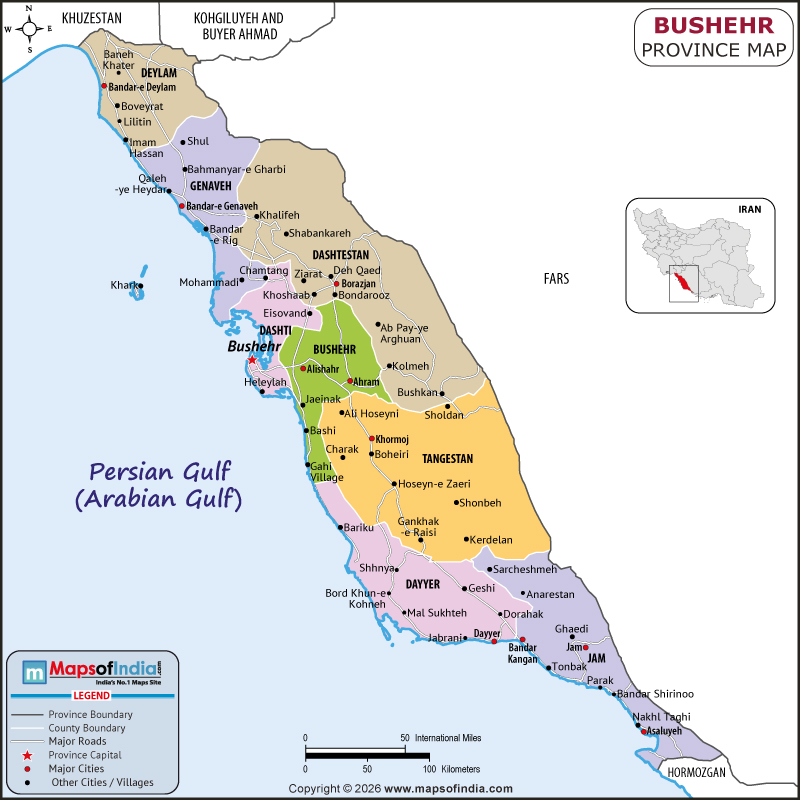



Bushehr is the coastal city in southern Iran located right beside the Persian Gulf. Its long standing trading history, moderate climate, and scenic sea views made Bushehr famous. Because of its geographical location, Bushehr has always been significant. The inhabitants of Bushehr are always in close contact with the sea, and this greatly influences their daily activities, food and occupations.
History
Bushehr's history is very long and interesting, and it has always been associated with the sea. This region was already a famous place for sailors and pearl divers thousands of years ago, during the time of the Elamite Empire. Archaeologists have discovered very ancient remnants that indicate that the city was part of a very primitive network of trade between the East and West.
The Sasanian Empire, which ruled Persia for a few centuries, turned the city into a crucial naval base. The kings were able to safeguard the Persian Gulf's waters from pirates through control; the kings were the ones controlling the sea. Even at that time, it was obvious that whoever held Bushehr was the master of the sea's wealth.
Nadir Shah, a strong and influential leader of the 18th century, had the ambition of turning Bushehr into a modern grand port. The king wanted to have a powerful navy to keep Iran safe, and the peninsula was the best location for this purpose. He imported workers and launched a shipbuilding programme, and soon the town became the centre for all imports to the country.
As it was a dominant port, the city experienced rapid growth and became a melting pot of people coming from different parts of the world. In the 19th century, a number of countries such as Great Britain and Russia had established large trade offices here. This gave the city a very interesting appearance, as the structures were the result of the blending of Persian and foreign styles. These high ceilinged houses are still present in the old town today.
Bushehr has also become known for its courageous nature and its legends. The local population resisted foreign powers during the 19th and the early 20th century by force. One of the leaders, Rais Ali Delvari, became the icon of liberty. He was the commander of a small battalion that took advantage of the rocky shoreline and their knowledge of the place to keep the invaders from their towns.
In the contemporary period, the city was transformed not only from a trade port to a considerable energy centre but also into the country’s first nuclear power plant, which is an extremely significant part of Iran’s modern history. The project not only provided new employment opportunities and brought in modern technology but also converted the region into a centre for scientists, engineers, and sailors.
Bushehr's past is not solely composed of rulers or battles; rather, it is the story of individuals who adapted to sea living. They took advantage of the sea breeze for house cooling and the sea for food and money. Bushehr continues to be a city of pride that has always maintained its bond with the Gulf's vast azure waters.
Culture
The culture of Bushehr is one of the most colourful and distinctive cultures in all of Iran. Despite being a port city, its customs are a mixture of Persian, African, and Indian influences. This blending took place over a long period of time as mariners and merchants from distant lands made their way to the sunny beaches and finally settled there. The city today seems to be inhabited by a large number of people who are all ecstatic like the sea.
The music represents the life of this city. The local sound known as Bandari is characterised by a fast and happy beat, which is the most striking feature. The Ney-anban, a bagpipe made of goatskin, is the primary instrument and it delivers a loud and bright sound. As the music plays, the people enliven the scene to the extent that they resemble the rolling waves of the Persian Gulf.
Bushehr’s “Old Quarter” depicts an extremely unique lifestyle. Houses are designed with very high ceilings and enormous windows so that the sea winds can come in and cool the rooms. The residents are very much engaged on their wooden balconies, conversing with the neighbours across the narrow streets. This results in a very tight-knit community where everyone is familiar with each other's names.
The sea has a great impact on the local crafts. It is still possible to witness the traditional wooden boat, popularly known as the dhow, being constructed by hand along the coast. The majority of women are occupied in the making of items from palm leaves, such as baskets and carpets, which are not only beautiful but also durable. These works of art represent the fact that the people of Bushehr are very dependent on the environment for their well-being.
Bushehr's culture is a kind of open culture to the world. It is a fusion of different kinds of music, food, and architecture coming together to form a whole new thing. The sound of bagpipes and the smell of spicy fish will be the memorable impressions of this joyful, seaside spirit that you will carry with you after your visit.
Language
The primary language in Bushehr is Persian. The majority of the population in Bushehr uses Persian as their language of communication in various contexts such as daily life, education, and business. The accent is not like standard Persian and is more gentle. The local dialect grants Bushehr a distinct linguistic identity.
Bushehri Persian comprises its own vocabulary and phonetics. The natives' way of talking is usually characterised by the use of the informal tone, the pronunciation of some words in a relaxed manner and the shortening of words. Certain phrases are also affected by the sea and the coastal lifestyle. This gives the conversations a warm and friendly character, particularly among local families and neighbours.
The language of Bushehr was influenced by Arabic as well. Since the town is situated near the Arab nations across the Persian Gulf, a daily conversation in the city often included Arabic words. Food names, greetings, and conversations related to trading were the fields most affected by this incorporation of words. Nevertheless, Persian still remains the principal language of communication.
The role of education in language usage today is considerable. The standard Persian language is the one that is taught in schools, and as a result, the students learn correct grammar and writing. However, the local Bushehri accent is heard by kids at home. Such a mixture maintains the balance of both formal and local languages.
Geography
Bushehr's geography is characterised by its close bond with the Persian Gulf. The city occupies a flat and low-lying peninsula that resembles a long finger stretching into the warm sea. As it is flanked by water on three sides, the sea is instrumental in determining every aspect of the city, right from the air one breathes to the city's appearance.
The terrain is quite flat and sandy, and there are no lofty mountains nearby that would obstruct the view. This evokes a sensation of vastness where the sky and water meet at a straight line. The city's low altitude makes the tides of the Persian Gulf very significant, as they often alter the appearance of the beaches and marshlands during the day.
The soil is one of the most essential components of geography. It is true that the soil is sandy and salty, but still it is the best place to grow date palms. The large groves of date palm trees can be seen just outside the city. Although their main function is to provide shade, these palm trees are very important in the region because they are responsible for the production of millions of sweet dates every year.
One more unbelievable geographic attraction in the region is the Jashak Salt Dome. The mountains here are purely composed of salt that has come up from the earth’s crust over millions of years. They appear as if they are huge white icebergs right in the middle of the hot desert. The rain has transformed them into uncanny forms like salt caves and white waterfalls.
The shoreline of Bushehr is incredibly extensive, going on for several hundred kilometres. It consists of numerous small bays and hidden beaches where the water is shallow and warm. In certain places, there are mangrove forests that have taken root in the briny water. These plants form a natural barrier, blocking the land from the waves and offering a place for fish to stay.
The geography of Bushehr is characterised by a combination of the salty sea and the sun-baked land. It is a region of unbroken layers of palms, waving palms, and odd salt mountains. The environment has made the people learn how to endure the heat and how to take advantage of the Persian Gulf's riches to establish a city that is powerful and enduring.
Quick Facts
| Official Name | Bushehr |
| Country | Iran |
| Capital | Bushehr |
| Area | 22,743 km² |
| Currency | Iranian Rial (IRR) |
| Religion | Mostly Islam |
| Language | Persian (Farsi) |
FAQs
Q1: Where is Bushehr located in Iran?
Bushehr is located in southern Iran along the coast of the Persian Gulf. It is the capital city of Bushehr province and an important coastal centre.
Q2: Why is Bushehr famous?
Bushehr is known for its long coastline, port activities, and strong connection with the Persian Gulf. It is also recognised for its role in trade and energy.
Q3: What is the main occupation of people in Bushehr?
Many people work in fishing, port services, and energy related jobs. Trade and small businesses also support the local economy.
Q4: What type of food is common in Bushehr?
Seafood plays a major role in Bushehr cuisine. Fish, rice dishes, and spicy flavours are common in local meals.
Q5: Is Bushehr important for Iran’s economy?
Bushehr is important because of its ports and nearby energy facilities. Its coastal location supports trade, shipping, and industry.
Last Updated on: June 22, 2026

