


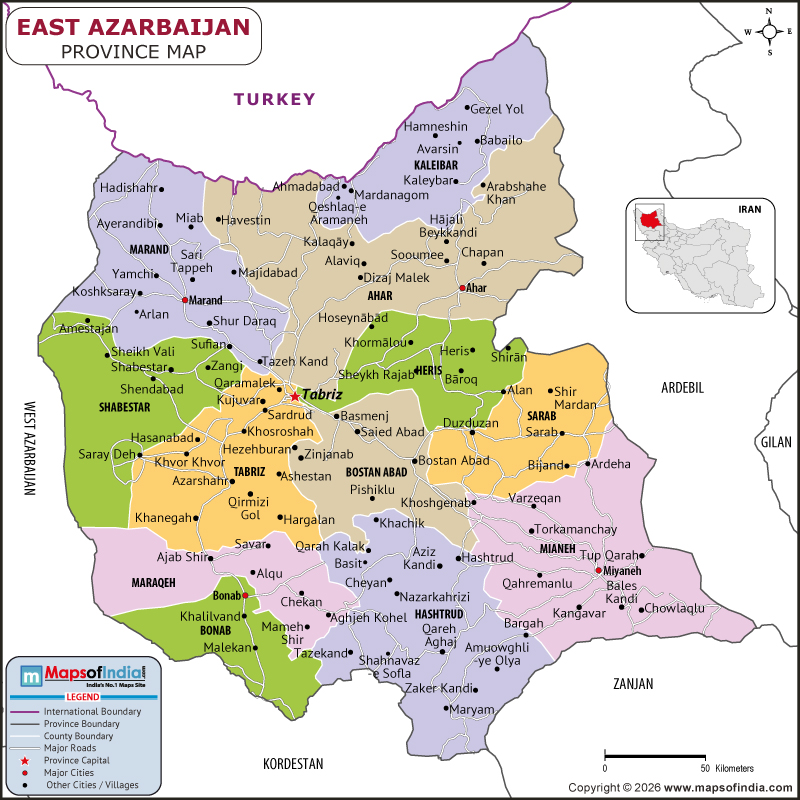



East Azerbaijan is a province in northwestern Iran. Tabriz is its capital city. The area has a significant location because it is near the borders of Turkey, Armenia, and Azerbaijan. East Azerbaijan has stunning scenery, a rich cultural heritage, and a long history. This region is home to numerous mountains, valleys, and a portion of Lake Urmia. The majority of people in the area are proud of their customs and speak Azerbaijani Turkish. Tabriz is a significant hub for industry, trade, and education.
History
East Azerbaijan has a rich and complex history. Numerous cultures and empires have existed in the area. Because of its position, it was crucial for both trade and politics. This area was traversed by several monarchs. Every era had an impact on the people and the land. The region was a part of the early Iranian civilizations. The area was near Anatolia and Mesopotamia. It was able to establish connections with other ancient cultures as a result. The area was suited for colonization and was fertile.
It was a part of the Median kingdom at that period. Among the first Iranian peoples were the Medes. They had a significant influence on the development of early Iranian history. The Achaemenid Empire eventually conquered the area. Cyrus the Great established this empire. During the Achaemenid era, East Azerbaijan developed into a significant province.
Alexander the Great entered Iran following the fall of the Achaemenids. The area was altered by his conquest. East Azerbaijan was ruled by the Seleucid Empire upon his death. During this period, Greek influence began to spread over the area. Local customs persisted, nevertheless.
The region was later dominated by the Parthian Empire. The Sassanian Empire took over after the Parthians. For numerous centuries, the Sassanians reigned. East Azerbaijan was incorporated within the empire's borders. The Byzantine and Roman empires often attacked it.
Iran was invaded by Arab Muslim forces in the seventh century. Islam took control of East Azerbaijan. Islam gradually expanded throughout the area. The majority of people eventually came to accept Islam. Even after the conquest, Persian culture persisted.
Several dynasties controlled East Azerbaijan throughout the early Islamic era. The area was frequently ruled by local leaders. Agriculture and trade both kept expanding. Cities like Tabriz became significant hubs.
In the eleventh century, the Seljuk Turks arrived. They introduced Turkic culture and language. The area was profoundly affected by this. Over time, a large number of individuals acquired the Turkic language. Persian governance and culture persisted, nonetheless.
Significant damage was suffered during the Mongol invasion in the thirteenth century. Numerous cities suffered damage. Numerous individuals perished. The area was later dominated by the Ilkhanate Mongols. Their capital was Tabriz. After its recovery, the city developed into a significant political hub.
East Azerbaijan became more important throughout the Safavid era. Shia Islam became the official state religion under the Safavids. The region's religious life was altered as a result. The Safavid Empire's original capital was Tabriz.
The Safavid Empire began to wane in the 18th century. In East Azerbaijan, local khans came to power. Afterwards, Nader Shah briefly regained power. The area became unstable once more after his passing. East Azerbaijan was important during the Qajar era. The crown prince moved to Tabriz. The area developed into a gateway to Europe and the Caucasus.
The region was involved in political activities during the 20th century. Tabriz was an ardent supporter of the Constitutional Revolution. Justice and the law were sought by the populace. Major roles were performed by regional leaders.
Parts of Iran were overrun by foreign armies during World War II. Political turmoil occurred in East Azerbaijan. Iran regained complete control of the area following the conflict.
East Azerbaijan joined the new political structure following the Islamic Revolution in 1979. Both industry and education in the area kept expanding. Tabriz continued to be a significant hub for both culture and commerce.
Culture
East Azerbaijan is a culturally diverse region in northwestern Iran. Azerbaijani Turks make up the majority of the population in this area. In daily life, they converse in Azerbaijani Turkish. They do, however, also speak Persian, the official language of Iran. Many people in the area are bilingual as a result. An essential component of their pride and identity is their language.
In East Azarbaijan, family is very important. Parents, elders, and family customs are respected. Families are typically warm, nurturing, and intimate. A significant aspect of the culture is hospitality. People treat visitors with kindness. They frequently invite guests around for meals or tea. People enjoy sitting together and chatting, and it's a usual and nice custom to provide tea.
There is a long history of dance and music in the area. Azerbaijani music is vibrant, expressive, and occasionally quite happy. The Saz is a well-known traditional musical instrument. Traditional dances are also performed at festivities and weddings. Weddings are significant occasions. They consist of gatherings of several family members and friends, food, dancing, and music.
The region's culture is also reflected in clothing customs. People used to dress in vibrant, traditional attire. Traditional attire is still worn during cultural festivals and ceremonies, even though the majority of people today wear modern clothing.
Another significant aspect of life in East Azerbaijanis food. The area is well-known for its delectable rice dishes, stews, and kebabs. Dishes like Tabriz Kofta are particularly well-known in Tabriz. The region's pastries and sweets are likewise highly liked. Eating together demonstrates friendship, love, and respect.
Another significant aspect of culture is religion. Shia Muslims make up the majority of the population in East Azarbaijan. Religious rites, prayers, and activities are important aspects of everyday life. Particularly on significant Islamic occasions, people congregate in mosques and participate in religious festivals.
Another important aspect of the culture is handicrafts. The area is well-known around the world for its carpets, particularly those from Tabriz. These meticulously crafted carpets exhibit exceptional talent, perseverance, and inventiveness. Additionally, people are proficient in traditional crafts, metalworking, and pottery.
Language
The majority of people in East Azerbaijan speak Azerbaijani Turkish. Another name for it is Azeri Turkish. The majority of individuals in the area speak this language on a daily basis. At home, kids pick it up from their parents. When conversing with friends, neighbors, and relatives, people use it.
The language of Azerbaijan is Turkic. It is connected to other Turkic languages in Central Asia as well as Turkish, which is spoken in Turkey. Turkish has many words that are similar to Turkish. Thus, there is a high degree of mutual understanding between speakers of both languages. But there are also some variations in vocabulary, pronunciation, and accent.
The majority of people in East Azerbaijanspeak two languages. This indicates that they are multilingual. They speak Persian (Farsi) in addition to Azerbaijani Turkish. Iran's official language is Persian. Persian is spoken in formal settings, government offices, schools, and national media. Pupils learn Persian well from an early age since they study it in school.
Azerbaijani Turkish is more than just a language. It also represents pride, culture, and identity. This language is used in a lot of sayings, songs, poetry, and stories. It aids individuals in preserving their history and customs. It plays a significant role in celebrations, everyday life, and cultural events.
Geography
East Azerbaijan is a province in northwestern Iran. Tabriz is its capital city. The area is near the borders of Turkey, Armenia, and the Azerbaijan Republic. Because of its position, it serves as a crucial entry point between Iran and the Caucasus and Anatolian nations.
East Azerbaijanhas a fairly varied topography. The terrain consists of rivers, lakes, valleys, plains, and mountains. The majority of the area is mountainous. The mountains are part of the Zagros and Alborz mountain systems. In the winter, the temperature is lowered and occasionally extremely cold due to these mountains. In many places, snow falls in the winter.
In between the mountains are numerous lovely lowlands and valleys. These areas are suitable for farming. Here, people cultivate fruits, vegetables, and crops. In these regions, animal husbandry is also prevalent.
Lake Urmia, one of the world's largest salt lakes, is one of the area's most well-known natural attractions. East Azerbaijancontains a portion of this lake. The lake is crucial to wildlife and the natural world. Its water level has dropped, which has caused environmental issues in recent years.
Rivers in the area run from the highlands to the plains. These rivers support agriculture and supply towns and villages with water. East Azerbaijan experiences mild to warm summers and generally frigid winters. Fresh air and stunning scenery characterize the pleasant seasons of spring and autumn.
There are natural parks, grassy hills, and woods in East Azarbaijan. The area's natural beauty, mountains, and cold climate draw a lot of people. East Azarbaijan's topography is diverse, lovely, and rich. The region's life, culture, and economy are shaped by its mountains, lakes, plains, and rivers.
Quick Facts
| Country | Iran |
| Region | East Azerbaijan |
| Area | 45,650 km2 (17,630 sq mi) |
| Population | 3,909,652 |
FAQs
Q1: What is the climate of the region?
East Azerbaijan has a cool, frequently cold climate. Winters are lengthy, chilly, and frequently covered in snow. Summers are not overly hot, but rather pleasant or warm. Fresh air makes spring and fall enjoyable. The weather is colder in the highlands than in many other regions in Iran.
Q2: What is the highest mountain in East Azerbaijan and where is it located?
Sahand Mountain is the highest point in East Azarbaijan. The mountain was formed by volcanic eruptions. It is roughly 3,707 meters high. It is situated to the south of Tabriz.
Last Updated on: April 02, 2026

