


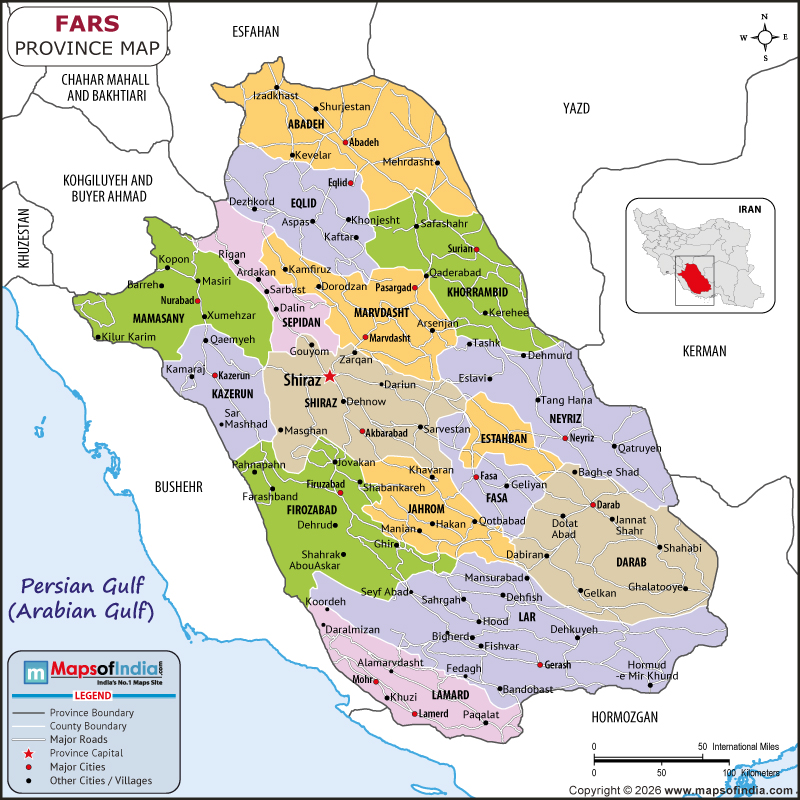



One of the most historically important provinces in the country and usually called the cradle of the Persian civilization is Fars Province, which is situated in the southern part of the country of Iran. It was the cradle of the ancient Achaemenid and Sassanian empires as evidenced by such recognizable places like Persepolis and Pasargadae as evidence of its imperial past. The capital of the province, Shiraz, is known for the rich literary life, gardens, and architecture. With a geographical diversity, Fars has mountains and fertile plain and arid areas, which facilitate agriculture, trade and cultural preservation. Fars Province is an important historical, cultural and Iranian identity center today.
History
The political, cultural, and imperial evolution of Iran is closely related to the history of Fars Province, which means that the latter is one of the most historically active areas of the ancient and medieval world. Being referred to in ancient times as Persis, Fars is considered as the core of Persian civilization and the originator of some of the biggest empires.
The movement of humans to the territory dates back to prehistoric periods, as archaeological evidence of the locations like Tall-e Bakun, Tall-e Malyan (ancient Anshan) suggests. In the early first millennium BCE, the Persian tribes continued to be under the influence of the Elamites, and became the home of the Persians tribes. These tribes such as the Achaemenids consolidated their powers slowly, which formed the basis of one of the greatest empires in history.
The Achaemenid Empire was founded by Cyrus the Great in the 6th century BCE, with Fars as the center. Cities like Pasargadae and later Persepolis were constructed as ritual and administrative centers, as they represented imperial power, advanced administration, and artistic performance. During the reign of such rulers as Darius I and Xerxes, the empire spread over three continents, although the ideological and cultural center was in Fars. The significance of the region faded away temporarily when Alexander the Great invaded it in 330 BCE and damaged Persepolis.
The local polity, or at times subordinate, rule of the achievements of the Fratarakas under the Seleucids and Parthians, Fars passed through periods of relative autonomy. It was revived in the 3rd century CE with the development of the Sassanian Empire under Ardashir I in Istakhr around Persepolis. Fars became the centre of major political and religious activity of Sassanians, which spread Zoroastrianism and created administrations, city planning, and monument buildings that shaped the future Islamic governance.
A significant shift was in the Arab conquest of the 7th century CE. Fars was slowly absorbed into the Islamic Caliphate and despite the fall of Zoroastrianism, the area assimilated with the Islamic culture without losing their Persian identity. Fars thrived in different dynasties, among them the Buyids, Seljuks and, subsequently, the Ilkhanids, at least in the medieval period. Shiraz became a university of great learning, literature, and art, which nurtured such famous poets as Hafez and Sa'di.
During the early modern period Fars was under effective significant hold of both the safavid and Zand dynasties. The urban stability and development came with the Karim Khan Zand making Shiraz the capital of his kingdom during the 18th century. During the periods of the Qajar and Pahlavi, Fars remained a significant administrative and cultural district.
Culture
The Fars Province culture is among the most rich and significant in Iran, which was created through the centuries of historical continuity, literature, and art. Being the center of ancient Persia, the territory has been a wellspring of cultural norms, values as well as traditions which subsequently diffused throughout the Iranian plateau region and further. Its cultural identity is a reflection of synergy between pre-Islamic tradition and mystic traditions, and this kind of heritage has resulted in a significant and permanent legacy.
Fars art and architecture is both imperial and luxurious in taste. The Archaic stone carvings of the Achaemenid and Sassanian eras transformed into sophisticated mosques, garden and bazaar architecture of Iranian Shiraz; in art, emphasis is made on symmetry, harmony and symbolism. The Eram Garden is an example of Persian gardens that influenced the landscape design and philosophical approaches to nature in the region.
The diversity of religious life in Fars has been a historical feature. Although Zoroastrianism was predominant in the ancient times, with the emergence of Islam, which became dominant after the 7th century, it influenced rituals, festivals and even social norms. Shrines, mosques, and religious commemorations merge with the traditional cultural practices especially in the seasonal events and local traditions.
The cultural landscape is also characterized by music, handicraft and cuisine. The classical Persian modes are used in traditional music which is usually accompanied by poetry. The craft work that includes carpet weaving, metalwork, and wood carving are some of the examples of handicrafts that have been handed down across generations. The food of Fars is characterized by the use of herbs, rice recipes, and subtle flavors, which echoes local farming and also the history of the exchange.
Language
The role played by language in developing the cultural and historical identity of the Fars Province cannot be overemphasized because the region is generally known to be the birthplace of the Persian language. The name Farsi itself derives itself out of Pars or Fars with which it is the central part of the formation and standardisation of Persian as a medium of language and literature. The language of this land experienced its development over centuries, and it was strictly related to the political influence, the overall culture production, and the social existence.
During the ancient times, Old Persian was spoken in Fars and used to inscribe the rulers of the Achaemenids as royal inscriptions, with the most famous of those being the ones inscribed at Persepolis and Naqsh-e Rostam. Old Persian was used as an official and ceremonial language written in cuneiform script and everyday communication probably comprised of local dialects. However, under the Sassanian rule, the standard language of administration, religion, and literature was Middle Persian or Pahlavi. It was vital in relaying Zoroastrian religious parables and government ideology.
During the Arab rule in the 7th century, Arabic was used as the administrative and religious language. Nonetheless, the Persian language did not die out. It was slowly revived in a new form called New Persian that was written in the Arabic script and embellished with Arabic words. The re-emergence and perfected use of Persian as a literary language took center stage in Fars Province and especially, in Shiraz.
Persian script produced in Fars during the medieval and early modern times established some linguistic and stylistic norms in the rest of the Iranian world. Administrators, poets and scholars of the region helped in transforming Persian into a transregional language that used in Iran, Central Asia and South Asia.
Geography
Fars Province is characterized by a high level of diversity that is determined by the geographic position and the diverse topography. The province is a broad zone of the Iranian plateau with mountains, plains, valleys, and arid areas present, which have greatly contributed to the settlement, the development of agriculture and history.
One of the significant geographical elements of the province is the mountain range of Zagros that cuts across the western and northern areas of this province. The early settlements and the development of sovereign political centers were historically secured by these mountains.
Unlike the mountainous areas, Fars is also endowed with fertile plains with the most prominent being the Marvdasht Plain which was the place where ancient cities like Persepolis and Pasargadae were formed. Alluvial soils and seasonal water sources enhance these plains making them agricultural. Wheat and barley, citrus fruits, and dates are some of the crops that are cultivated and help in supporting local consumption and regional trade.
This province has a very hot climatic condition mostly arid to semi-arid, however there are great fluctuations in the climate depending on the elevation. Summers tend to be hot and dry particularly at the southern lowlands whereas winters might be cold at the mountainous north. The distribution of rainfall is also unevenly spread compromising a major part of the yearly rainfall during the months of winter and early spring. This weather variability has encouraged the development of irrigation and water management systems.
The province is crossed by several rivers and seasonal streams, one of which is the Kor River that passes through the territory of the Marvdasht region and feeds the agricultural activities. Nonetheless, there are a great number of watercourses that are short-lived, as it is a problem of water scarcity. Lakes like the Lake Bakhtegan which are now greatly diminished through drought and human intervention were at a time considered important ecologically.
The geographical location of Fars has historically linked the interior with the coastal areas and the trade routes were opened between central Iran and the Persian Gulf.
Quick Facts
| Country | Iran |
| Region | Fars |
| Area | 122,608 km2 (47,339 sq mi) |
| Population | 4,851,274 |
FAQs
Q1: What is so great about Fars Province to the tourists?
The Fars Province is referred to as the cultural core of Iran and the origin of the Persian civilization. It is a tourist attraction due to its ancient archaeological sites, classical Persian gardens, ancient mosques and literary traditions. It is an important destination for history, culture, and heritage tourism due to world-famous sites like Persepolis, Pasargadae and Shiraz.
Q2: Does Fars Province have a friendly attitude to the tourists?
Generally, the Fars Province is visitor friendly and there is established infrastructures, guided tours, hotels, and local transportation, particularly in Shiraz. It is one of the most tourist friendly areas of Iran due to its rich history of cultural exchange.
Last Updated on: April 15, 2026

