


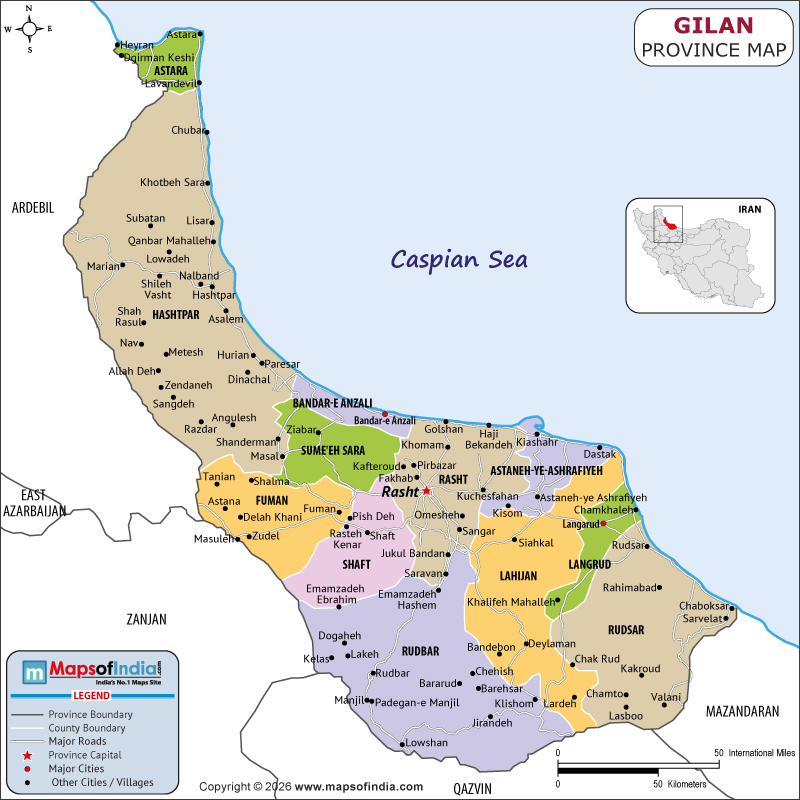



Gilan Province is a unique and fascinating part of Iran between the soaring Alborz Mountains and the glitter of the Caspian Sea. This green belt of Northern Iran shows a landscape which is such dramatic contrast to the dry interior of the nation that first time visitors tend to find it hard to accept such a contrast to their initial perception of the Persian geography. Having a subtropical climate, rich forests and plenty of rainfall, Gilan has gained an image of the most green province in Iran, where the generosity of nature has influenced the landscape as well as the personality, culture and a means of living of its inhabitants throughout the centuries.
History
Gilan has a long historical account which dates back to the obscurity of ancient times and evidence provided by archaeologists is that people have been living there thousands of years. The region belonged to the ancient kingdom of Hyrcania that the Greeks and Romans called the land of the wolves and forests. Gilan became part of the huge Persian lands during the Achaemenid Empire, but due to its mountainous nature and dense woodlands, the latter had a certain level of independence that would define its relations with the central authorities in the following centuries.
Islamic occupation of Iran in the seventh century introduced radical changes in Gilan even though the conversion was very slow and complicated. The area became the haven of all sorts of irregularities escaping the turmoil of early Islamic Iran such as the Alid refugees who took shelter in its inaccessible valleys. This flow helped Gilan to finally turn into a Shia, and it would be a part of the provincial identity.
Gilan became a semi-autonomous kingdom during the medieval times, and was frequently governed by local dynasties who made token obedience to whoever was in charge of the Iranian plateau. The Kiya iii dynasty that ruled the area between the last fourteenth and the first half of the sixteenth century marked perhaps the peak of the Gilan independence. These lords easily manoeuvred the difficult seas of local politics, which kept them in their niche thanks to the diplomatic savvy and the inherent protection of the geography of the region.
The Safavid rule was a turning point of how Gilan would relate to the central authority. The Safavid shahs had come to realise the economic and strategic value of the province and slowly brought it under closer control. The silk production of the region became more specifically useful and Gilani silk was exported via Caspian sea to Russia and other countries, and thus the province was a major source of imperial income.
The eighteenth and the nineteenth centuries were marked with the complete assimilation of Gilan into the developing Iranian state, but the local opposition to centralisation sometimes erupted. Gilan was keenly interested in the Constitutional Revolution of the early twentieth century, and especially in Rasht, which was a fierce nest of constitutionalist action. The short-lived Persian Socialist Soviet Republic with Mirza Kuchik Khan briefly resided thereafter in Gilan, another incident that mirrored both the spirit of independence of the province and its exposure to the machinations of the great powers.
Culture
Gilani culture is an interesting fusion of Persian civilisation and unique local customs, shaped by the province’s distinct environment and historical experiences. Abundant water resources and rich vegetation have created a worldview very different from Iran’s desert regions. Agriculture, especially in the past, provided a stable foundation that supported a lively and diverse cultural life.
Gilani culinary art is widely admired across Iran and beyond. The local cuisine relies heavily on fresh, locally sourced ingredients such as rice, herbs, and Caspian fish. Dishes like mirza ghasemi, a smoky eggplant and egg dish, along with various herb-based stews, reflect the richness of Gilani gardens. The region is also famous for cultivating sour pomegranates and using local greens in ways uncommon in other parts of Iran.
Music and dance are central forms of cultural expression in Gilan. Traditional music, performed with local instruments such as the neylangi (a type of flute) and various percussion instruments, accompanies folk dances commonly seen at weddings and celebrations. While these artistic traditions share elements with broader Iranian culture, they retain distinct characteristics that make them clearly Gilani.
Gilani architecture is closely adapted to the region’s humid and rainy climate. Traditional houses feature steep roofs to channel heavy rainfall and elevated floors to protect against moisture. Built primarily from local forest wood, this vernacular architecture differs greatly from the brick and mud structures common elsewhere in Iran. The blend of detailed wooden craftsmanship with simple, practical design reflects generations of adaptation and local ingenuity.
Language
Gilaki, which is a Northwestern Iranian language and the most widely spoken local language, is the main medium of daily communication for most people living in Gilan. Gilaki belongs to the Caspian branch of the Iranian languages and therefore shares some similarities with Mazandarani, the language of the neighboring province to the east. Despite these similarities, Gilaki is an independent language and is not mutually intelligible with Mazandarani.
Gilaki is not a single uniform language but consists of several dialects spoken across the province. The most important division is between western and eastern Gilaki, with the city of Rasht roughly marking the boundary between the two. These dialects differ in pronunciation, vocabulary, and certain grammatical features, although speakers generally understand each other without much difficulty. Each major variety also includes smaller subdialects, reflecting the historical isolation of communities within Gilan’s mountainous landscape.
Persian is the official language used in education, government, and formal communication in Gilan, as in the rest of Iran. Most Gilaki speakers are bilingual, using Gilaki at home and in informal settings while switching to Persian in official contexts and increasingly in urban areas. This widespread bilingualism has raised concerns among language activists about the long-term survival of Gilaki, especially as younger generations in cities such as Rasht are becoming more inclined to use Persian even in casual conversation.
Geography
Most of Gilan’s population is concentrated on the fertile coastal plain, which has been enriched over millennia by river-borne soil deposits originating in the surrounding mountains. This lowland area receives exceptionally high rainfall, averaging about 1,350 millimetres per year in Rasht and reaching up to 1,900 millimetres in some locations, making Gilan one of the wettest regions in Iran. The province has a humid subtropical climate with mild, rainy winters and warm, humid summers, a sharp contrast to the largely continental and arid climate found in much of the country.
The Alborz Mountains form Gilan’s southern boundary and create a powerful natural barrier between the Caspian coast and the Iranian plateau. Moisture-laden air masses rising over these mountains produce heavy precipitation that sustains Gilan’s lush vegetation. The northern slopes of the Alborz are covered with dense temperate forests that form part of the Caspian Hyrcanian mixed forests, a UNESCO World Heritage site recognized for its exceptional biodiversity and its status as a remnant of ancient forests that once covered vast areas of the region.
Several rivers flow through Gilan and drain northward into the Caspian Sea. The Safid River is the largest of these waterways, originating in the mountains and forming a broad delta before reaching the sea. Historically, such rivers have served as transportation routes and sources of power, although they have also posed flood risks to nearby communities during periods of heavy rainfall.
Gilan is rich in natural resources, particularly its extensive forests, which have supported timber industries for centuries. However, deforestation and environmental pressures now threaten these ecosystems. The Caspian Sea provides valuable fishing resources, especially sturgeon, which are the source of the region’s famous caviar. In recent decades, overfishing and pollution have severely impacted fish populations.
Agriculture in Gilan benefits greatly from the favorable climate and abundant water supply. Rice cultivation dominates much of the landscape, with characteristic paddy fields spread across the plains. The province is also covered with tea plantations and produces nearly all of Iran’s tea. In addition, citrus fruits such as oranges, along with a wide variety of vegetables and herbs, thrive in Gilan’s warm and humid environment.
Quick Facts
| Official Name | Gilan Province |
| Area | 14,042 km² |
| Population | 2.5 million (As of 2016) |
| Language | Gilaki, Persian |
| Religion | Islam |
FAQs
FAQs
Q1: What makes Gilan's climate different from the rest of Iran?
Gilan receives abundant rainfall and has a humid subtropical climate due to moisture from the Caspian Sea, while most of Iran has an arid or semi-arid climate.
Q2: What is Gilan famous for producing?
Gilan is renowned for its rice, tea (producing nearly all of Iran’s tea), Caspian caviar, silk, and distinctive culinary traditions.
Q3: How old is human settlement in Gilan?
Archaeological evidence shows that people have lived in Gilan for thousands of years, with the region historically forming part of the ancient kingdom of Hyrcania.
Q4: Why are Gilan's forests important?
Gilan’s forests are part of the Caspian Hyrcanian mixed forests, a UNESCO World Heritage site that represents ancient temperate forests with exceptional biodiversity.
Last Updated on: April 15, 2026

