


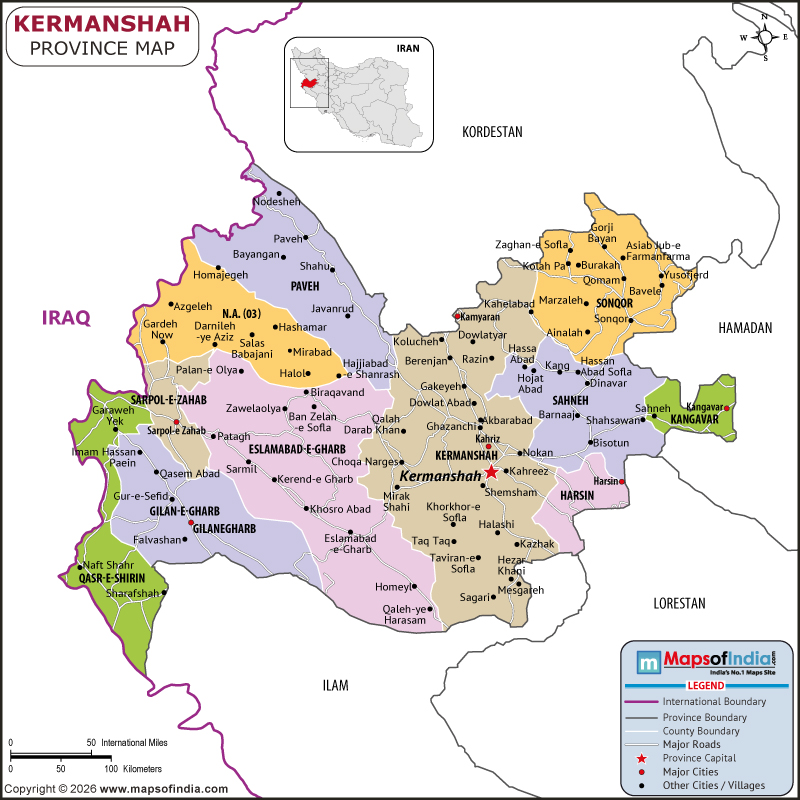



Kermanshah is a historical region in western Iran, famous for its ancient origins and vibrant cultural life. Located near the Zagros Mountains, it has long been a popular location for human settlements. The region connects Iran with Mesopotamia, making it an important route for trade and travel. It is well-known for historical landmarks such as Behistun and Taq-e Bostan. It is also home to a diverse population, primarily Kurdish populations. The history, culture, language, and natural surroundings all contribute to a strong and distinct regional identity.
History
Kermanshah is one of western Iran's oldest provinces, with a rich and complex history dating back thousands of years. Because of its closeness to the Zagros Mountains and Mesopotamia, Kermanshah has always been a hub for human settlement, trade and culture. Many ancient civilizations passed through or resided in this region, leaving monuments, inscriptions and customs that continue to shape it today.
Archaeological evidence indicates that humans inhabited the Kermanshah region as early as the Paleolithic period. Caves like Warwasi and Bisitun include artifacts and remnants that demonstrate how early humans exploited this region for shelter and hunting. It was an ideal location for farming and animal husbandry because of the lush valleys, meandering rivers and temperate climate. Small villages develop into organized communities over time.
The Elamite civilization is among the oldest known civilizations linked with Kermanshah. Beginning about 3000 BCE, the Elamites ruled over a portion of western Iran and had significant cultural and political impacts. The region then joined the Median monarchy. In the seventh century BCE, a group of Iranians known as the Medes contributed to the fall of the Assyrian Empire. Because of its location, Kermanshah was of major importance for managing the roads connecting Iran and Mesopotamia.
Kermanshah became much more important during Cyrus the Great Achaemenid Empire (550–330 BCE). Darius the Great's reign is shown by the well-known Behistun Inscription, which is situated close to the city. One of the crucial historical documents from antiquity, this enormous rock sculpture and multilingual writing detail Darius' ascent to power. The fact that it was written in Babylonian, Elamite and Old Persian demonstrate how important this area was to the empire.
Kermanshah was ruled by Alexander the Great and then the Seleucid Empire following the collapse of the Achaemenids. Local Iranian customs mixed with Hellenistic influence as it spread over the area. This was then followed by Parthian control, during which Kermanshah remained a strategic territory due to its location along commercial and military routes. The Parthians exploited the area as a barrier against Roman advance.
The Sasanian Empire (224–651 CE) was a golden age for Kermanshah. Several major Sasanian monuments can still be seen today, particularly in Taq-e Bostan. The rock reliefs depict Sasanian kings being crowned and celebrating triumphs. Kermanshah's proximity to the Sasanian capital of Ctesiphon gave it political and military importance.
During this period, the region grew from agriculture and trade. Kermanshah joined the Islamic world following the Arab-Islamic conquest of Iran in the 7th century. Islam slowly grew across the region, and new cities, mosques and schools were built. Under many Islamic dynasties, including the Umayyads, Abbasids and later local rulers, Kermanshah remained an important provincial centre. During the medieval period, Kurdish tribes gained importance in the region, influencing its ethnic and cultural identity.
The region rose to prominence as a border province between Iran and the Ottoman Empire during the Safavid dynasty. Therefore, it has seen various wars and battles. The Safavids encouraged Shi'a Islam, which dominated the province, though Sunni communities persist. Its governors played major roles in safeguarding Iran western frontiers.
It was an important military and commercial hub during the Qajar era (1796–1925). As European tourists and diplomats moved through the city, a few contemporary establishments gradually emerged. But the area also faces economic challenges and political unrest. For a brief period during World War I, foreign armies invaded Kermanshah, which was not easy for the locals.
The province saw modernization initiatives during the Pahlavi dynasty in the 20th century, including the construction of new roads, schools and businesses. The Iran-Iraq War (1980–1988) was one of the region's most crucial times following the Iranian Revolution in 1979. The region was severely impacted by bombings and military assault due to its closeness to the Iraqi border.
Many towns were damaged, and thousands of people were displaced. Kermanshah is a resilient city with a rich past. Its ancient monuments, diverse people and cultural traditions demonstrate thousands of years of change and continuity. The region’s history is more than simply rulers and empires; it is also about the people who lived, struggled and preserved their identity across generations.
Culture
Kermanshah's culture is rich, diversified, and strongly rooted in its history, geography, and people. The region, located in western Iran near the Zagros Mountains, has long served as a cultural crossroads. This has resulted in a distinct cultural identity that remains quite strong today.
It is heavily influenced by its people. The vast majority of the population is Kurdish, primarily from the Kalhor, Jaff, and other Kurdish tribes. Along with Kurds, there are Lurs, Persians, and minor settlements of other ethnicities. This has resulted in a society that emphasizes hospitality, close family relationships, and relation to tradition. Guests are greeted graciously, and sharing food is considered a gesture of honor and friendship.
In Kermanshah's cultural life, music has a very unique place. Many people adore traditional Kurdish music, which is frequently played at social events like weddings and festivals. Commonly utilized instruments include the tanbur, daf, and kamancheh. In particular, the tanbur has spiritual importance and is linked with the ingrained Yarsan (Ahl-e Haqq) religious heritage. Songs frequently narrate tales of love, bravery, the natural world, and historical occurrences.
Another powerful representation of the local way of life is traditional attire. Kurdish ladies wear vibrant gowns adorned with pure embroidery, coins, and jewelry, while Kurdish males frequently wear baggy pants, thick belts, and coats. These garments are still worn to exhibit pride in one's local identity during festivities and cultural gatherings.
Food in Kermanshah reflects both the landscape and the culture. Dandeh kebab, khoresh-e khalal (an almond stew), and nan-e berenji, a rice-based sweet bread sometimes perfumed with rosewater, are among the region's most famous foods. Dairy products, beef, grains, and native herbs are used, owing to the region's agricultural and pastoral culture.
Religion also influences cultural life in Kermanshah. The majority of people practice Shi'a Islam, but there are also Sunni Muslims and Yarsanism adherents. This religious diversity has fostered a culture of peace and mutual respect over time.
Language
The Kermanshah language represents the region's vast cultural and ethnic diversity. The most widely spoken language is Kurdish, particularly the Southern Kurdish dialects. Kalhori Kurdish is widely spoken in the city and surrounding areas. This dialect has a distinct accent, vocabulary, and expressions that differentiates it from other varieties of Kurdish spoken in Iran, Iraq, and Turkey.
Along with Kurdish, Persian (Farsi) is extensively spoken. Persian is Iran's official language, used in schools, government agencies, the media, and formal communication. Most Kermanshah residents are multilingual, speaking Kurdish at home and in everyday life and Persian in official or educational situations. This bilingualism is a common feature of life in the region.
Luri is also spoken by smaller groups in some rural locations, particularly close to the borders of nearby provinces. Due to long-standing contact with Arabic-speaking areas, trade, and religion, Arabic terms can occasionally be heard in local speech as well.
The languages of Kermanshah have an oral legacy. Elders frequently transmit proverbs, poetry, music, and folktales. Spoken forms lead to the preservation of local values and history. In general, Kermanshah's languages have a significant role in the region's identity and cultural memory in addition to serving as communication tools.
Geography
Kermanshah is located in western Iran, close to the Iraqi border. The region is largely located in the Zagros Mountain range. As a result, the terrain is extremely mountainous and uneven. There are several hills, valleys, and high peaks in the province. Some flat plains do exist, particularly around the main cities and farming areas. These plains are vital for agriculture and settlement.
Several rivers flow in Kermanshah. The three most important rivers are the Gamasiab, Qareh Su, and Alvand. These rivers aid in agriculture and give water to humans and animals. Many villages are located near rivers or natural springs. Some valleys have fertile soil that can support crops such as wheat, barley, and fruit.
Kermanshah has a generally chilly to moderate climate. Particularly in mountainous regions, winters can be bitterly cold and protracted. Higher altitudes frequently experience snowfall. When there is a lot of snow, certain villages may close their roadways. Summers are dry and warm but they are not particularly harsh because of the mountain climate, which keeps high heat at bay in many locations.
Spring is one of the most delightful seasons of the region. The terrain turns green during this period due to increased rainfall. The hills and valleys are covered in grass and flowers. Autumn is pleasant as well, with less rain and colder temperatures.
Quick Facts
| Official Name | Kermanshah |
| Location | Central Iran |
| Area | NA |
| Population | 2,030,484 |
| Language | Kurdish |
FAQs
Q1: What languages are spoken in the region?
Most people speak Kurdish dialects such as Kalhori, while Persian is used in schools, offices, media, and formal communication throughout the region.
Q2: What is Kermanshah famous for culturally?
Kermanshah is well known for its rich Kurdish music, traditional clothing, local foods like dandeh kebab, and strong traditions of hospitality, family life, and community bonds.
Q3: What is the climate like in Kermanshah?
Kermanshah experiences cold winters with snowfall in mountainous areas, mild springs, warm and dry summers, and a climate that is well suited for agricultural activities.
Last Updated on: June 22, 2026

