


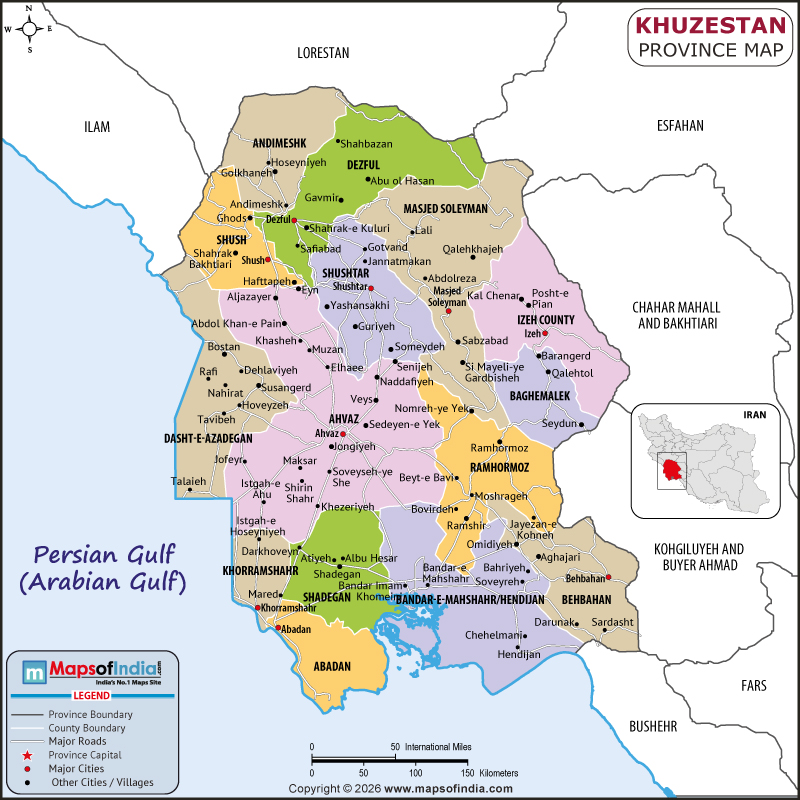



Khuzestan, located in southwestern Iran is a province which has a rich historical heritage, and has a border with Iraq and Persian Gulf. It was the heartland of the Elamite kingdom and later played a significant role under the Achaemenid and Sasanian reigns. There are numerous archaeological sites, to which the Susa, one of the oldest cities in the world, is part of this region. It is also in Khuzestan that Iran produces the majority of its oil, which plays a significant role in the economic life of the country. It has a varied population, fertile plains, and large rivers such as Karun which make it both a cultural and economic hub.
History
Khuzestan boasts a complex and a rich history, which marks it as one of the most important regions of the ancient Near East. It has a pre-historic beginning, where prehistoric people, who lived as nomadic hunters and gatherers, saw its fertile plains as home, which was watered by the Karun, Karkheh and Dez rivers.
Khuzestan, which was known as Susiana, became the political and cultural core of the Elamite culture. The capital of the Elamites Susa emerged to become a great city that had advanced administrative structures, monumental buildings, and early writing systems. Elam interacted with the Mesopotamian empires, particularly, Sumerian, Akkadian, and Babylonian, occasionally in the form of trade and other times through military conflict. Elam is the region that preserves the strong cultural identity despite numerous invasions and managed to preserve it for centuries.
Following the establishment of the Achaemenid Empire in the sixth century BCE, Khuzestan became part of the empire with Cyrus the great. One of the main capitals of the empire was Susa, which also used to be an administrative and ceremonial hub of that region. The political significance was expressed by the existence of magnificent palaces including that constructed by Darius I. The Achaemenids made Khuzestan part of a large imperial structure stimulating infrastructure, irrigation, and maritime trade.
After the defeat of the Achaemenids, Khuzestan became the domain of the following authorities such as the Seleucids and, further on, the Parthians. The region revived around the third to seventh centuries CE under the Sasanian rule. Urban development, massive projects in irrigation systems and agricultural growth made Khuzestan a rich province. Cities such as Gundeshapur turned out to be learning, medical, and philosophical centers that drew scholars of the whole empire.
This was a major turning point that came with the conquest of the Arabs-Muslim in the seventh century CE. Khuzestan was being Islamized which slowly integrated Arabic culture with the established Persian customs. During the medieval times, the area witnessed political changes in different dynasties, such as the Abbasids, Buyid, and Seljuk. Agriculture and trade were able to sustain the local economy, even in the periods of instability.
Khuzestan acquired a second strategic value during the modern period due to the oil discovery in the early twentieth century. This changed its economy and made it one that was closely connected to the industrial growth of Iran. During the Iran-Iraq War (1980-1988), the province also underwent a lot of destruction.
Culture
Being one of the oldest occupied areas of the ancient Near East, its cultural identity speaks of the evolution of the prehistoric agrarian societies up to the intricate urban society. These factors include the availability of rivers, fertile plains and trade routes that have inspired a way of life that has always been closely related to agriculture, craftsmanship and commerce, which are still affecting the social practices up to date.
Khuzestan has a traditional social life which values family, kinship and community relationships. Hospitality is a cultural aspect which is manifested in the generosity in food and in the respectful attitude to the guests. Social events normally centred around shared meals, seasonal festivals and religious holidays help in maintaining unity among people.
The dressing in the area is accustomed to the hot climate and the traditions of a specific area and usually the dress making is inclined to loose and airy dresses. Modern areas use modern clothes; however, traditional customs are also applicable in the organization of festivals, rites and even in the countryside, as a way of maintaining the culture. There are also jewelry and decorative accessories that are culturally relevant in nature, particularly those motifs inspired by nature and history.
The cultural life in Khuzestan is connected with music, dance and oral traditions. Folk performances are often based on nature, labour, heroism and historical memory. Weddings, communal gatherings and ritual occasions involve music and dancing, which serves as a means of happiness, identification and coexistence. Through storytelling and poetry, local history, values and group experience are preserved in the generation-to-generation continuum.
Food is at the center of the cultural expression process influenced by the fertility and river nature of the area. Food is mostly made of grains, dates, fish and produced locally, cooked in rich flavours and traditional methods. Food is not merely a means for sustenance, it provides a symbol of generosity and social bond particularly at social events such as festivals and at family meetings.
Another dimension of the culture of Khuzestan is the religious and ritual practices. The cultural calendar is defined by sacred spaces, pilgrimage practices and commemorative ceremonies that also gives them the feeling of continuity with the past. It also has many rituals that show a mix of old traditions with the new religious ones, which define the multi-layered history of the region.
Language
Khuzestan is multi-lingual as it has a rich history of migration, imperialism and mixing of cultures. Languages in the region evolved due to thousand-year intercultural interaction of the ancient societies of the Iranian plateau and Mesopotamia, which is why it is one of the most linguistically diverse regions of Iran. This diversity is not new but it is historically ingrained in the processes of settlement and social life development.
The Elamite, the first written language in the history of the Near East, was used by the oldest known residents of the country: the Elamites. Inscriptions at Susa and elsewhere show that the region was administratively and culturally advanced in the earliest period of Elamite history. During the time frame Khuzestan, being a part of more significant empires, started to become less and less popular, replaced by other languages linked to ruling authorities.
The use of official language became part of the government, particularly in royal inscriptions and administration as Old Persian, together with Elamite and Akkadian, was employed when the region became a part of the Achaemenid Empire. Subsequent eras brought in the influence of new languages with the Seleucid, Parthian rule and the Sasanian rule whereby the role of Middle Iranian languages (Pahlavi) dominated administration and culture.
Arabic became widely used, and an indelible mark was created on the linguistic horizon after Arabic became widely used due to the conquest in the seventh century by the Arab-Muslim. Arabic and Persian were in close contact during several centuries influencing the daily communication patterns, the development of the literary spheres, and the administrative forms.
Geography
The region is in the southwest region of the country and it creates a natural link between the Iranian plateau and Mesopotamia. The geographical feature that can be seen in Khuzestan is its expansive alluvial plain which is due to centuries of deposition by major rivers. It is one of the most fertile plains in Iran and it has been used to sustain human settlement since prehistoric times. Large-scale agriculture was also possible, and this, combined with the flat land, stimulated the growth of premodern cities. Grains, sugarcane, and dates are some of the crops that have long been doing well here because of the rich alluvial soil.
A number of significant rivers cross Khuzestan and form the most significant part of its geography and economy. Karun River is the only navigable river in Iran, and it is the most important, as it supplies water to the irrigation systems, transportation, and industries. There are other rivers including the Dez and Karkheh, which supply a large scale irrigation system and sustain agriculture carried out in the plains. These rivers have determined the settlement pattern and even trade routes, which connected Asian areas with the Persian Gulf.
The natural topography on the west and south, to the north and northeast, is the Zagros Mountains which contrast sharply with the lowlands. The presence of these mountains has an impact on the climate of this region as the moisture bearing winds are blocked forming differences in the rainfall. They also provide rivers which come down to the plains with fertile silt. The foothill areas are habitat for pastoral activities and seasonal migration which contributes to the geographical diversity in the region.
Quick Facts
| Country | Iran |
| Region | Khuzestan |
| Area | 64,055 km2 (24,732 sq mi) |
| Population | 4,710,509 |
FAQs
Q1: To what extent is Khuzestan tourist-friendly?
Khuzestan is well connected by road, rail, and air. Major cities such as Ahvaz have railway stations and airports, making travel convenient. The province offers tourist infrastructure including hotels, transport services, and guides, especially in urban centers and heritage sites.
Q2: When should one go to Khuzestan?
Khuzestan can be visited throughout the year except during the summer season. The ideal time to travel is between late autumn and early spring, particularly from November to March. During this period, temperatures are moderate and suitable for sightseeing, while summers can be extremely hot and uncomfortable, especially in the plains.
Last Updated on: April 15, 2026

