


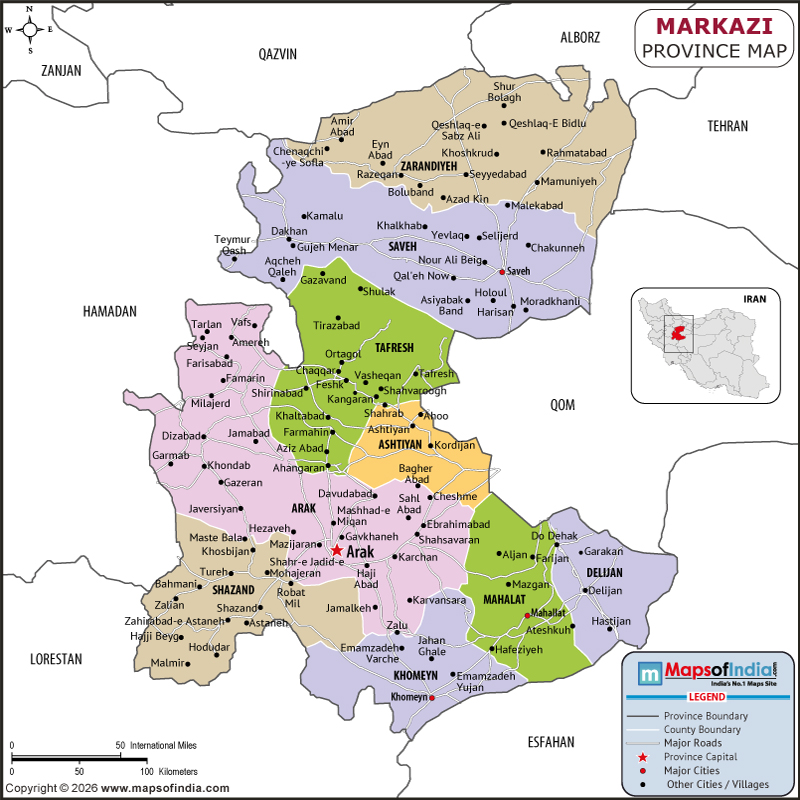



The Iranian province of Markazi holds a significant position in the history and culture of the nation. Due to its strategic location, it has long facilitated trade, travel, and intellectual exchange between many regions. The region's combination of plains, mountains, and arid environments is well-known and influences how people live and work. With traditions based on family life, religion, and regional customs, Markazi has a strong sense of cultural identity. Although there are some regional varieties, Persian is the primary language spoken here. Therefore, despite the gradual growth of modern life, Markazi feels calm, traditional, and profoundly rooted in Iran's past.
History
Markazi Province, whose name roughly means “central,” is located in the heart of Iran. Although it has not always received the same attention as major cities such as Tehran or Isfahan, its central location has made it historically significant for thousands of years. Human settlement in this region dates back to the earliest periods of habitation on the Iranian Plateau.
In ancient times, the territory that now forms Markazi Province was part of the larger region of Media. The Medes, one of the earliest Iranian peoples, established a powerful kingdom in the seventh century BCE, and historians believe that parts of present-day Markazi were under their control. The region’s mountains, water sources, and fertile lands made it suitable for agriculture and animal husbandry. Most people lived simple rural lives in small villages.
During the Achaemenid Empire, Markazi became more closely connected to the wider Iranian world. Although it was not a political capital, its proximity to major routes linking central and western Iran gave it strategic importance. The Achaemenids improved roads and communication networks, helping integrate the region into the imperial system.
After the fall of the Achaemenids, Markazi came under the rule of the Seleucids and later the Parthians. During the Parthian period, the area consisted mainly of villages and small towns. While it was not densely populated, it played an important role in supplying agricultural products and resources to nearby urban centers. The region gained renewed importance under the Sasanian Empire, which strengthened administration and infrastructure across much of Iran.
The Arab conquest of Iran in the seventh century brought significant changes to Markazi, as it did to many other regions. Islam gradually spread among the population, though the transition took time. Some communities adopted the new religion quickly, while others held on to older traditions for generations. Fire temples were eventually replaced by mosques, yet the Persian language remained dominant in everyday life.
Throughout the medieval period, Markazi experienced cycles of stability and hardship. The region suffered particularly during the Mongol invasions, which led to population decline and the destruction of many settlements. Some areas were abandoned for years as living conditions worsened. Over time, however, people returned and rebuilt their communities, with agriculture continuing as the main livelihood even during uncertain periods.
Greater stability returned during the Safavid era. After Shi’a Islam was declared the state religion, religious institutions expanded across the province. Towns such as Sultanabad—later renamed Arak—began to grow in importance. In the early nineteenth century, during the Qajar period, Sultanabad was officially founded for military and administrative purposes and gradually developed into the largest city in the region.
Despite these developments, Markazi remained largely rural during the Qajar era. Some industries began to emerge, most notably carpet weaving. Markazi carpets became well known for their quality and provided income for many families. Agriculture, especially grain farming and livestock raising, continued to dominate daily life, and social change occurred slowly.
Modernization became more visible during the Pahlavi period. New schools, factories, and roads were built, and Arak emerged as an important industrial center, particularly in manufacturing and heavy industry. Many villagers migrated to urban areas in search of employment, leading to demographic and social changes and a gradual decline in traditional village life.
After the Islamic Revolution of 1979, Markazi continued to develop as an industrial and educational region. Access to education expanded, and industrial growth continued. At the same time, efforts were made to preserve the province’s cultural and historical identity. Today, Markazi Province is recognized as a place where modern industry and ancient traditions coexist, reflecting its long and layered history.
Culture
The culture of Markazi Province is shaped by its long history, diverse population, and central location within Iran. Because the region has long served as a crossroads for tribes, traders, and travelers, its culture reflects a blend of traditional values and modern influences. The people of Markazi are often known for their calm nature, strong work ethic, and deep attachment to their land and customs.
Family plays a central role in everyday life. Family gatherings are common, especially during religious events and national holidays, and respect for elders is highly valued. Important life events such as weddings, births, and funerals are not limited to close relatives but involve the wider community. Both towns and villages maintain a strong sense of social unity, with neighbors frequently supporting one another.
Religion is an important cultural foundation in Markazi. The majority of the population follows Shi’a Islam, and religious beliefs influence daily routines, social behavior, and clothing. Major occasions such as Nowruz, Ramadan, Ashura, and the month of Muharram are observed with care and devotion. During Muharram, communities organize processions, recite elegies, and distribute free food, practices seen as both religious duties and expressions of cultural pride.
Traditional clothing is less common in urban areas, but in rural communities, older men and women still wear traditional garments during festivals and special occasions. Handicrafts remain an important cultural feature. Carpet weaving, rug making, ceramics, and simple metalwork are practiced in many areas. These skills are often passed down within families, even though younger generations are gradually moving toward modern occupations.
Poetry and music hold a respected place in Markazi’s cultural life. Folk songs are often performed at celebrations and during agricultural activities. Poetry readings remain popular at cultural gatherings, and many people admire classical Persian poets such as Hafez, Saadi, and Rumi. In some smaller towns, local literary events highlight the region’s appreciation for learning, literature, and the arts.
The food culture of Markazi is simple yet rich in flavor. Daily meals typically include rice, bread, vegetables, dairy products, and meat. Home-cooked food is preferred over restaurant dining, and guests are warmly welcomed. Offering food to visitors is considered a sign of respect and generosity.
Overall, Markazi culture is calm, steady, and deeply rooted in tradition. Although lifestyles are gradually changing in response to modern influences, many residents make a conscious effort to preserve their cultural values, often blending long-held traditions with new ways of life.
Language
Persian, commonly known as Farsi, is the primary language spoken in Markazi Province. As the official language of Iran, it is used in daily communication, education, workplaces, and the media. In urban areas, especially among younger generations, standard Persian is widely spoken. In villages and smaller towns, however, speech often carries a more regional tone and accent.
Several local varieties of Persian exist across Markazi, influenced by neighboring regions and older Iranian languages. These dialects may differ in pronunciation, vocabulary, and sentence structure, sometimes sounding unfamiliar to outsiders. Older generations tend to use these regional forms more frequently, while younger people usually understand them but prefer standard Persian in everyday use.
As a result of modernization and formal education, some of these local dialects are gradually fading. In certain parts of the province—particularly near borders with other regions—some residents may also understand or speak languages such as Azeri or Luri, though this is relatively uncommon. Persian continues to serve as the main language that connects all communities in Markazi.
Language in Markazi is often enriched by the use of proverbs, poetry, and storytelling. Even in casual conversations, people frequently include short sayings or poetic expressions. Although everyday speech may be informal and not always grammatically precise, it is generally warm, expressive, and reflective of the region’s cultural depth.
Geography
The geography of Markazi Province is diverse and plays an important role in shaping life in the region. Located in central Iran, the province acts as a link between several major areas of the country. Because of this central position, Markazi includes both mountainous regions and wide plains, giving the landscape a varied and uneven character.
Large parts of Markazi are covered by mountains and hills, especially in the northern and western areas. These regions are part of the Zagros mountain system. The mountains strongly influence the local climate and, in some places, limit agricultural activity. Steep terrain and colder weather make farming more challenging in these areas.
In contrast, the southern and eastern parts of the province consist mainly of flatter land and open plains. These areas are more suitable for agriculture and livestock grazing, although water resources are often scarce. Farming in these plains depends heavily on careful water management.
Markazi generally has a dry climate. Summers are hot and arid, while winters can be cold, particularly in higher elevations. Mountain towns often experience snowfall, whereas desert and semi-arid areas receive very little rainfall. Due to limited precipitation, residents rely on wells, qanats, and small rivers for their water supply.
There are no major permanent rivers flowing through the province, but seasonal streams appear after rainfall. In some areas, salt lakes and dry basins can also be found. Overall, the geography of Markazi is simple yet demanding, and over generations, people have learned to adapt their lives to these natural conditions despite the challenges they present.
Quick Facts
| Country | Iran |
| Region | Markazi |
| Area | 29,127 km2 (11,246 sq mi) |
| Population | 1,429,475 |
FAQs
Q1: What is the predominant language spoken in Markazi?
The primary language spoken in Markazi is Persian (Farsi). In rural areas, people often speak local Persian dialects that differ slightly from standard Persian.
Q2: What is the climate like in the Markazi region?
The climate is mostly dry. Summers are hot, while winters can be cold, especially in mountainous areas. Rainfall is limited, so water resources are scarce in many places.
Q3: What are the main cultural traditions in Markazi?
Religious occasions such as Muharram, Ramadan, and Nowruz are highly significant. Family gatherings, hospitality, community participation, and respect for elders are key parts of daily life.
Last Updated on: April 15, 2026

