


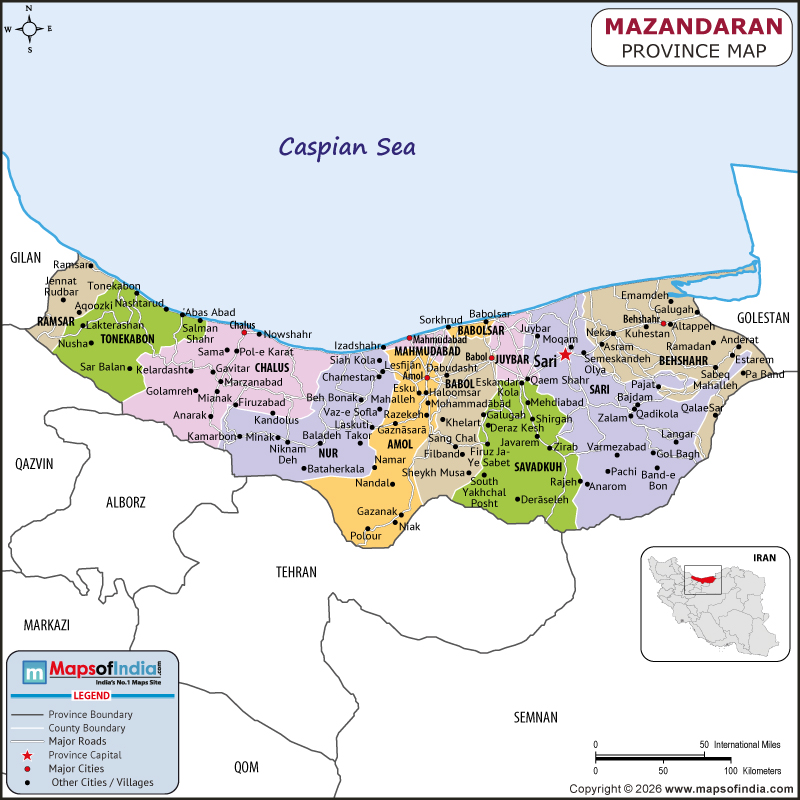



Lying between the southern part of the Caspian Sea, Mazandaran province is one of the most fascinating provinces in Iran, where fertile forest areas intertwine with the traces of ancient history and the colourful culture flourishes under the veil of mists between the mountains. Singularly endowed with its own geography, which sets the arid plateau of Iran apart in relation to the Caspian coast, this province has long been an island of its own and its own language, own customs and identity and yet part of Persian civilisation. Mazandaran has a spectacular natural diversity with snow-topped mountains in the Alborz Mountains and the humid subtropical coastline. It was the geographic position that defined the history of the region and the waves of settlers, invaders and traders attracted the region with their own patterns of joining the cultural tapestry of this unique province.
History
Isfahan is among Iran's oldest and most important cities. For thousands of years, it has played an important role in Iranian politics, culture, and art. Isfahan is known as "half of the world" in Persian tradition due to its long history and rich legacy.
In antiquity, the Isfahan region was home to early farming settlements. It was an appropriate locale for the inhabitants due to its central Iranian position. It was situated along important trade routes connecting various sections of the Iranian plateau. Despite not being a capital city during the Elamite, Median, and Achaemenid dynasties, Isfahan remained a useful and vibrant settlement.
Isfahan's importance grew during the Parthian and Sasanian periods. The city developed strong fortifications and evolved into a regional hub. Because of its strategic location, it served as a military base during the Sasanian Empire. Fire temples existed in and around Isfahan, and Zoroastrianism, the empire's official religion, flourished there. At this time, the city consisted of several smaller towns and villages rather than a single unified metropolis.
Arab Muslim forces took control of Isfahan in the seventh century as part of the Islamic expansion. Although Islam gradually became the dominant religion, other communities such as Christians and Jews continued to live in the city. During the Islamic era, Isfahan expanded and became a significant urban center.
Islamic traditions blended with Persian culture as mosques, bazaars, and educational institutions were constructed. Persian remained widely spoken and continued to be used in daily life and literary works.
Isfahan experienced exceptional growth during the Seljuk period in the eleventh and twelfth centuries, when it briefly served as the capital of the Seljuk dynasty. The city attracted wealth, scholars, and artists. Many important architectural works were constructed, including major portions of the Jameh Mosque of Isfahan, which still stands today.
During this era, Isfahan gained recognition as a center of learning, science, and religion. However, following the Seljuk decline, the city faced hardship. Mongol invasions in the thirteenth century caused widespread destruction and loss of life.
Although Isfahan eventually recovered, it did not immediately regain its former splendor. The Timurids and other later rulers governed the region but often focused their attention elsewhere.
The height of Isfahan’s history occurred under the Safavid dynasty in the late sixteenth and early seventeenth centuries. In 1598, Shah Abbas I selected Isfahan as the Safavid capital, transforming the city permanently. Extensive investments were made in urban planning and monumental architecture to showcase the power and glory of the Safavid state.
Magnificent mosques, palaces, bridges, wide avenues, and large public squares were built. Naqsh-e Jahan Square, one of the largest city squares in the world, dates from this era and is surrounded by Ali Qapu Palace, Sheikh Lotfollah Mosque, and Shah Mosque. Isfahan also became a major commercial center, connected to international trade routes. The settlement of Armenian merchants in the New Julfa district encouraged trade and cultural exchange, making the city a truly cosmopolitan hub.
With the decline of the Safavid dynasty in the eighteenth century, Isfahan suffered greatly. Afghan invasions caused significant damage, and the city lost its status as the capital. Under later dynasties such as the Qajars, political power shifted to other cities. Although Isfahan remained culturally and economically important, it never regained the same level of political dominance it had enjoyed during the Safavid period.
Culture
The culture of Mazandaran can be attributed to its own historical path and geographic isolation, and the traditions developed in this part of Iran can be seen as unique compared to other areas of Iran. The folk music of the province, with its special rhythms and musical instruments, including the neyanban (a kind of bagpipe) and the dotar has some echoes of the traditions before Islam. The Mazandarani dance especially the vigorous chubazi (done with sticks) still thrives during a wedding or festival rewarding the spirited cultural identity of the region.
The ancient structure of Mazandaran was very cleverly modified to the wet weather with houses having steeply inclined thatched tops to remit the heavy rains and the buildings being raised to fight the moisture. These mud-built houses are mostly made of wood and thatch, which makes them form a unique visual image that is very different compared to the adobe and brick buildings in the central part of Iran. Modernisation has diminished their use, but the preservation of these architectural traditions still exists as they have been identified as cultural and environmental values.
Mazandarani food is based on the richness of the province in agriculture, rice is the basis of most meals. The area is one of the largest rice producers in Iran and the cuisine of the area like aash-e mast (yoghurt-based soup), baghala ghatogh (stew of fava beans and dill) and other dishes rich in herbs demonstrate the high level of using the local products. The Caspian fish, especially the sturgeon which was so highly esteemed in the coast, is a major part of the coastal cuisine, but overfishing and environmental destruction have rendered such delicacies more of a luxury.
Storytelling, poetry and oral literature traditions remain very robust in the province, and Mazandarani language has been a means to transmit an impressive body of folk tales, proverbs and songs. The traditional beliefs such as respect to the natural spirits represented by the forests and the water do not disappear and the spiritual landscape of syncretism is formed. The shrine of Shah Abbas at Behshahr and a wide variety of imamzadehs (shrines of the descendants of Shia saints) are significant pilgrimage locations, as well as museum of religious worship and local traditions.
Language
Mazandarani language, also known locally as Tabari, is one of the major local languages in Iran, part of the Northwestern branch of the Iranian language of Indo-European languages. Mazandarani is spoken by about three million people, and is completely dissimilar to Persian, though there has been considerable borrowing of lexical material in centuries of interchange. The language is characterized by a significant dialectal difference throughout the province, and the coastal and mountain varieties have different phonological and grammatical characteristics.
In contrast to Persian, which is itself a script of modified Arabic and which is the official language of the Iranian Republic, Mazandarani is almost entirely orally spoken language, however, in the recent decades, attempts to write it down have occurred. The oral tradition of the language has kept the rich folklore, historical accounts and cultural information that have been transferred across generations. Linguists acknowledge the value of Mazandarani in the interpretation of the Iranian language development since it still has archaic characteristics that have been lost in Persian and other Iranian languages.
Geography
The province of Mazandaran is stretched along about three hundred kilometres of the coast of Caspian, and occupies an area of twenty three thousand seven hundred and forty two square kilometres. The geography of the province can be divided into two different areas, which are the narrow coastal plain, not more than fifty kilometres across, and the soaring Alborz Mountains that climb towards the south. This topography is aligned in such a way that it gives amazing ecological diversity in a very small distance because one can move through the sea-level beaches to mountain peaks of more than four thousand metres within a few hours.
The Alborz range is a tremendous barrier between the Mazandaran and the Iranian plateau with the highest peak in Iran, which is fifty thousand six hundred and ten metres making it visible in most parts of the province, Mount Damavand. These mountains have many rivers which flow down and form fertile valleys to supply water to agriculture and as a source of hydroelectric power. Historically, settlement and agricultural practices have been influenced by the seasonal aspect of water flow, which has extreme peaks due to the thawing of snow in the spring.
The climate at Mazandaran is strikingly different to that of the entire Iran because the Alborz Mountains trap the Caspian moisture and form a humid subtropical climate by the coastline. The rainfall is usually greater than one thousand millimetres per year with most of it received during autumn and winter, which contributes to the lush vegetation unlike the arid terrain that most parts of Iran are known to have. The climate is moderate and there is no severe winter in coastal regions, but it is very severe in the mountains with heavy snow cover.
Forests located in the province are a biodiversity hotspot of international importance, as they are a part of the ecoregion of the Caspian Hyrcanian mixed forests, which is a UNESCO World Heritage site. These primeval forests are the home of numerous endemic species, and homes to wildlife such as the now probably extinct Caspian tiger as well as the Persian leopard which has tenuous populations in the remote regions. Deforestation, agricultural development and urban development continue to threaten these ecosystems in spite of conservation initiatives.
Quick Facts
| Official Name | Mazandaran Province |
| Area | 23,833 km² |
| Population | 3.3 million (As of 2016) |
| Language | Mazandarani (Tabari) and Persian |
| Religion | Islam |
FAQs
Q1: What is Mazandaran province famous for?
Mazandaran is renowned for its lush forests, Caspian Sea coastline, rice cultivation, and its distinct Mazandarani language and culture.
Q2: What is the climate like in Mazandaran?
Mazandaran has a humid subtropical climate with mild temperatures, heavy rainfall, and high humidity, which strongly contrasts with Iran’s generally arid climate.
Q3: Can tourists visit the Caspian forests in Mazandaran?
Yes, several national parks and protected areas are open to visitors, offering opportunities to experience the region’s unique forest ecosystems and natural beauty.
Q4: What traditional foods should visitors try in Mazandaran?
Popular dishes include baghala ghatogh (fava bean stew), various herb-based foods, locally grown rice dishes, and Caspian fish when available. Last Updated on: April 15, 2026

