


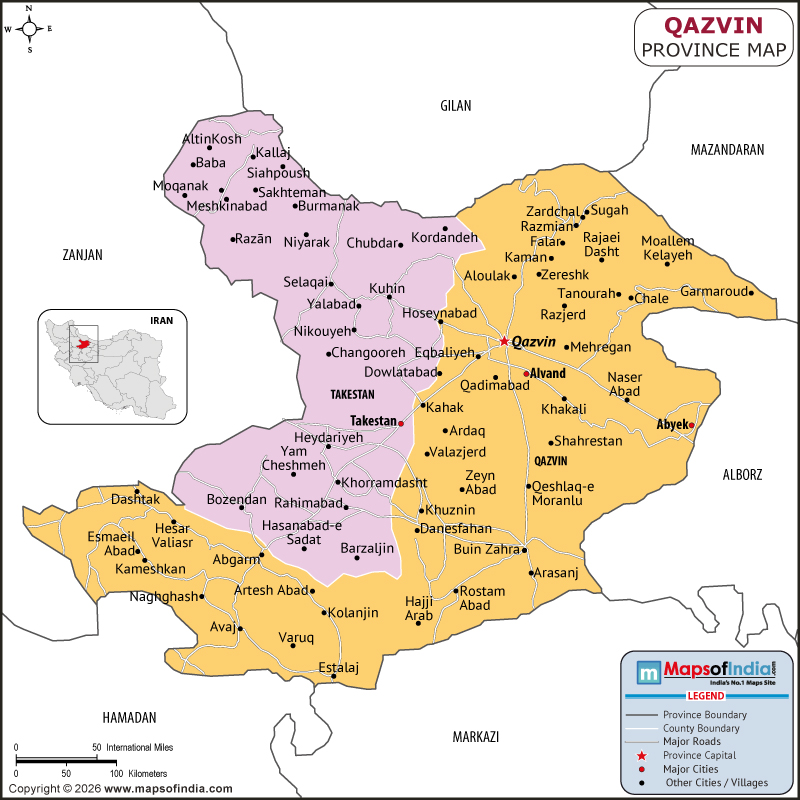



Qazvin Province is one of the 31 provinces of Iran and it is strategically located in the northwestern part of the country with the provincial capital of Qazvin being an ancient city. Having been separated as a separate province in 1997, when it was cut off of Tehran and Zanjan provinces, Qazvin is a striking example of a mix between history and modernity. With more than two thousand architectural and archaeological attractions, the province is a goldmine to historians and those interested in the Persian civilisation. Its geographical location has traditionally rendered it a key point where Tehran and Isfahan meet the Persian Gulf with the coast of the Caspian Sea and Asia Minor, which guarantees its users will remain significant during different periods of history.
History
The history of Qazvin Province has a long history that dates back to the antiquity and it is believed that the region was the territory of the Median kingdom. Nonetheless, the Qazvin city was formally established by the Sassanid king, Shapur I circa 250 AD, who named it Shad Shahur as a military base to counter the Daylamites, who occupied the Iranian northern areas. Such military importance would become a common theme in the history of Qazvin.
Qazvin was conquered by the Arab forces following the Islamic conquest of Persia and later on it was used as an important base to launch military campaigns and the spread of Islam across the region. Harun al-Rashid, the famous Abbasid caliph fortified the walls that existed around the city. This was the early Islamic period and the city was a major learning place and a centre of cultures. But such a prosperity was rudely cut short in the 13th century with the Mongol army of Genghis Khan blowing down the city during their rampage of the land.
The brightest period in the history of Qazvin took place under the rule of Safavid dynasty. When the Persian capital was temporarily taken over by the Ottomans in 1555, Shah Tahmasp I moved it to Qazvin, where he realized it had more defensive inland location and strategic location. Qazvin, which had a title of dar al-saltana, was 43 years in the revered position of imperial capital. This era was marked by a massive growth of the city and the number of its citizens had also gone to approximately 100,000. Artisans, scholars and merchants were drawn to the capital and Qazvin was turned into a cosmopolitan centre of Persian culture and politics. This golden period was ended in the year 1598 when the Shah Abbas the great shifted his capital to Isfahan in search of an even more glorious location in which to host his court.
Qazvin continued to hold status as a government centre in the Qajar dynasty and up to the modern period because of its closeness to Tehran. In the history of the 20th century Iran the province was central when in 1921 General Reza Khan was staging his coup d'etat through Qazvin with his Russian trained Cossack brigade which triggered the establishment of the Pahlavi dynasty directly. Qazvin was another centre of foreign influence during the 19th and early 20th centuries with both Russian and British armies being present in the city at one point or the other.
Culture
The Province of Qazvin has a rich cultural heritage which traces its origins to the ancient times when it was a hub of the Persian civilisation. The city of Qazvin is officially known as the Calligraphy Capital of Iran with the title granted by the ministry of culture and Islamic guidance. This title recognizes the province as the centre of the Persian calligraphy with the famed master calligrapher Mir Emad Qazvini whose pieces of work are regarded as of the best examples of the Persian script.
The architectural heritage of the province is outstanding as it contains buildings that represent different epochs. The Jameh Mosque of Qazvin has a chamber of the dome built during 1106-1114 that is one of the oldest buildings that are still left in the city. The modern mosque is mainly of Safavid and Qajar date, and is one of the largest of Iran. Sepah Street is the first modern street in Iran, being completely paved with cut grey stone, and having in it the stores of traditional craftsmen. The Sa'd al-Saltaneh Caravanserai which is considered to be the largest urban caravanserai in Iran has been restored and serves as a tourist site as well as a living marketplace.
The art of customary crafts flourishes in Qazvin, where the manufacture of high-quality Persian carpets known all over Iran is done. The province is skilled in different handicrafts including copperwork (mesgarha), traditional weaving (moj), production of ornamental equipment using embroidery and metalwork. These trade are still being done in the historic bazaar whereby the artisans carry on the tradition that has been done centuries old.
Another factor of the cultural identity of Qazvin is its culinary traditions. The most famous dish at the province is Gheymeh Nesar which is made mostly during great events and ceremonies. It is a fancy rice dish, which makes a combination of mutton, saffron, barberries, orange zest, almonds and pistachios and represents a show of colours and flavours. Additional regional delicacies are Shirin Polo (sweet rice) and Dimaj which is a traditional summer dish. Grapes and other conventional sweets are also what the province is known by such as Baklava.
The province has given rise to many great persons of the Persian culture and learning. Ali Akbar Dehkhoda, the renowned linguist and author of the first modern Persian dictionary was born in Qazvin. Obeid Zakani, a satirical poet of the middle ages, and the historian and geographer Hamdallah Mustawfi both referred to Qazvin as their place of home. The province still preserves this intellectual tradition in a number of cultural institutions and learning establishments.
Language
The linguistic environment of Qazvin Province can be described by the diversity of ethnic backgrounds of people living there. Persian is the most important and official language, spoken with the typical Qazvini accent which has the effects of the historical location of the region on the main trade routes. This dialect has some phonetic peculiarities that differentiate it among other regional varieties of the Persian language without losing full intelligibility among the speakers in the whole of Iran.
Most of the population in the Qazvin city is ethnically Persian and Persian is used as lingua franca in trade and educational and official activities all over the province. There is however a great deal of linguistic diversity, especially in various geographical regions of the province. Various sources mention that in the Alamut region in northeastern Qazvin people speak the dialects of Mazandarani or Gilaki languages which are the part of the Northwestern Iranian branch. Other sources recognize these speakers as Tats speaking Tati dialects but some linguists indicate that the term Tati might have been used in the past by the Turkic speakers on other non-Turkic speaking groups.
Azerbaijani Turkish is also spoken by a significant Azeri community in the province especially in some districts and townships. Another important linguistic group is this Turkic language that is close to Turkish language in the Republic of Azerbaijan. The minority languages are Kurdish and Lori, which are spoken by the minority groups which have moved to the province and some communities of Gilaki speakers also exist in some regions, especially in those regions which border Gilan province.
Geography
The Qazvin Province is located in the strategic position in the North western part of Iran with a total area of 15,821 square kilometres. The provincial borders of Mazandaran and Gilan border the province to its north, Hamadan and Zanjan borders the province to the west, Markazi Province borders the province to the south and Tehran and Alborz borders the province to the east. Such a location makes Qazvin a natural passage between the northern and the central plateau of Iran and the Caspian regions.
The Alamut Valley is in the mountainous area in the North and represents the dramatic landscape that typifies this area. This valley, in a U-shaped form, is surrounded by Alborz Mountains and opens to the plain of Qazvin and traditionally offered perfect defensive sites in which to build fortresses. There are many historical castles in the valley, the most prominent being the Alamut Castle erected on a 200-metre-higher rock at the altitude of 2,163 metres above sea level and Gazorkhan village. Other natural features in the area are the Ovan Lake that is located some 25km off Rajai Dasht at a height of approximately 3,750 meters and is a registered national natural monument.
The climate is different in the different parts of the province because of the variation in the altitude and geographical location. The mountain climates experienced in Northern mountainous regions are cold with snowy winters, and temperate summers. The foothills and the mid-elevation regions are relatively milder in climate and the southern plains have warm climate with dry and semi-dry winters and summers.
There are signs of humid subtropical climate characteristics to some areas especially in Tarom, and the Shahroud Valley. The Qazvin plain, which is limited by water resources, was traditionally irrigated by one qanat and four small streams, but nowadays, the agricultural capacity has been increased due to the appearance of modern irrigation systems. The mean annual rainfall is of about 350 millimetres and is mostly received during the spring and autumn months.
Quick Facts
| Country | Iran |
| Region | Qazvin |
| Area | 64.132 km2 (24.762 sq mi) |
| Population | 402,748 |
FAQs
Q1: When was Qazvin the capital of Iran?
Qazvin served as the capital of the Safavid Empire from 1555 to 1598, a period of 43 years.
Q2: What is the Alamut Castle famous for?
Alamut Castle is famous as the headquarters of Hassan-i Sabbah and the Nizari Ismaili state from 1090 to 1256, often known in the West as the stronghold of the Assassins.
Q3: What is Qazvin Province known for culturally?
Qazvin is known as the Calligraphy Capital of Iran, famous for its Persian carpets, traditional crafts, historical architecture and being the birthplace of renowned scholars like Ali Akbar Dehkhoda.
Q4: How far is Qazvin from Tehran?
The city of Qazvin is located approximately 150 kilometres northwest of Tehran, making it easily accessible from the capital.
Last Updated on: April 15, 2026

