


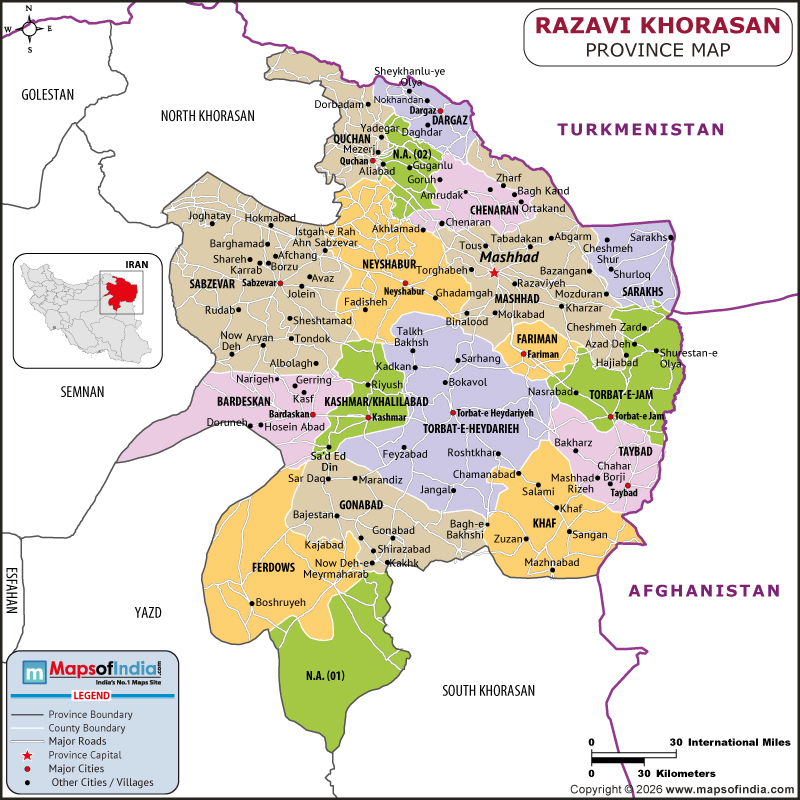



Razavi Khorasan Province is one of the oldest and culturally diverse areas of Iran located in the northeast of this country. Formed in 2004 after the bigger Khorasan Province was split into three administrative regions, Razavi Khorasan is the centre of what was Greater Khorasan, a huge region, which occupied most of Central Asia and provided a birthplace to the Persian civilisation over a thousand years. The capital of the province, Mashhad, is the second largest city of Iran and the main religious centre of the country that attracts more than 20 million pilgrims and tourists to the magnificent shrine of Imam Reza, the eighth Shia Imam. This spiritual meaning, cultural legacy, and economic life intersect, which is why Razavi Khorasan is province of great importance in the contemporary Iran.
History
The Razavi Khorasan Province territory has been a venue of many dynasties and empires that have risen and fallen throughout its history. The ancient geographers partitioned Iran into eight parts with Greater Khorasan being regarded as the most prosperous and the largest. The area was within the Achaemenian Empire between the sixth and the fourth century BCE and later was the center of the Parthian Empire that had its base in Merv in Khorasan for years. The province fell under the control of a military commander by the title Padgosban who ruled it between the third and the seventh centuries CE with four margraves having control over the four quarters of the province.
After being conquered by Arabs in 651–652 CE, Khorasan kept its name and most of its administrative system. The area of the Abbasid and Umayyad caliphates was split into four large portions according to the cities of Nishapur, Merv, Herat, and Balkh. Even Arab political domination could not take long to see the birth of local forms of resistance. The earliest kingdom to gain independence from Arab control was formed by Tahir Phoshanji in 821, marking the beginning of a remarkable age of cultural and scientific prosperity.
There followed successive waves of conquest, including the Ghaznavids (963–1167) and the great Seljuqs (1037–1194). Each dynasty left its mark on Khorasan in terms of cultural and architectural heritage. However, the most devastating phase in the region’s history occurred with the Mongol invasion in 1220, when the armies of Genghis Khan caused widespread destruction of cities and irrigation systems.
Another major invasion took place around 1383 under Timur. Despite these disasters, Khorasan demonstrated resilience. Herat emerged as a great cultural center under Timurid rule, while other cities gradually regained their former significance and vitality.
During the Safavid dynasty (1502–1736), Khorasan became a strategically important frontier province, frequently contested against Uzbek invasions from the north. The region reached particular prominence under Nader Shah, a native of Khorasan born in Mashhad, who established Mashhad as the capital of his Iranian empire after ending Afghan domination in the early eighteenth century.
Following the death of Nader Shah in 1747, Khorasan experienced brief periods of Afghan occupation before becoming part of the Qajar dynasty. In the late nineteenth century, the borders of Iranian Khorasan were formally defined through treaties with Russia in 1881 and Afghanistan in 1893, shaping the modern political boundaries of the province.
Culture
Razavi Khorasan Province is a living museum of Persian cultural heritage, combining ancient traditions with modern innovation. The cultural identity of the province is deeply centered around the Imam Reza Shrine complex in Mashhad, one of the largest and most elaborate religious architectural complexes in the Islamic world. This vast complex includes the holy shrine with its iconic golden dome, the magnificent Goharshad Mosque renowned for its exquisite tilework, as well as numerous courtyards, libraries, museums, and theological schools. Each year, millions of pilgrims visit the shrine, creating a unique atmosphere where spiritual devotion, architectural splendor, and commerce coexist.
The province has produced and inspired some of the greatest figures of Persian literature and art. The epic poet Ferdowsi, author of the Shahnameh in the tenth century, was born in Tus near Mashhad, and his mausoleum is today an important cultural and tourist landmark. Other prominent literary and artistic figures such as the mystical poet Farid al-Din Attar, the mathematician and poet Omar Khayyam, and the celebrated painter Kamal-ol-Molk are associated with Nishapur. As a result, the city has become a place of pilgrimage for admirers of Persian intellectual and artistic heritage. This rich literary tradition continues to influence contemporary cultural expression throughout the province.
Handicrafts in Razavi Khorasan demonstrate artistic skills refined over centuries. Khorasani carpets are regarded among the finest in the world, admired for their distinctive patterns, rich color palettes, and exceptional quality. Local weavers rely on traditional techniques passed down through generations, producing carpets that serve not only as floor coverings but also as wall decorations and valuable investments. Beyond carpets, the province is also famous for turquoise jewelry, particularly in Nishapur, where turquoise has been mined continuously for over 5,000 years.
Persian culinary heritage is vividly reflected in the refined cuisine of the province. One of the most renowned dishes is Shishlik Mashhadi, consisting of marinated lamb ribs grilled over an open fire. Another celebrated dish is Sholeh Mashhadi, a slow-cooked stew made with meat, legumes, and aromatic spices, developed through hours of careful preparation. The province is also a major producer of distinctive ingredients and condiments, most notably saffron. Accounting for approximately 82 percent of global production, this “red gold” is hand-harvested in the early morning to preserve its quality and commands high prices in international markets.
Language
The official administrative language used in Razavi Khorasan Province, as well as the primary means of everyday communication, is Persian, commonly known as Farsi. The Persian spoken in Khorasan belongs to the eastern dialect group of the language and displays certain phonological and lexical characteristics that distinguish it slightly from the accents of Tehran or Isfahan. Despite these variations, speakers from different regions can easily understand one another.
The widespread use of Persian across the province facilitates administration, education, and commercial activities, while also providing a shared cultural and linguistic foundation for the diverse communities living in Razavi Khorasan. This common language plays an essential role in maintaining social cohesion and preserving the province’s connection to the broader Persian cultural heritage.
Geography
Razavi Khorasan Province covers an area of 118,851 square kilometres and is the fifth-largest province in Iran, comprising about 7.3 per cent of the country’s total territory. The province has international borders to the north and east, sharing approximately 532 kilometres of border with Turkmenistan and around 302 kilometres with Afghanistan. Domestically, it is bordered by North Khorasan Province to the north, South Khorasan Province to the south, and Semnan Province to the west. This strategic position has historically made the region an important corridor linking the Iranian plateau with Central Asia and Afghanistan.
Mountain ranges dominate the province’s topography and play a crucial role in shaping its climate, water resources, and settlement patterns. The Binalud Mountains extend northwest–southeast across the central part of the province, particularly around Nishapur and Mashhad, forming one of its most prominent geographical features. Mount Binalud, rising to 3,211 metres, is the highest peak in Razavi Khorasan and serves as a vital watershed, collecting rainfall that feeds rivers and irrigation systems in the surrounding valleys.
The province generally experiences a dry to semi-arid climate, though significant variations occur due to differences in elevation and geography. Average annual precipitation is about 208 millimetres, most of which falls during winter and spring. Summers are typically hot and dry in the lowland areas, while winters in mountainous regions can be cold, sometimes accompanied by heavy snowfall. The mountains support limited scrubland and grassland vegetation, whereas lower elevations are characterised by sparse desert plants adapted to arid conditions.
Agricultural activity is concentrated in irrigated valleys and areas surrounding major cities where water resources are available. Fertile oases, particularly around Mashhad, support intensive cultivation of crops such as wheat, sugar beet, almonds, and pistachios. However, the province’s most celebrated agricultural product is saffron, grown extensively in regions such as Torbat-e Heydariyeh, Gonabad, and Qaen. These areas possess ideal climatic conditions and centuries of cultivation experience, making Razavi Khorasan one of the world’s foremost saffron-producing regions.
Quick Facts
| Country | Iran |
| Region | Razavi Khorasan |
| Area | 118,884 km² (45,901 sq mi) |
| Population | 6,434,501 |
FAQs
Q1: What is Razavi Khorasan Province best known for?
The province is best known as the location of the Imam Reza Shrine in Mashhad, making it Iran's primary religious pilgrimage destination for Shia Muslims.
Q2: What makes Khorasan saffron so valuable?
Khorasan produces approximately 82 per cent of the world's saffron using traditional hand-harvesting methods, creating the highest-quality spice with intense colour, aroma, and flavour.
Q3: When was Razavi Khorasan Province established?
The province was created on 29 September 2004 when the historic Khorasan Province was divided into three separate administrative units.
Q4: What is the climate like in Razavi Khorasan?
The province has a predominantly dry and semi-arid climate, with hot summers and cold winters in mountainous areas, and hotter conditions in low-altitude regions.
Last Updated on: April 15, 2026

