


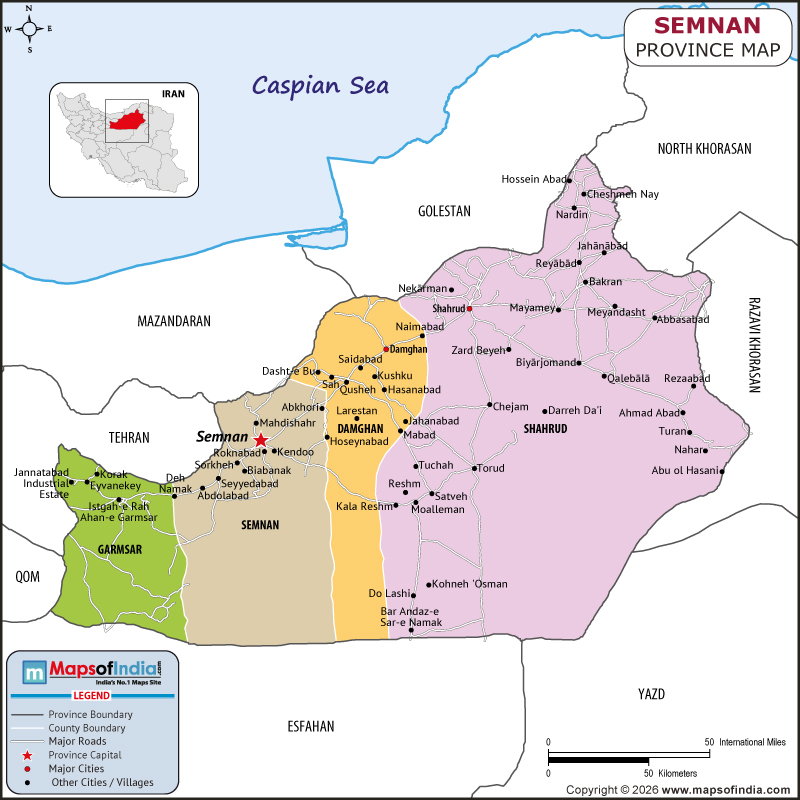



Semnan is an ancient city in north central Iran, the capital city of Semnan Province. It is located between the Alborz mountains and the Dasht-e Kavir desert which has long been a connecting place between Tehran and the eastern part of the country. Semnan boasts of a strong cultural heritage, traditional architecture and ancient mosques, one of which is the Jameh Mosque of Semnan.
History
Semnan has a rich historic background, and it is one of the historically important Iranian cities. Archaeological records indicate that the place has had human habitation as early as the prehistoric period which is mainly because of its strategic location between the fertile mountain ranges and the desert plains of central Iran. Semnan was situated on significant east-west routes, and these routes became elements of larger trade and communication routes between various regions of the Iranian plateau.
The Parthians were present in the area of Semnan during the Parthian era (c. 247 BCE-224 CE). Other historians consider nearby locations, including Hecatompylos (in modern-day Damghan), as some of the major capitals of Parthians, and Semnan enjoyed an elevated political and economic status. The city in this period served as a backward settlement, which enabled trade, agriculture, and the transportation of the military. Zoroastrianism exercised great power in the land as indicated by the remains of ancient fire temples and religious customs that persisted up to the time of Islamic early era.
As the Arabs conquered Iran in the 7th century CE, Semnan transitioned to the Islamic rule of the maize trade. The city has adjusted to new forms of administration and still maintained the components of its pre-existing cultural identity. In the first centuries of the Islamic era, Semnan was one of the centers of the area that had mosques, caravanserais, and irrigation facilities. The building of the Jameh Mosque of Semnan, some of which was erected in the 11th century is a monument to the increasing religious and architectural significance of the city.
Semnan also experienced periods of boom and downfall occurring during the medieval period. The city enjoyed relative political stability and economic growth even during the Seljuk dynasty (11th-12th centuries). It turned out to be a functional trading point between Khorasan and central Iran. Semnan, however, is a city just as other Iranian cities, which were ravaged by the invasions of Mongols in the 13th century causing massive destruction and decline in population. Nevertheless, the city slowly returned on its feet during subsequent dynasties such as Ilkhanids and Timurids.
In the Safavid period (16th-18th centuries) Semnan became more important again because internal security was enhanced and Shi'ia Islam was proclaimed as the official religion of the state. The religious establishments in the city grew and life in the city stabilized. During the Qajar period, Semnan remained a provincial town and enjoyed the advantage of being situated along the roads leading Tehran to the northeastern part of Iran.
Semnan experienced administrative and infrastructural development in the modern period particularly in the Pahlavi era. There was the development of roads, learning institutions and industries that made the city more integrated into the national economic plans.
Culture
The culture of Semnan is seen as a good mix of ancient culture, regional diversity and emerging modern culture influenced by its geographical location that is defined by its position within the Alborz mountains and the inland desert in Iran. This distinctive environment has been of much importance in defining the local lifestyle, social behaviors, and cultural meanings. The culture of Semnan is highly entrenched in Iranian culture, but there are still local peculiarities that make life in this region unique.
Intricate traditional clothes in Semnan used to reflect the climate and the social traditions of the place. Though modern outfits are prevalent now, there are still some parts of the traditional dress designs in the cultural festivals and ceremonies. The role of traditional craftsmanship is emphasized through handwoven textiles, woolen clothes and other accessories produced on the local level. In some cases, especially carpet weaving, designs frequently incorporate natural motifs or geometric forms by the locals.
Cultural life revolves around religious and social practices. Most people in Semnan are Shiite and religious practices are deeply ingrained like the Muharram processions. Such rituals ease the bonds within the communities and the traditions of the rituals passed over the ages. Coupled with the religious practices, the seasonal festivals and local celebrations that are related to nature and the agricultural world still influence the life of the community.
Semnan is also characterized by music and performing arts. Folk music can be defined as a type of music that has a simple melody and uses traditional instruments and reflects life, nature, and history themes. These kinds of music are usually played at weddings and at local events strengthening the culture in terms of identity.
Another distinct cultural identifier is cuisine in Semnan. Dishes of local specialties are adjusted to the climate of the location and the available resources, and they usually include grains, legumes, dried fruits, walnuts, and dairy items. The simplicity and nourishment are emphasized in foods like chelo gosht and other food revolving around bread.
Language
The use of language is important in the development of the cultural identity of Semnan because of the rich history of the city and the cultural diversity in the region. Although the official and the most general spoken language, Persian (Farsi), is used in, school, and mass media, the residents of Semnan have maintained a set of regional languages and dialects that linguistically separate the region and a larger part of Iran.
Semnani is the most popular local language and a part of Northwestern Iranian branch of the Iranian language family. Semnani is not just one homogeneous language; it consists of closely related dialects spoken over the territory of Semnan, including dialects such as Sangsari, Lasgerdi and Shahmirzadi. A significant part of linguistics features found in these dialects is archaic and can be dated to ancient Iranian language and is of great interest to linguists and historians. Their vocabulary, phonetics and grammatical constructions have a significant difference with the standard Persian.
Historically, these local dialects were the major source of daily language at the family level and community. But, as formal education grew, urbanization as well as mass media, Persian has since prevailed, especially among younger generations.
Despite this degradation, scholars and local cultural organizations have continued to work on documenting and rejuvenating these languages. Folklore, poetry and oral narrations documented in Semnani dialects are valuable cultural resources and assist in retaining linguistic consciousness.
Geography
Semnan is characterized by the geographical location, which is a result of a collision of contrasting natural features in the north central of Iran and determines both the physical and human environment of this land. Located in the southern slopes of the Alborz mountain range and the northern boundary of the Dasht-e Kavir (Great Salt Desert), Semnan is a transitional region between mountainous country and desert arid plains. This strategic place has had historic implications of settlement patterns, climate, agriculture and transport.
The geography of Semnan is dependent on the Alborz Mountains to the north. These mountains are a climatic wall restricting moisture from the Caspian Sea, which makes the region semi arid to arid. Meanwhile, higher areas of elevation release seasonal rivers and underground water supply, with limited agriculture being possible. The foothills are comparatively fertile areas in contrast to the rest of the desert and have been used to house human beings over the centuries.
The terrain gradually descends towards the south to the expansive Dasht-e Kavir. This is a desert which is described by salt flats and sandy plains and extreme temperatures. It has had a historical role of constraining large scale settlement and has also been used as a natural barrier to defense. The mountain aspect and desert make Semnan have a variety of topography in a smaller area.
But the climate of Semnan is cold semi-arid with hot summers, cold winters, and low precipitation during the year. The day-night temperatures vary considerably and this is especially in upper regions that are nearer to the desert. These climatic areas have influenced the conventional designs with thick walls and compact urban planning of urban areas being tight and not spacious aimed to cool and hold the heat, to save on energy.
There is a setback of hydrology, and there are no significant permanent rivers passing through the city. Historically, water in the past has always been extracted by qanats, underground irrigation canals that can carry the water from mountain aquifers to the fields and cities. These systems indicate how we humans have adapted to geographic restrictions and they serve as significant heritage of the region.
Semnan is also strategically located in geographic terms as a transport route. It is situated along major east-west corridors between Tehran and northeast and east Iran.
Quick Facts
| City | Semnan |
| Country | Iran |
| District | Central |
| Elevation | 1,130 m |
| Population | 185,129 |
FAQs
Q1: What is the best time to visit Semnan?
The most appropriate season to visit Semnan is spring (March to May) and autumn (September to November), when the weather is moderate and suitable for sightseeing and outdoor activities. During summer, it can be very hot, especially in desert regions.
Q2: Is Semnan safe for tourists?
Generally, Semnan is safe for tourists. Like other cities, visitors are advised to respect local cultural customs, dress modestly, and follow standard travel safety precautions.
Last Updated on: April 15, 2026

